
PROLOGUE: THE VEIL THINS
The year is 1860s America. The air is thick with grief. The Civil War, a brutal, fratricidal conflict, had ripped apart the fabric of the nation, leaving over 600,000 dead—a number that, proportionally, would dwarf the casualties of any other American war. Every town, every family, carried the raw, unhealed wound of a lost father, son, husband, or brother. In this crucible of sorrow, a desperate yearning took root: the desire to reconnect, just once more, with the beloved departed.
Into this spiritual vacuum stepped a curious phenomenon: Spiritualism. Séances were held in parlors across the country, mediums claimed to channel voices from beyond the grave, and the belief that the veil between worlds had thinned became a comforting, almost necessary, balm for countless aching hearts. It was an era ripe for wonder, for faith, and for profound, often tragic, deception.
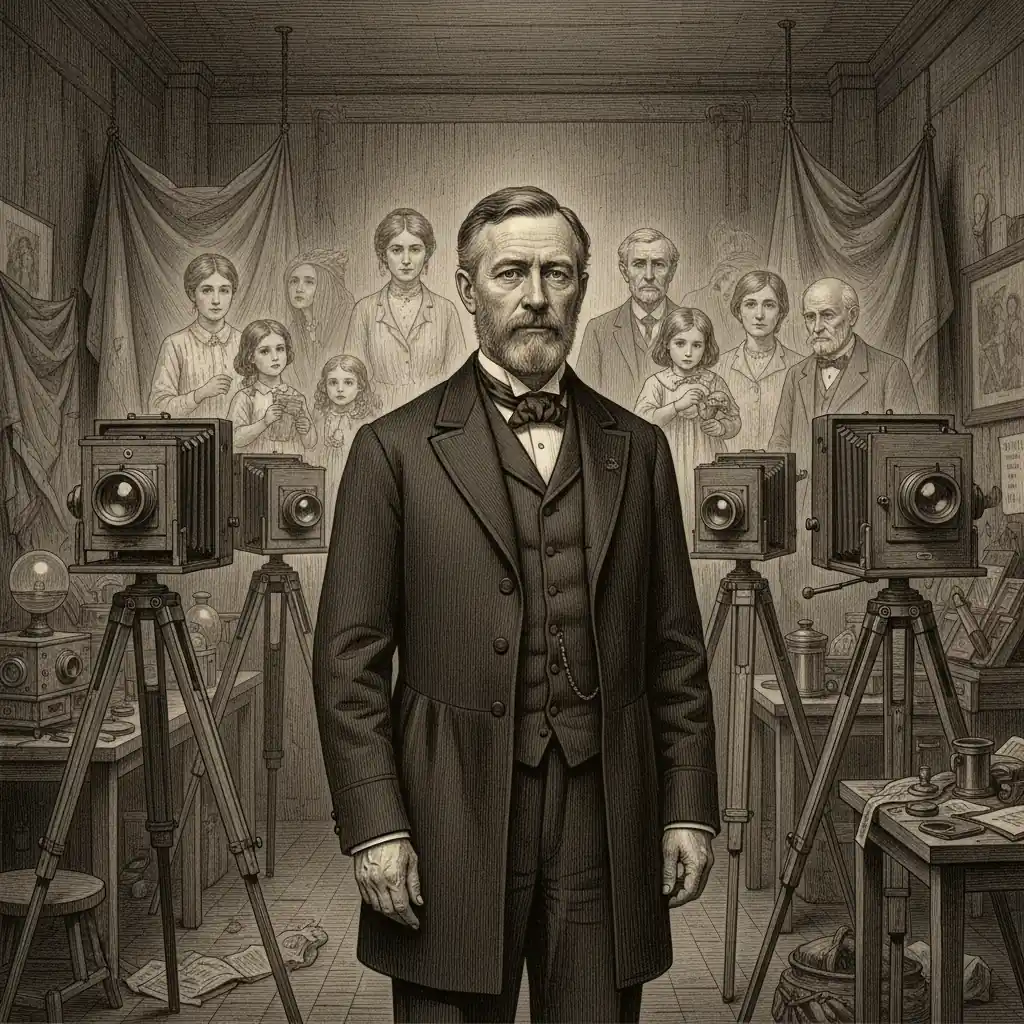
Our story begins in Boston, with a man named William H. Mumler. A quiet, unassuming engraver by trade, Mumler had a hobby that was still very much in its infancy: photography. He worked from his home, painstakingly developing images in his makeshift darkroom, a world of chemicals, light, and nascent technology. It was here, in the dim glow of his developing trays, that Mumler stumbled upon what he claimed was an accidental revelation—a discovery that would catapult him from obscurity to infamy, forever linking his name with the eerie, captivating, and ultimately controversial art of 'spirit photography.'
He claimed it began with a self-portrait. After developing the plate, he noticed a faint, ethereal shape hovering in the background, a translucent figure that wasn't there when the photo was taken. He was baffled, then astonished, then, perhaps, saw an opportunity. In a world starved for proof of life beyond death, Mumler had, by chance or by design, offered a glimpse into the impossible. Or so he said.
The stage was set for a cultural phenomenon, one built on a potent mix of technological novelty, human vulnerability, and the eternal hope for a sign from the other side. But was Mumler a genuine conduit to the spectral realm, or simply a master manipulator who understood the deepest yearning of a grieving nation? The answer would ignite a scandal, a sensational trial, and a legacy that still sparks debate today.
ACT I: THE GHOST IN THE LENS
Before he became 'The Spirit Photographer,' William H. Mumler was a struggling jewelry engraver in Boston. Like many of his time, he was fascinated by the burgeoning art of photography. In the early 1860s, photography was still a complex and somewhat mysterious process, involving glass plates, dangerous chemicals, and lengthy exposure times. This very complexity, as we shall see, created fertile ground for both genuine discovery and clever trickery.
Mumler’s claim to fame—or notoriety—began around 1861 or 1862. As the legend goes, he was attempting to take a self-portrait. Upon developing the photographic plate, he noticed a faint, semi-transparent image in the background, distinct from his own. Initially, he dismissed it as a smudge or a flaw in the plate. But a closer look revealed what appeared to be the figure of a young girl. Mumler, a fervent Spiritualist himself, soon identified the spectral image as his deceased cousin, who had passed away twelve years prior. This was his initial 'ghost in the lens'.
News of Mumler's 'discovery' spread quickly, first through Boston's tight-knit Spiritualist community, and then outwards. The idea of capturing a 'spirit' on film was revolutionary, offering tangible proof of life after death—something mediums and séances could only promise through whispers and darkened rooms. People, desperate for connection, flocked to his home studio.
His first public successes were compelling. One notable case involved Mrs. Stuart, a prominent Spiritualist lecturer, who sat for Mumler and reportedly received a clear image of her deceased brother. Another client, Mr. H.L. Williams, was equally astonished when a spirit portrait of his dead wife and children appeared alongside him. These early 'successes' were pivotal. They provided social proof and fueled the growing demand, particularly as the Civil War raged, multiplying the bereaved across the nation.
The technical limitations of early photography inadvertently played into Mumler's hands. Long exposure times meant subjects had to sit perfectly still for several seconds, sometimes even a minute. Any slight movement would result in a blur. Furthermore, the glass plates were often cleaned and reused, sometimes retaining faint 'latent images' from previous exposures. A skilled manipulator could also pre-load plates with faint images or engineer double exposures by exposing the plate twice—once to a 'spirit' image (perhaps a living person dressed in white, or a photograph of the deceased) and then again to the client.
By 1868, Mumler's fame had outgrown Boston. He moved his operation to New York City, the epicenter of American culture and commerce, where the market for spiritual solace was even greater. He opened a studio at 630 Broadway, offering 'Spirit Photographs' for the hefty sum of $10 apiece—roughly equivalent to $200-$300 today. His wife, Hannah Mumler, a known trance medium, often assisted him, interviewing clients, and setting the spiritual atmosphere. This transition marked a crucial shift: from an 'accidental' discovery to a full-fledged, commercial enterprise, operating in a city teeming with both fervent believers and cynical opportunists. The veil had thinned, and Mumler was ready to charge admission to the other side.
ACT II: CELEBRITY AND SPECTERS
In New York, William Mumler’s studio became a magnet for the grieving elite and the merely curious. His reputation preceded him, and clients lined up, desperate for a tangible link to their lost loved ones. The promise was simple: sit for a portrait, and alongside your living form, a spectral image of your deceased relative might appear. For many, it was an answer to prayers, a profound comfort in an age of overwhelming loss.
Among Mumler’s most famous and emotionally charged clients was Mary Todd Lincoln, the profoundly grieving widow of President Abraham Lincoln. Mary Todd had always been susceptible to Spiritualism, seeking solace in séances even before her husband’s assassination. The successive deaths of three of her four sons, culminating in the brutal murder of her husband, plunged her into deep depression and an intense yearning for connection with the spirit world. In 1870, under the assumed name 'Mrs. Lindall' to avoid public scrutiny, she visited Mumler’s studio in New York.
The resulting photograph became arguably the most iconic spirit photograph ever produced. It depicts Mary Todd Lincoln seated, with the ghostly, translucent image of Abraham Lincoln standing behind her, his hands resting gently on her shoulders. The image is hauntingly poignant, a visual representation of a love that transcended death. For Mary Todd, it was absolute proof, a source of immense comfort. To skeptics, it became the most damning piece of evidence of Mumler’s elaborate fraud.
Other prominent figures also sought Mumler’s services. General Lafayette C. Baker, head of the National Detective Police, known for capturing John Wilkes Booth's conspirators, sat for a portrait and claimed to have received an image of a deceased friend. This endorsement from a man of such investigative standing lent Mumler considerable credibility, at least initially. The New York Tribune even reported on Mumler's work, acknowledging the wonder it inspired, even if not fully endorsing its authenticity.
The typical sitting at Mumler's studio was carefully orchestrated. Clients would arrive, often pre-interviewed by Mumler’s wife, Hannah, who would inquire about their lost loved ones. They would then sit for the photograph, sometimes for an extended period. Mumler would manipulate the camera and plates, often behind a curtain, and then produce the finished product. The 'spirits' themselves were often indistinct, slightly blurry, and faded—exactly as one might expect a ghost to appear. Crucially, they were almost always recognizable as the client's deceased family members, a detail that stretched the bounds of coincidence for many.
The success of these celebrity cases wasn't just about money; it was about the profound emotional impact. For a mother who had lost a child, or a widow still mourning her husband, the image, however ambiguous, offered a moment of hope, a flicker of peace. Mumler tapped into a universal human need, offering not just a photograph, but a fleeting reunion. This genuine emotional resonance made it incredibly difficult for many to accept any rational explanation for the 'spirits,' making the eventual accusations of fraud all the more contentious.