
PROLOGUE: THE WHISPER OF ANCIENT VOICES
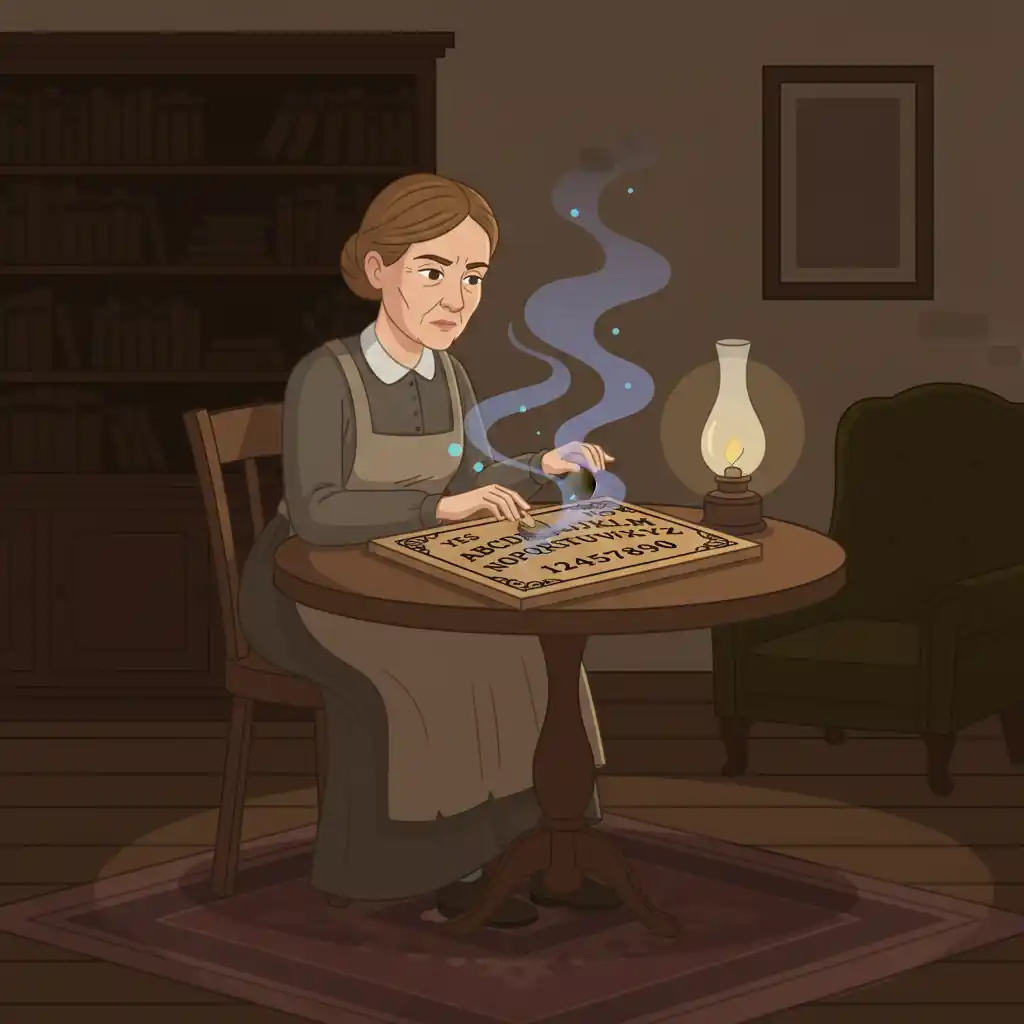
St. Louis, Missouri, 1913. The world was hurtling into the 20th century, but in parlors across America, an older fascination still held sway: the tantalizing promise of communication with the great beyond. Ouija boards, once a niche spiritualist tool, were fast becoming a household game, marketed as harmless entertainment. But for Pearl Curran, a seemingly unremarkable housewife, that innocent wooden board was about to become a gateway to an unparalleled literary phenomenon, challenging everything known about authorship, consciousness, and the very nature of reality.
Imagine this scene: A quiet woman, far from the bohemian salons of writers or the lecture halls of academics, finds herself the unwitting conduit for a voice from another age. Not a ghostly whisper, but a torrent of meticulously crafted prose, poetry, and philosophy – delivered with astonishing speed, depth, and a linguistic style centuries out of date. This was the bizarre, captivating reality of Pearl Curran, the 'Automatic Writer,' and the enigmatic spirit known as Patience Worth.
Pearl Curran was no mystic, no professional medium seeking fame or fortune. She was a practical, devoutly Christian woman, a wife, and a mother, with no formal literary training beyond a high school education. Yet, over the course of more than two decades, through the clunky, often frustrating mechanics of a Ouija board, she would transcribe a body of work so vast and complex that it would confound scientists, captivate critics, and baffle the literary world. Her story is not just a footnote in the history of spiritualism; it's a profound interrogation into the boundaries of the human mind and the potential for genius to emerge from the most unexpected places.
The question wasn't if the words were being produced – they were, in undeniable volumes. The question that rattled experts and believers alike was: from where? Was it a clever hoax, a profound manifestation of the subconscious, or a genuine, posthumous collaboration with a long-dead soul? Whatever the answer, the words themselves spoke with an authority that demanded attention, carving a unique place for Patience Worth in the annals of American literature.
ACT I: THE WOODEN ORACLE
Born Pearl Lenore Pollard in 1883, she grew up in Mound City, Illinois. Her childhood was unremarkable, save for a recurring dream of a 'great flood' – a dream that seemed to foreshadow nothing in her mundane life. She married John Howard Curran, an insurance executive, and settled into the comfortable, conventional life of a middle-class St. Louis housewife. Her interests were domestic, her education limited, and she showed no particular artistic or literary talent. She was, by all accounts, an ordinary woman, living an ordinary life, far removed from the esoteric fringes of society.
The year 1913 was a turning point. America was captivated by the Ouija board, now mass-produced and marketed by Parker Brothers. It was a parlor game, a novelty, and Pearl, along with her mother and a friend, Mrs. Emily Hutchings, decided to try it. Initial sessions were, predictably, mundane – a few nonsensical messages, perhaps a clumsy attempt to contact a deceased relative. It was a pleasant diversion, nothing more.
Then, in July 1913, the planchette began to move with a strange, undeniable force. Not the faltering movements of a nervous participant, but a confident, almost impatient glide across the lettered board. The message that emerged was startling: 'Many moons ago I lived. I am Patience Worth.' The language was antiquated, the tone imperious. This was no departed aunt; this was someone new, someone utterly distinct.
The initial reactions ranged from amusement to outright suspicion. Pearl herself was a skeptic, convinced her friends were unconsciously pushing the planchette. But the messages kept coming, forming coherent sentences, then paragraphs, and soon, entire narratives. The character of Patience Worth rapidly emerged: a demanding, often witty, always eloquent persona who claimed to have lived in 17th-century England and later emigrated to America, dying in an Indian raid.
The physical process was arduous. Someone had to painstakingly call out each letter as the planchette moved. Early sessions were slow, often requiring hours to complete a single short story. Pearl, initially reluctant, found herself drawn into the phenomenon, compelled by the sheer persistence and the growing intelligence of the 'voice.' This was not random gibberish; it was literature. The pace, however, quickly accelerated. Patience Worth, it seemed, was in a hurry to tell her stories.
Soon, the words flowed so quickly that multiple transcribers were needed. Patience would spell out entire lines of poetry or dialogue, often demanding that the transcribers keep up, sometimes even chiding them for their slowness. The output was not only vast but consistently impressive, with a distinct archaic vocabulary and syntax that Pearl herself did not possess. The 'wooden oracle' had become a literary pipeline, churning out narratives at a rate that defied explanation.
Fun Fact: Pearl Curran reportedly never liked the Ouija board itself. She found the process tedious and physically exhausting, often complaining about the strain on her arms and eyes. She only continued because she felt an intense, undeniable compulsion to bring Patience Worth’s stories into the world.
ACT II: THE VOICE OF PATIENCE
Patience Worth, as channeled by Pearl Curran, was no ordinary ghost. She was a fully formed literary personality, verbose, opinionated, and possessing an astonishing command of archaic English. Her claimed biography was sparse: born in Dorset, England, around 1649, she emigrated to the Massachusetts Bay Colony in her youth and died in 1694 during an Indian raid. These few details were all Pearl ever received, yet from them sprang a world.
The hallmark of Patience Worth's communication was her unique linguistic style. It was a blend of 17th-century diction, intricate metaphors, and a rhythmic flow that was both poetic and precise. Words like 'ere,' 'perchance,' 'anon,' and sentence structures rarely heard in 20th-century conversation became common. This was not the broken English of a simple 'spirit,' but the articulate voice of a master storyteller. How could a woman of Pearl Curran's limited education suddenly manifest such a sophisticated and consistent voice?
The sheer volume of work was staggering. Over the course of 25 years, Patience Worth produced:
- Seven novels (including The Sorry Tale, an epic 650-page story of Christ's time, and Hope Trueblood, a tale of rural English life)
- Thousands of poems
- Numerous short stories
- Several plays
- Philosophical dialogues and witty conversations
One of her most famous works, The Sorry Tale (1917), was an instant sensation. Critics marveled at its vivid historical detail and emotional depth, describing it as a literary triumph. It depicted the life of a fictional character named Hathan, a physically deformed contemporary of Jesus Christ, offering a unique perspective on that historical period. The book was published to widespread acclaim, though some reviewers struggled with its archaic language.
Another striking aspect was the speed of the composition. Pearl and her transcribers reported that Patience often dictated at a rate of 2,000 to 3,000 words an hour – far faster than any human could consciously write or even think of. She would work on multiple projects simultaneously, shifting between a poem, a novel, and an answering dialogue without missing a beat, displaying an astounding mental agility.
The content itself was equally remarkable. It encompassed a vast range of human experience, from the idyllic landscapes of English villages to the stark realities of biblical Jerusalem. Patience's characters were rich and complex, her plots intricate, and her themes universal. She demonstrated a knowledge of history, geography, and human psychology that was far beyond Pearl Curran's known capacities.
Skeptics often pointed to the possibility of a subconscious genius within Pearl, a hidden reservoir of talent and knowledge. But if so, it was a subconscious so powerful and so distinct that it possessed its own fully formed identity, complete with an independent memory and a stubborn will. The contrast between the plain-spoken Pearl Curran and the erudite, witty Patience Worth was stark, fueling the mystery that continues to this day. How could such a creative volcano lie dormant within an ordinary housewife, only to erupt through a wooden board?