
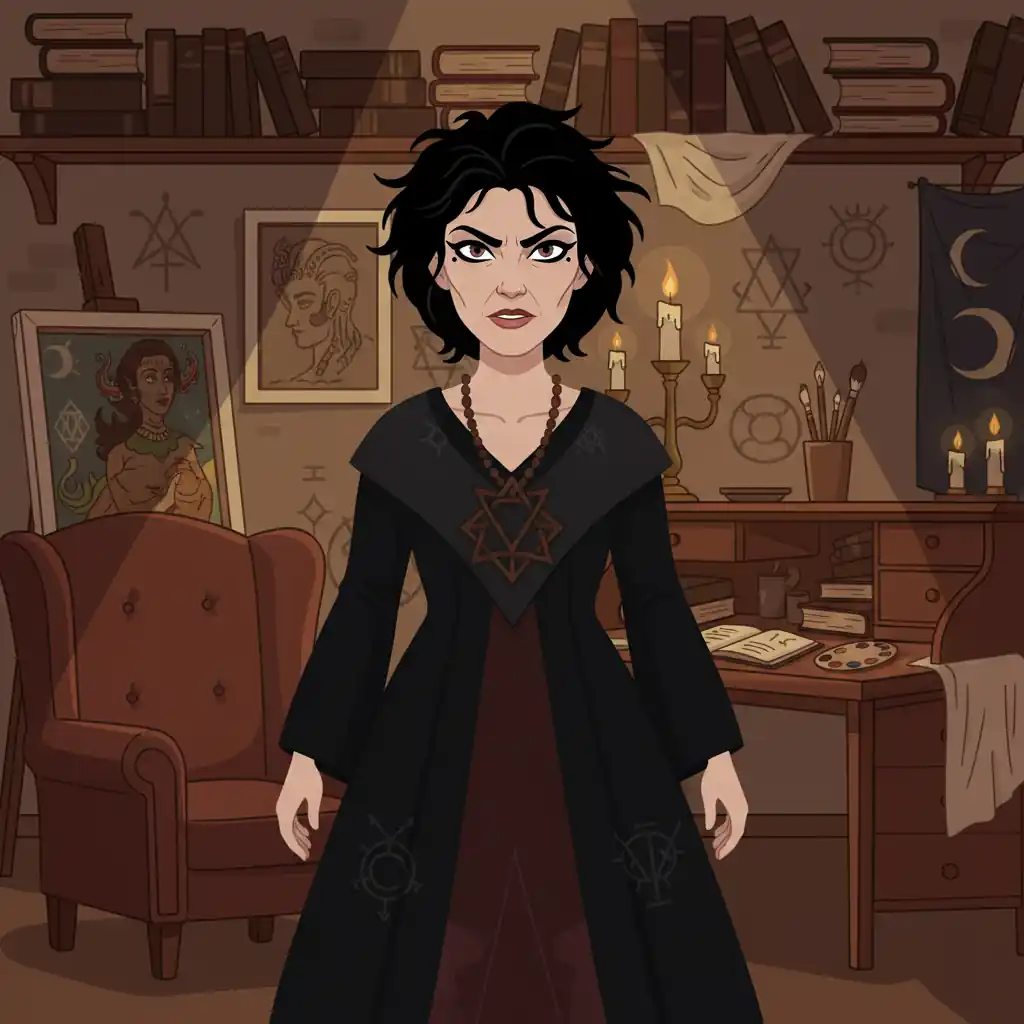
PROLOGUE: THE WHISPERS OF KINGS CROSS
Imagine Sydney in the mid-20th century. A city of sun-drenched beaches, burgeoning suburbs, and a deep-seated, often stifling, conservatism. But tucked away, a vibrant, illicit heartbeat pulsed within Kings Cross. Here, neon signs flickered above jazz clubs, prostitutes plied their trade, and bohemian artists sought refuge from the straight-laced moral police. This was a place of shadows and secrets, ripe for a figure who would embody its deepest, wildest desires and fears.
Into this simmering cauldron stepped Rosaleen Norton, a woman who would become known, reviled, and ultimately celebrated as 'The Witch of Kings Cross.' She was a living provocation, a walking art piece, and a high priestess of a world many Australians dared not acknowledge. Her art—a phantasmagoria of pagan deities, demonic entities, and raw, untamed sexuality—was a direct challenge to the era's rigid sensibilities, catapulting her into an endless cycle of police raids, public outrage, and legal battles.
Norton didn't just depict the occult; she lived it. Her Kings Cross apartment became a sanctuary, a coven, and a studio, where ancient rituals were performed, and visions were translated onto canvas with furious intensity. She was a self-proclaimed witch, a practitioner of an eclectic blend of ceremonial magic, and an artist whose work blurred the lines between spiritual devotion and audacious transgression. This is the story of a woman who dared to conjure her own reality in a world determined to burn her at the stake.
ACT I: THE ORPHAN, THE ODDITY, AND THE OCCULT CALLING
Rosaleen Norton's journey into the esoteric began far from the humid streets of Sydney, in the cooler climes of Dunedin, New Zealand. Born in 1917, her childhood was marked by peculiarity from the start. Legend has it she possessed an unusually prominent forehead and strange, intense eyes, earning her the childhood nickname 'the little witch.' Her family, conventional and Protestant, struggled to understand their daughter's intense visions and unsettling fixation on the macabre. As a child, she was reported to have experienced vivid, hallucinatory visions and precognitive dreams, often populated by mythical creatures and grotesque entities.
When she was eight, her family relocated to Sydney, Australia. The transition did little to temper her eccentricities. Norton was a defiant child, often expelled from schools for rebellious behavior and for drawing 'disgusting pictures' in class – early iterations of the fantastical beasts that would later define her art. She rejected formal education and traditional career paths, instead immersing herself in esoteric literature, mythology, and the nascent spiritualist movements of the era. She devoured books on Crowley, ancient Egyptian magic, and Eastern mysticism, forging her own unique spiritual path.
As a young woman, Norton was undeniably striking, though not in a conventional sense. She deliberately cultivated an appearance that defied norms: thick, dark eyeliner, heavy makeup, and unconventional clothing. She was tall, with a gaunt intensity that commanded attention. She worked odd jobs – as a model, a tea-leaf reader, a shop assistant – but her true calling was art and magic. She believed her art was not merely creation but a form of invocation, a portal to other dimensions. The spirits and deities she encountered in her visions became the subjects of her intricate, often disturbing, drawings and paintings.
Her earliest artistic influences were diverse, ranging from Aubrey Beardsley's decadent illustrations to the dreamscapes of Symbolist painters. But Norton’s vision was uniquely her own, raw and unfiltered, pulling from a deep, primal wellspring. She saw herself as a medium, allowing cosmic forces to manifest through her brush. This conviction, coupled with her burgeoning interest in ceremonial magic, would soon transform her into the unlikely focal point of Sydney’s underground occult scene.
During her rebellious youth, Norton once reportedly conjured a minor demonic entity in her family home, causing a disturbance that terrified her conservative parents. While likely embellished, such stories cemented her early reputation as a genuine 'witch' long before the media coined the term.
ACT II: THE KING'S CROSS MUSER AND THE LEFT-HAND PATH
By the late 1940s, Rosaleen Norton had found her spiritual and physical home in Kings Cross. Her small apartment at 179 Brougham Street became more than just a residence; it was a temple, a studio, and a magnet for fellow seekers, bohemians, and the genuinely curious. This was her sanctum, a space adorned with her grotesque and beautiful artworks, candles, occult symbols, and a pervading scent of incense. Here, she fully embraced her role as a high priestess of a unique, personalized paganism she called 'Pansophy,' a philosophy centered on the ancient god Pan as the embodiment of universal nature and wild, untamed energy.
Norton’s artistic process was deeply intertwined with her magical practice. She would often enter trance states, sometimes induced by ritual or other means, and claim to receive visions directly from various deities, demons, and archetypal figures. These were not benign spirits; her pantheon included figures like Lilith, Hecate, and the powerful, horned god Pan, often depicted in explicit, sexually charged forms. She rejected the Christian dichotomy of good and evil, believing all aspects of existence were sacred. Her art was raw, visceral, and unapologetically sexual, often blending human and animal forms in a celebration of primal instincts.
Her preferred mediums were pen and ink, and later oils, which allowed her to capture the intricate detail and intense shading necessary for her complex compositions. Each piece was meticulously crafted, often taking weeks or months to complete, and was considered an act of devotion as much as artistic creation. Her work was not merely symbolic; she believed it possessed genuine magical power, a 'gateway' for the entities depicted. This wasn't art about the occult; it was occult art.
Around her, a small circle of disciples and associates formed. Among them was her partner and muse, Gavin Greenlees, a young poet and aspiring occultist who shared her fervent beliefs. Together, they explored ceremonial magic, delving into the works of Aleister Crowley, whom Norton admired but never fully embraced, preferring her own intuitive path. Their rituals were often elaborate, conducted with serious intent, aimed at spiritual revelation and the invocation of otherworldly forces. These were not casual dabblings; they were serious attempts to bridge the mundane and the magical, to unlock hidden dimensions of consciousness.
Norton reportedly had a dedicated 'shrine to Pan' in her apartment, complete with statues, offerings, and an ever-present burning lamp. Visitors described the atmosphere as both electrifying and unsettling, often recalling the intense, unblinking gaze of Norton herself, who seemed to be perpetually observing the invisible currents around them.
ACT III: THE SCANDALS AND THE CENSORS' FIRES
Rosaleen Norton's provocative art and lifestyle were on a collision course with post-war Australian society. In 1949, this collision became spectacular. Sydney publisher Walter Glover, recognizing the unique power of Norton's work, dared to publish The Art of Rosaleen Norton, a collection of her pen-and-ink drawings. The book included a poem by Gavin Greenlees. It was an aesthetic manifesto, a bold declaration of a hidden world, but to the authorities, it was outright blasphemy and obscenity.
The public outcry was immediate and furious. Police, fueled by moral panic and media sensationalism, raided Glover's premises, seizing copies of the book. Norton herself was subjected to harassment. The ensuing court case branded the artwork 'obscene' and 'blasphemous.' Glover was fined, and the book was banned, cementing Norton's reputation as a purveyor of 'pornography' and a dangerous influence. This trial, however, only amplified her notoriety, drawing more attention to the 'Witch of Kings Cross' and her forbidden art.