
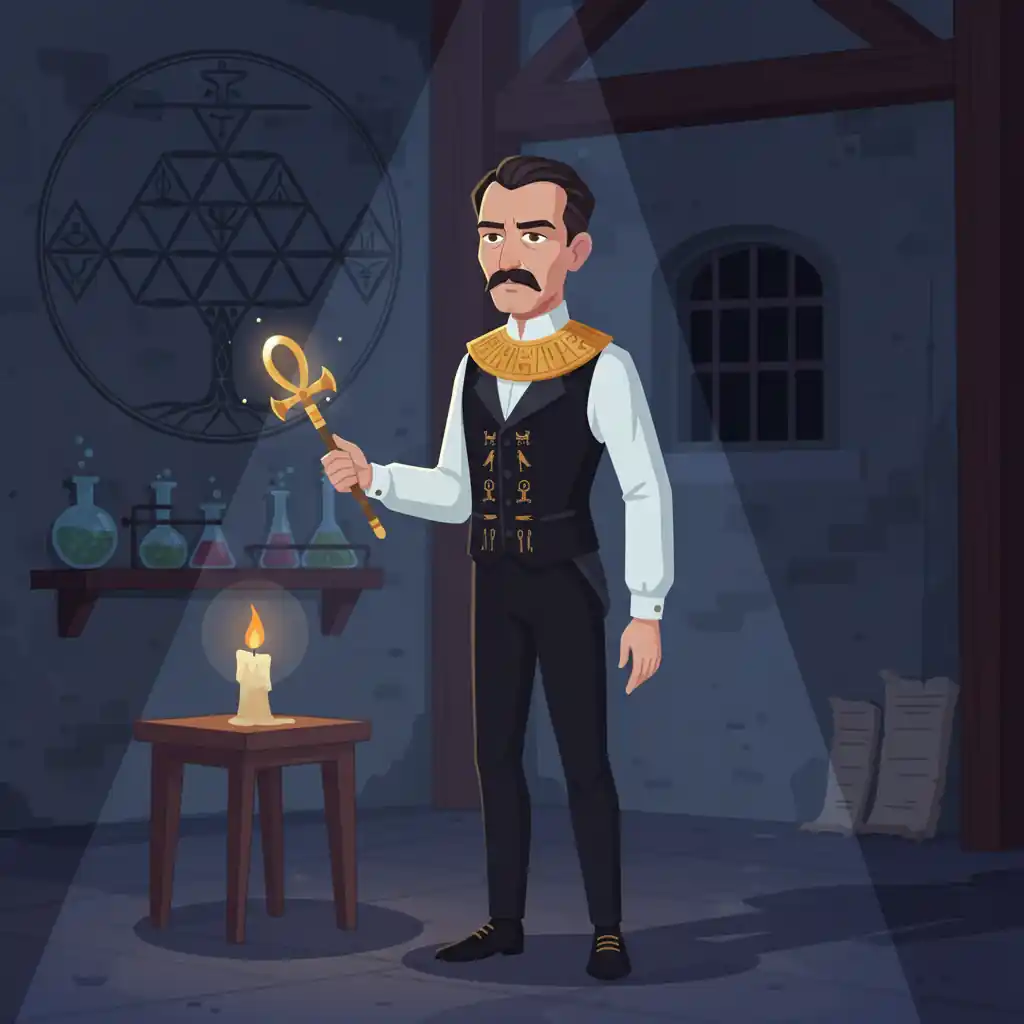
PROLOGUE: THE WHISPER OF ANCIENT RITUALS IN VICTORIAN LONDON
Imagine a gas-lit London, swirling with fog and the hushed whispers of progress and scientific marvel. Yet, beneath the veneer of rationality, a darker current ran – a yearning for the arcane, the mystical, the forbidden. The late 19th century was a cauldron of spiritualism, mesmerism, and a rediscovery of ancient esoteric traditions. It was into this fertile, curious soil that Samuel Liddell MacGregor Mathers would plant the seeds of an order that would forever change Western occultism.
Before Aleister Crowley became 'The Great Beast,' before Wicca found its voice, before chaos magic fractured the foundations, there was Mathers. He was the architect, the mad genius, the tyrannical high priest of the Hermetic Order of the Golden Dawn. Without him, modern ceremonial magic as we know it simply would not exist. He didn't just 'discover' ancient wisdom; he synthesized it, codified it, and—with a dash of theatrical flair and an unshakeable belief in his own destiny—willed it into being.
But who was this man? Not a wealthy aristocrat, nor a celebrated academic. He was a quiet, almost reclusive scholar with a fierce intellect and an even fiercer imagination. Born in 1854 near Hackney, London, Mathers was the son of a commercial clerk. His early life was marked by intellectual pursuits and a deep dive into the obscure, rather than conventional education. He shunned the mundane, drawn instead to the dusty tomes of the British Museum and the whispered legends of secret societies.
Mathers was a man of intense contradictions. A vegetarian, an anti-vivisectionist, yet prone to dramatic outbursts and megalomaniacal pronouncements. He was a devoted husband, yet an autocratic leader. He could be charming and magnetic, drawing some of the brightest minds of his era into his orbit, from Nobel laureates to celebrated poets. But he could also be paranoid, vindictive, and consumed by a grandiosity that ultimately brought his empire crashing down. This is the story of a man who believed he walked with gods, and in doing so, changed the world beneath his feet.
ACT I: THE LONE SCHOLAR AND THE OCCULT BOOM
Mathers' early life offered few clues to the magus he would become. His father died when he was young, and his mother followed soon after, leaving him an orphan. He scraped by, largely self-educated, spending countless hours in libraries, devouring everything from ancient Egyptian hieroglyphics to Kabbalistic texts and Rosicrucian manifestos. His fascination wasn't merely academic; he was convinced that hidden truths, powerful rituals, and lost secrets lay just beneath the surface of the mundane world.
He was a polymath with a particular talent for languages—translating classics like Knorr von Rosenroth's Kabbala Denudata (The Kabbalah Unveiled) and several ancient grimoires. These translations weren't just academic exercises; they were the raw material for his magical system. He wasn't afraid to get his hands dirty, meticulously drawing ritualistic diagrams and symbols. This meticulousness would become a hallmark of the Golden Dawn.
Mathers claimed to be descended from the MacGregor clan of Scotland, adopting the 'MacGregor' surname and often sporting a kilt, despite little concrete evidence for his claim. This was an early indicator of his penchant for dramatic self-reinvention and embracing a more mystical, noble heritage than his humble origins suggested.
Victorian England, despite its industrial might, was ripe for the occult. The decline of traditional religion left a void, filled by a diverse tapestry of spiritualism, Theosophy (led by the enigmatic Helena Blavatsky), and various Masonic and Rosicrucian currents. Séances were fashionable, and secret societies proliferated, promising access to hidden knowledge and supernatural power. Mathers, with his deep erudition and unwavering conviction, was perfectly positioned to tap into this burgeoning occult scene.
He joined the Societas Rosicruciana in Anglia (SRIA), a Masonic appendant body that focused on Rosicrucian and alchemical studies. Here, he met William Wynn Westcott and William Robert Woodman, two other prominent Masons and occultists. These men, respectable in their public lives, shared Mathers' deep, almost obsessive, interest in esoteric traditions. They were the perfect collaborators, possessing the organizational skills and social connections that Mathers, the lone wolf scholar, often lacked.
The SRIA, while interesting, was largely a discussion group; it didn't offer a practical system for magical development. Mathers craved ritual, direct experience, and a structured path to enlightenment. He saw the fragments of ancient wisdom scattered across texts and traditions, and a vision began to form: a complete, coherent system that would synthesize Kabbalah, Egyptian magic, astrology, alchemy, and more, into a single, potent magical curriculum. This was the genesis of the Golden Dawn, a secret order designed to unlock the untapped potential of its initiates and, perhaps, of its founders themselves.
ACT II: THE DAWN OF THE GOLDEN DAWN – A FABRICATED FOUNDATION
The official narrative of the Golden Dawn’s founding is steeped in a carefully constructed myth. In 1887, Westcott claimed to have received encrypted manuscripts, known as the 'Cipher Manuscripts,' from the estate of Kenneth Mackenzie, a fellow Mason and occultist. These manuscripts, written in a strange cipher, allegedly contained the outlines of advanced magical rituals and the address of a German Rosicrucian adept named Anna Sprengel. Westcott, seemingly unable to decipher them alone, enlisted Mathers’ brilliant mind.
Mathers, with his linguistic prowess and occult knowledge, supposedly cracked the cipher. He then corresponded with 'Fräulein Sprengel,' who, in turn, supposedly granted permission for the establishment of a new Rosicrucian order in England. This narrative provided the Golden Dawn with a prestigious lineage, a connection to ancient wisdom, and a legitimate authority. The first temple, Isis-Urania No. 3, was consecrated in London in 1888.
Most historians now agree that the 'Cipher Manuscripts' were a brilliant forgery, likely concocted by Westcott himself, and that Anna Sprengel was a fictional construct. Mathers, however, either genuinely believed in their authenticity or was a willing participant in the elaborate charade. This act of 'creative myth-making' gave the fledgling order a powerful origin story, essential for attracting serious aspirants in a competitive occult landscape.
What made the Golden Dawn revolutionary wasn’t just its claims of ancient lineage, but its practical, progressive approach. Unlike many secret societies of the time, it admitted both men and women on equal terms, a remarkably forward-thinking policy for Victorian society. Its curriculum was structured into grades, each corresponding to a Sephirah on the Kabbalistic Tree of Life, guiding initiates through a systematic process of self-initiation and magical development.
Mathers was the undisputed ritual master. He meticulously designed the elaborate ceremonies, drawing heavily from his translations of ancient texts and his encyclopedic knowledge of occult symbolism. These rituals were far more complex and theatrical than anything seen before in Western occultism, involving robed initiates, consecrated tools, symbolic gestures, and invocations of Egyptian gods and Kabbalistic angels. They weren't just intellectual exercises; they were immersive, transformative experiences designed to engage the entire being of the practitioner.
Under the triumvirate of Mathers, Westcott, and Woodman (who sadly died in 1891), the Golden Dawn rapidly attracted a remarkable roster of members. Among them were Irish poet W.B. Yeats, feminist pioneer Maud Gonne, supernatural fiction author Arthur Machen, and later, the infamous Aleister Crowley. These individuals, drawn by the promise of profound mystical insight and magical power, would become instrumental in spreading the Golden Dawn’s influence, even as internal strife threatened to tear it apart.
The Order's core teachings focused on the development of the 'inner faculties,' the awakening of psychic and magical abilities, and the attainment of spiritual illumination. Mathers believed that by carefully performing these symbolic rituals, initiates could directly interact with divine forces and achieve a higher state of consciousness. He was building not just a lodge, but a university of magic, designed to create true adepts.
ACT III: THE HIGH MAGUS AND THE INNER ORDER
As the Golden Dawn grew, its structure became more complex. Mathers, now often referred to by his magical motto, 'S’Rioghail Mo Dhream' (Royal is My Tribe), or simply as the 'High Magus,' increasingly asserted his authority. The Order was divided into two main sections: the Outer Order, where basic teachings of Kabbalah, astrology, and geomancy were taught, and the Inner Order, the Rosae Rubeae et Aureae Crucis (R.R. et A.C.), where the truly potent ceremonial magic began.
It was in the Inner Order that Mathers’ genius truly shone, and where his more audacious claims began to manifest. He designed the advanced rituals, which involved complex invocations of Egyptian deities (particularly Isis and Osiris), Enochian magic (a system of angelic magic channeled by Elizabethan occultist John Dee), and intricate Qabalistic paths. He wasn't simply translating; he was synthesizing, innovating, and, by his own account, receiving direct instruction from hidden, secret masters.