
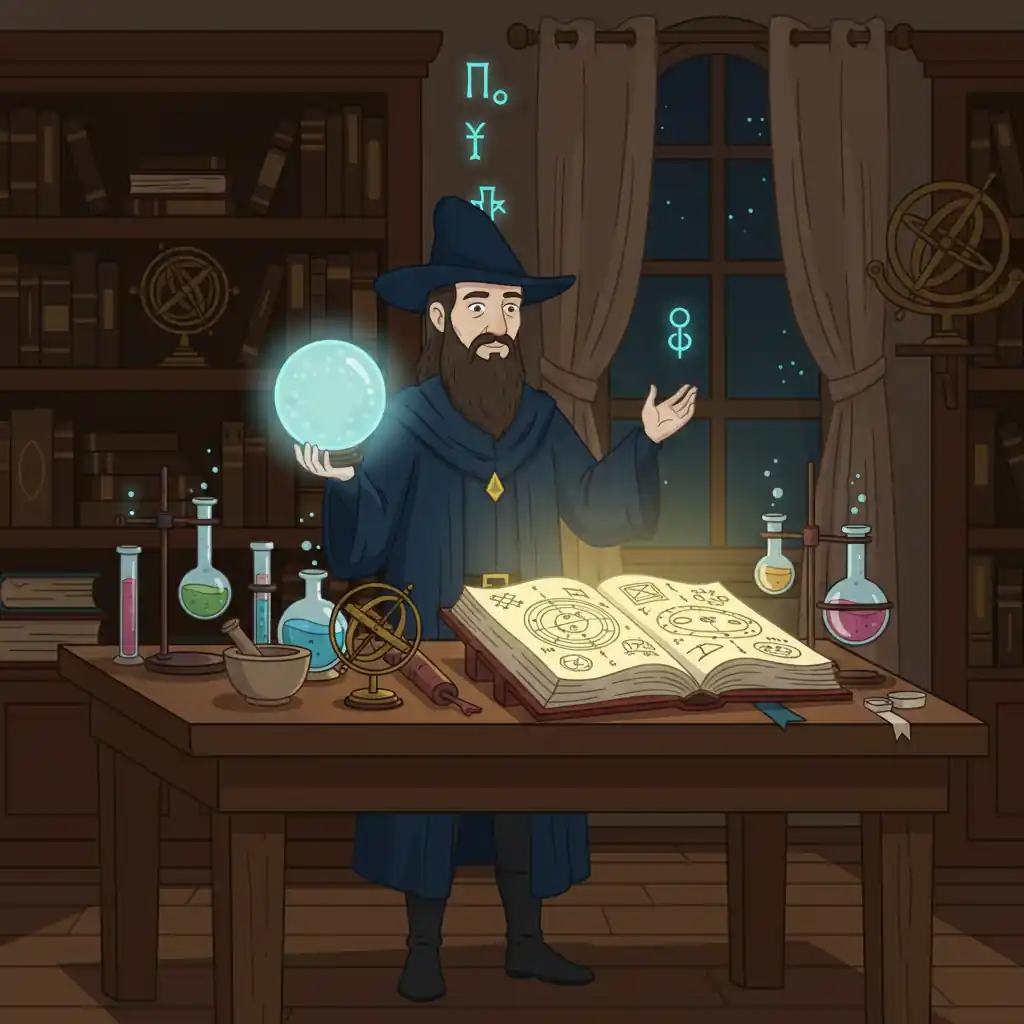
PROLOGUE: THE QUEEN'S CONJURER
Imagine a man who advised the most powerful monarch of his age, charted unexplored oceans, invented critical mathematical concepts, and yet believed he conversed regularly with angels. This was Dr. John Dee (1527-1609), a figure so utterly unique to the Elizabethan era that he defies easy categorization. He was a brilliant polymath—a pioneer in mathematics, astronomy, navigation, and cartography—but also a fervent mystic, whose later life became consumed by the search for divine knowledge through direct communication with celestial beings.
In an age where the lines between science, philosophy, and magic were fluid, Dee walked a razor's edge. He was Queen Elizabeth I’s trusted confidant, personal astrologer, and even the man who coined the term 'British Empire,' yet he spent countless hours in darkened rooms, staring into crystal balls, meticulously recording what he believed were the direct words of God's messengers. How did such a towering intellect descend, or ascend, into what many would consider the realm of the utterly fantastical?
This is not merely the story of a madman or a charlatan. It is the story of a man genuinely seeking ultimate truth, a man who pushed the boundaries of human knowledge so far that he felt compelled to reach beyond them entirely. His journey illuminates the profound intellectual and spiritual ferment of the Renaissance, where the scientific revolution was nascent, but the hunger for ancient, hidden wisdom remained intensely powerful. Dee's life is a testament to the belief that the universe held secrets accessible not just through reason, but through revelation.
He was a living paradox: a rationalist who embraced the irrational, a loyal servant to the Crown who flirted with heresy, and a scholarly recluse whose actions profoundly influenced the trajectory of England. His pursuit of angelic communication was not a side-hobby; it became the central, driving obsession of his later life, leading him on a bizarre continental odyssey and ultimately, to the brink of ruin. To understand John Dee, we must first understand the world that shaped him—a world where magic was a legitimate field of study, and angels were not just figures of scripture, but active participants in human affairs.
ACT I: THE RENAISSANCE MAN & THE ROYAL COURT
John Dee was born in London in 1527, the son of a Welsh courtier. From an early age, his intellect was undeniable. He entered St. John’s College, Cambridge, at just fifteen, devouring vast quantities of knowledge. He was so dedicated to his studies that he reportedly allowed himself only four hours of sleep a night, a rigorous discipline that characterized his entire life. His early genius shone brightest in mathematics and astronomy. He lectured on the groundbreaking work of Euclid at the University of Paris, attracting international acclaim. He was truly a man ahead of his time, an early advocate for Copernicus's heliocentric model, long before Galileo.
His talents, however, came with a dangerous edge. In an era rife with religious and political paranoia, advanced knowledge was often indistinguishable from sorcery. In 1555, under the reign of Catholic Mary I, Dee was arrested and charged with 'calculating' – essentially casting horoscopes – for Princess Elizabeth and other Protestant figures. Though eventually cleared of heresy, the accusation of 'conjuring' would dog him for the rest of his life. This brush with persecution ironically positioned him perfectly for the next reign.
When Elizabeth I ascended the throne in 1558, Dee's fortunes reversed dramatically. The young Queen, fascinated by learning and intrigue, recognized Dee's unique blend of scientific prowess and esoteric wisdom. He was immediately brought into her inner circle, becoming her trusted adviser. Dee calculated the most auspicious date for her coronation (January 15, 1559), based on astrological readings – a task that cemented his position as her personal 'magus' or conjurer. He even tutored her on mystical interpretations of ancient texts.
Dee's influence extended far beyond mere horoscopes. He was a leading expert in navigation, advising English explorers like Martin Frobisher and Sir Francis Drake on routes and celestial navigation. His maps and instruments were instrumental in England's burgeoning maritime power. He advocated for a reform of the Gregorian calendar and designed fantastical stage machinery for theatrical productions. It was Dee who conceptualized and tirelessly promoted the idea of a 'British Empire,' urging Elizabeth to expand England's influence globally, connecting her lineage to legendary figures like King Arthur to legitimize her claim to overseas territories. He was the intellectual architect of England's imperial ambitions.
Yet, for all his monumental contributions to science and the state, Dee found himself increasingly frustrated. He believed that much of the world's truly vital knowledge had been lost, either deliberately suppressed or corrupted over time. The books in his legendary library at Mortlake (which housed over 4,000 volumes, the largest private library in England) were not enough. He sought a direct conduit to divine wisdom, an uncorrupted source of truth that could unlock the universe's ultimate secrets. This insatiable hunger for ultimate knowledge, a common thread among Renaissance thinkers, led him away from purely empirical observation and towards the perilous path of direct communication with the divine – a path he believed was the only way to truly advance humanity.
ACT II: THE CALL OF THE CELESTIAL
By the 1580s, John Dee’s pursuit of knowledge had reached an inflection point. He felt he had exhausted conventional means of inquiry. His rational mind, paradoxically, led him to believe that the only way to access the pure, uncorrupted knowledge of God’s creation—the Prisca Theologia (ancient theology)—was through direct revelation. He became convinced that angels, being divine messengers, held the keys to this ultimate wisdom, a wisdom lost since the Fall of Man. This wasn't a casual interest; it was a deeply spiritual and intellectual quest for the very operating system of the cosmos.
To achieve this, Dee needed a specific kind of medium: a 'seer' or 'scryer.' He believed that while he, with his profound intellectual and spiritual discipline, could interpret the angelic messages, he lacked the natural ability to see or hear them himself. He employed several individuals for this task over the years, but none proved satisfactory. They were either ineffective or, Dee suspected, simply fraudulent. He diligently recorded every attempt, every perceived failure, showing a meticulousness that belied the esoteric nature of his work.
Then, in March 1582, a man named Edward Kelley entered Dee’s life, and everything changed. Kelley was a notorious figure, approximately thirty years old, with a checkered past. He was rumored to have been punished by having his ears cropped for forgery in Lancashire—a common punishment for criminals at the time. Despite his dubious character, Kelley possessed a magnetic, if unsettling, charisma and, crucially, claimed to possess the ability to communicate with spirits and see visions in Dee’s 'shew-stone'—a polished obsidian mirror or a crystal ball that Dee used for scrying.
Dee, ever the scholar, set strict protocols. He would sit at a table, often for hours, with Kelley looking intently into the crystal. Dee would then transcribe, word for word, everything Kelley claimed to see and hear: the appearance of angels, their names, their messages, and their instructions. This became the angelic conversations, later compiled into his sprawling, controversial work, A True and Faithful Relation of What Passed for Many Years Between Dr. John Dee and Some Spirits. Dee's meticulousness is astounding; he treated these sessions with the rigor of a scientific experiment, convinced he was documenting a profound truth.
From these sessions, the most famous output was the revelation of the 'Enochian' language. Kelley claimed angels dictated a complex, structured language, complete with its own alphabet, grammar, and syntax. Dee believed this was the very language spoken by Adam before the Fall, and by the patriarch Enoch, hence 'Enochian.' It was, for Dee, the ultimate key to universal knowledge, a means to understand God's creation directly. The 'Enochian Tablets' and 'Calls' were intricate magical diagrams and incantations, supposedly given by the angels to unlock profound spiritual and magical powers. Dee dedicated himself entirely to learning and disseminating this celestial tongue, convinced he was on the precipice of humanity's greatest discovery, led by messengers from the highest spheres.