
PROLOGUE: THE VEIL OVER THE CRESCENT CITY
New Orleans. A city steeped in humidity, jazz, and secrets. A place where the veil between worlds feels perpetually thin, where Catholic saints mingle with African deities, and where the scent of jasmine mixes with the lingering smoke of forgotten rituals. In this crucible of cultures and contradictions, one figure rose to become an undeniable force, her name whispered with reverence and trepidation: Marie Laveau.
She was more than a Voodoo practitioner; she was a spiritual entrepreneur, a social architect, and a psychological master, wielding power over the city’s elite and its most vulnerable alike. Her influence was so profound that even a century and a half after her death, her spirit is said to walk the labyrinthine streets, a perpetual guardian of the Crescent City’s most potent magic.
This is the story of how a free woman of color became an uncrowned queen, her throne built not of gold, but of faith, fear, and an unparalleled understanding of the human heart.
ACT I: A CONFLUENCE OF SPIRITS – THE ROOTS OF THE VOODOO QUEEN
Born in 1801, or perhaps 1794 (the records, like much of her early life, are fluid), Marie Catherine Laveau emerged from the rich, complex tapestry of New Orleans society. Her heritage was a powerful confluence: part African, part Native American, part French. This mixed ancestry placed her within the gens de couleur libres, the free people of color who occupied a unique social stratum, distinct from both white society and enslaved populations. This was a class known for its economic independence, its skilled trades, and its vibrant cultural life.
New Orleans itself was a city unlike any other in North America. A French and then Spanish colony before the Louisiana Purchase, it remained a distinctly non-Anglo-Saxon enclave. Its population was a volatile mix of French Creoles, Spanish settlers, Haitian refugees (many bringing their Vodou practices with them), enslaved Africans, and a transient population of sailors and merchants. This cultural gumbo created fertile ground for the syncretic religion of Louisiana Voodoo. Unlike the more codified Vodou of Haiti, New Orleans Voodoo was fluid, adapting, and borrowing from Catholicism, European folk magic, and indigenous spiritual practices. It was a religion of practicality, offering healing, protection, love spells, and vengeance to a population that often found little solace or justice in the official channels.
Marie Laveau's early life likely exposed her to these burgeoning spiritual traditions. Her grandmother, Catherine Henry, was a Voodoo practitioner, and it's believed Marie inherited a deep understanding of herbs, rootwork, and spiritual communication from her. She married Jacques Paris, a free person of color, in 1819. He disappeared shortly after, and she later entered a plaçage (an informal, yet socially recognized, arrangement common among free people of color) with Christophe Dominick Duminy de Glapion, a wealthy white Creole man. This relationship, which lasted over 30 years and produced numerous children, further cemented her social connections and provided a degree of economic stability crucial for her later endeavors.
It was through these early connections—her Creole family, her mixed-race community, and her exposure to the city's diverse spiritual landscape—that Marie Laveau began to forge the foundational elements of her extraordinary power. The seeds of her reign as the Voodoo Queen were sown in the very soul of this exotic, often dangerous, and endlessly fascinating city.
ACT II: THE HAIRDRESSER AND THE SERPENT – ASCENSION TO THE THRONE
Marie Laveau’s ascent to the apex of New Orleans’ spiritual hierarchy was not accidental; it was a carefully constructed empire built on shrewd observation, impeccable timing, and an unparalleled network. Her primary profession, the one that offered her access to the city’s most intimate secrets, was that of a hairdresser. This wasn't merely a side job; it was her intelligence agency.
As she braided the hair of wealthy white Creole ladies, black domestic workers, and free women of color, she became privy to their deepest anxieties, their secret loves, their bitter rivalries, and their unspoken fears. The gossip exchanged in the parlors of the elite, the whispered concerns of mistresses, the anxieties of husbands – all flowed directly into Marie’s eager ears. This unique vantage point allowed her to gather an astonishing amount of information.
When a client sought her spiritual advice, Marie often already knew the intricate details of their predicament. Her "prophecies" and "revelations" weren't divine foresight alone; they were often the result of meticulous information gathering, carefully presented to appear supernatural. This blend of street intelligence and spiritual mystique made her pronouncements eerily accurate and undeniably powerful.
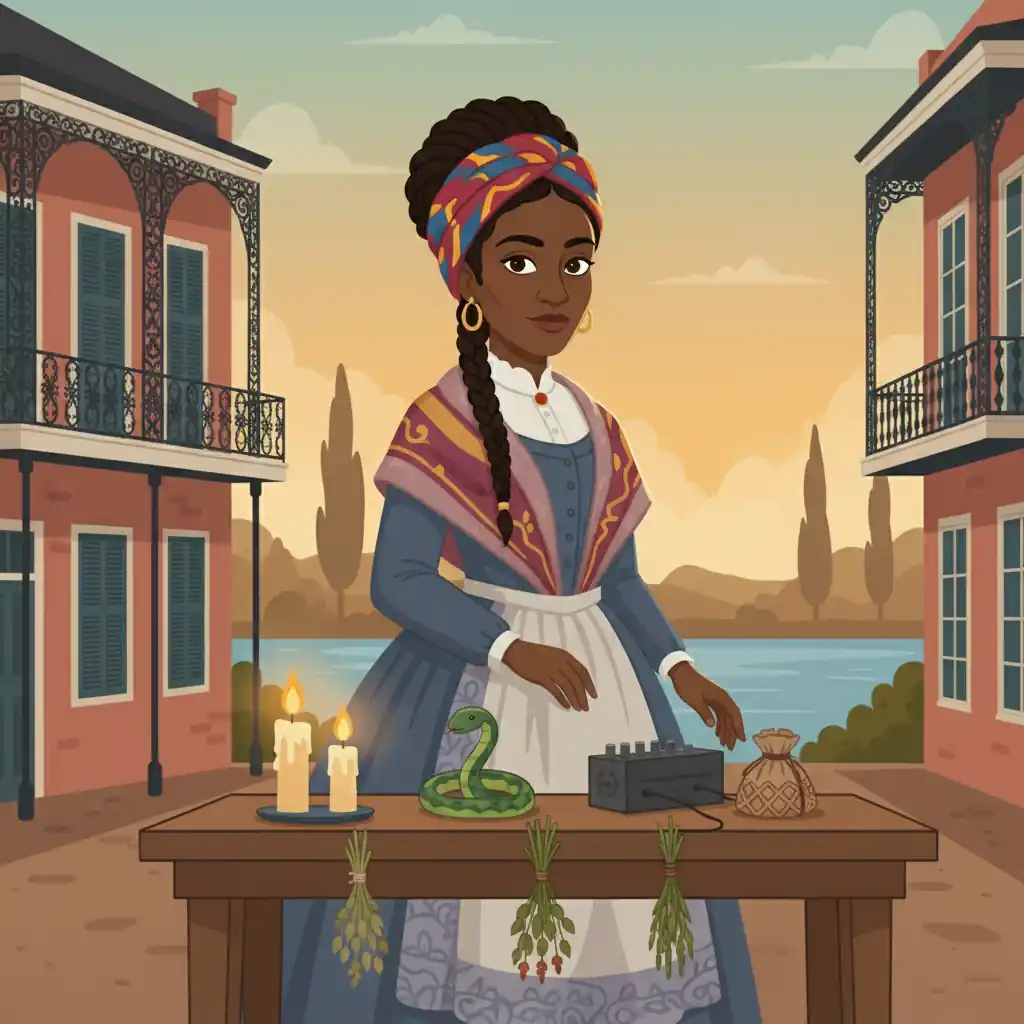
Her spiritual base was centered in her modest cottage on St. Ann Street in the French Quarter. Here, clients from all walks of life would gather, seeking her remedies for illness, her love potions, her protection spells, or her infamous curses against enemies. She was a master of psychology, using dramatic rituals, specific gris-gris bags, and compelling storytelling to instill belief and achieve desired outcomes. Her rituals were often theatrical, involving candles, herbs, strange incantations, and even her pet snake, Zombi, a symbol of the loa Damballah, the serpent spirit of wisdom and fertility.
Beyond her St. Ann Street home, Marie also presided over the city’s most significant Voodoo gatherings. The most famous of these took place on the shores of Lake Pontchartrain and, controversially, in Congo Square. These public rituals, often attracting hundreds, sometimes thousands, of participants and curious onlookers, were vibrant, ecstatic affairs of drumming, dancing, singing, and spirit possession. Marie Laveau, adorned in her distinctive tignon (head-wrap) and often holding a snake, was the undeniable high priestess, orchestrating the spiritual frenzy. These events served not only as religious ceremonies but also as powerful public displays of her authority, solidifying her reputation and fear among both her followers and the wider, often disapproving, white establishment. It was through this potent combination of private counsel, public spectacle, and a truly astonishing intelligence network that Marie Laveau transformed herself from a simple hairdresser into the undisputed Voodoo Queen of New Orleans.