
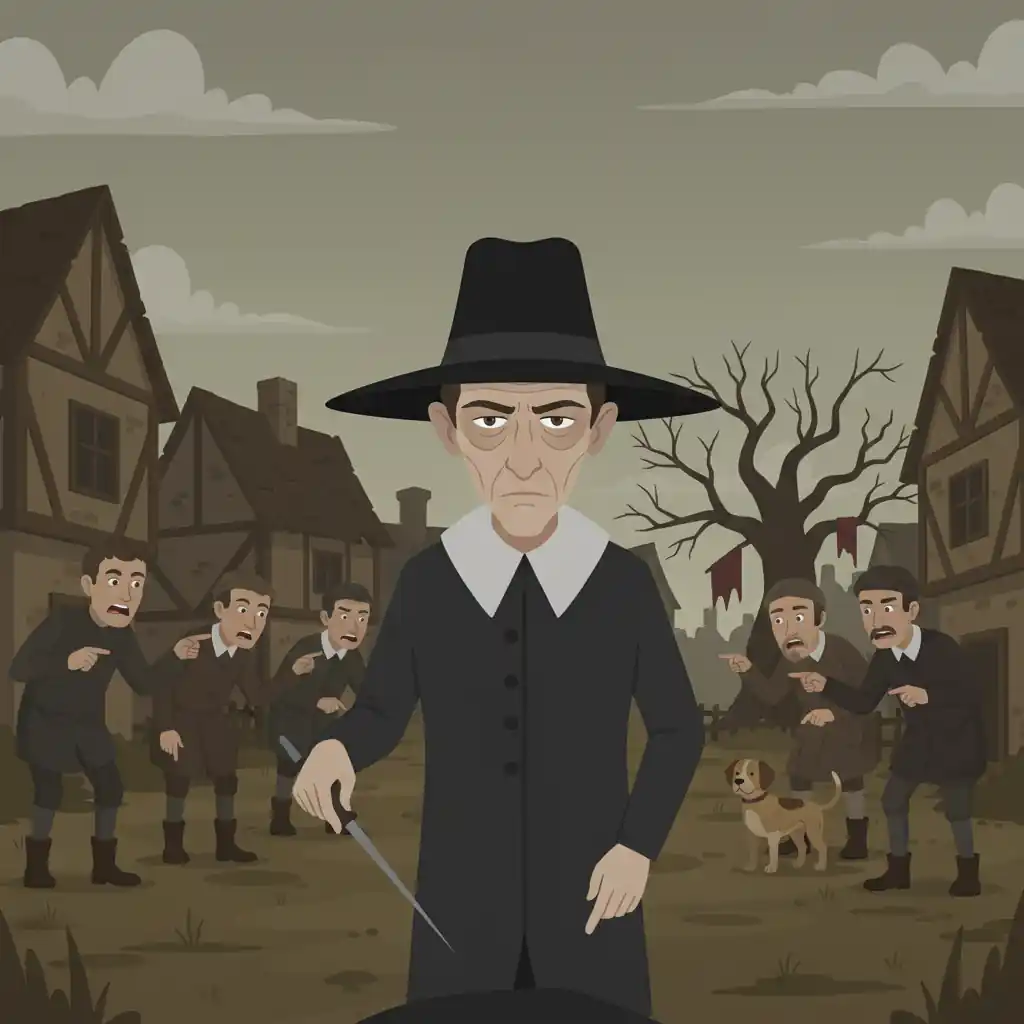
PROLOGUE: A NATION CONSUMED BY FEAR
Imagine England in the 1640s: a nation tearing itself apart. The English Civil War raged, pitting Parliament against the King, brother against brother. Order collapsed, law became arbitrary, and the old certainties dissolved into chaos. Plague, famine, and economic hardship stalked the land. In this crucible of fear and desperation, a darker terror began to spread, not from the battlefield, but from the shadows of rural villages, whispered on the wind: witchcraft.
It was into this fractured landscape that an unlikely figure emerged, a man who would exploit the deepest anxieties of his age and etch his name into history as a harbinger of death: Matthew Hopkins, the self-proclaimed 'Witchfinder General.' His reign was brief, lasting barely three years, yet in that time, he orchestrated a systematic campaign of terror across East Anglia, leading to the execution of an estimated 300 women and men, more than all other English witch hunts combined over the preceding century.
This is the story of a man who rose from obscurity to wield unimaginable power, fueled by fervent Puritan belief, a thirst for profit, and the collective paranoia of a broken nation. It’s a chilling tale of injustice, manipulation, and the brutal efficiency with which fear can be weaponized.
ACT I: THE RISE OF THE WITCHFINDER
To understand Matthew Hopkins, we must first understand the ground he walked upon. Mid-17th century England was a deeply religious, often superstitious society. The Puritan movement, ascendent during the Civil War, preached a rigid, Old Testament-style faith, emphasizing humanity's innate sinfulness and the ever-present threat of the Devil. Every misfortune – a crop failure, a sick child, a cow gone barren – could be attributed not to bad luck, but to malevolent supernatural forces at work.
Hopkins himself was a relatively obscure figure before 1644. Born around 1620, the son of a respectable Puritan clergyman, James Hopkins, he was likely trained in law, though he never achieved significant legal standing. He was a 'gentleman' of moderate means, residing in Manningtree, Essex. His ambition, however, was anything but moderate.
Before his infamous career began, Matthew Hopkins was known for little more than his small inheritance. He bought a house in Manningtree, a town that would become the epicenter of his first, highly publicized witch hunt, ironically setting the stage for his macabre fame right on his doorstep.
Hopkins claimed his career as a witchfinder began through a stroke of divine providence. He overheard local women in Manningtree discussing their nightly meetings with the Devil, conspiring to cause mischief. This 'discovery' led to the accusation of a local impoverished woman named Elizabeth Clarke, a one-legged widow already viewed with suspicion. What started as local gossip, Hopkins spun into a grand conspiracy.
In a town gripped by Puritan fervor and Civil War anxieties, Hopkins presented himself as God’s chosen instrument, an expert in the dark arts of uncovering Satan’s agents. He wasn't a magistrate, or a priest, or even a formally appointed official. He was a self-made 'professional' who capitalized on a catastrophic breakdown of legal authority. With his assistant, John Stearne, a man equally zealous and ruthless, Hopkins would embark on a systematic campaign that turned suspicion into conviction, and local quarrels into death sentences.
His initial success in Manningtree, securing numerous confessions and convictions, quickly established his 'reputation.' Word spread, and soon, towns across Suffolk, Norfolk, and other East Anglian counties, desperate for order and eager to purge what they believed was evil, began to solicit his services. The stage was set for a terrifying journey into the heart of human paranoia.
ACT II: THE INSTRUMENTS OF INQUISITION
Hopkins's methodology was brutal, systematic, and remarkably effective at extracting confessions. His techniques were not new, but he applied them with an unprecedented rigor, turning a local superstition into an industrial-scale operation. The core of his process relied on physical examinations, psychological torture, and the cultivation of an environment of absolute terror.
The 'Witch's Mark' and the Pricker
One of Hopkins's primary tools was the search for the 'witch's mark' – a blemish on the body believed to be where a witch suckled her demonic 'familiars.' These marks could be moles, birthmarks, freckles, scars, or even hemorrhoids. Hopkins and Stearne employed 'prickers,' often women, who would strip the accused and painstakingly search every inch of their body.
A common trick of the prickers was to use a retractable blade or a blunt needle. They would 'prick' the mark, and if it didn't bleed or cause pain (because it wasn't a real prick), it was declared a witch's mark. This 'proof' was almost always manufactured, designed to secure a conviction, regardless of the truth.
Sleep Deprivation and 'Watching'
The most insidious and psychologically damaging method was 'watching.' Accused witches were placed in a room, often with their legs crossed, and constantly observed by a team of 'watchers' for 24-72 hours. They were denied sleep, food, and water, and often forbidden to sit or even lean. The watchers would harass them, trying to force a confession or to witness the arrival of a familiar.
Under such extreme duress, subjects would inevitably become disoriented, delirious, and prone to hallucinations. In this broken state, they would often 'confess' to anything, name other 'witches' to end their torment, or describe bizarre apparitions that were, in reality, figments of their sleep-deprived minds. These confessions, often detailed and vivid, were then used as primary evidence.
The 'Swimming Test' (or Ordeal by Water)
Less frequently used by Hopkins himself but a widespread practice, the 'swimming test' was a perverse form of trial. The accused was stripped, bound, and thrown into a body of water. If they floated, the water was said to 'reject' them, proving them guilty. If they sank and drowned, they were innocent – but dead. It was a no-win scenario, a macabre demonstration of the brutal logic underpinning the witch hunts.
The Familiars: Demonic Companions
The confessions extracted under these torturous conditions often included vivid descriptions of the accused's 'familiars' – animal-shaped demons that served witches. These were often described as common creatures like cats, dogs, mice, toads, or even more exotic ones like polecats or imps with fantastical names (e.g., 'Jarmara,' 'Sack-and-Sugar'). These fantastical stories, born of delirium, lent a chilling credibility to the accusations in the eyes of the terrified public.
These methods, combining pseudo-scientific examination with severe psychological pressure, were remarkably effective. Hopkins didn't need concrete evidence; he created it. He transformed local fears into tangible 'proof,' securing an alarming number of convictions and solidifying his reputation as the one true Witchfinder General.
ACT III: THE SCOURGE OF EAST ANGLIA
From his base in Manningtree, Matthew Hopkins, often accompanied by his more physically imposing associate John Stearne, embarked on a systematic campaign across the counties of East Anglia. They rode from town to town, summoned by panicked communities or ambitious local magistrates, leaving a trail of terror and death in their wake.
Their first major success, after Manningtree, came in the town of Chelmsford, where 20 women were tried, and four executed. But it was in Suffolk where Hopkins's campaign reached its terrifying zenith. In the spring of 1645, he arrived in the thriving market town of Bury St Edmunds. Here, he oversaw the trials of 18 alleged witches in a single week. The chilling efficiency with which these trials were conducted shocked even contemporary observers.
One of the most tragic victims was Reverend John Lowes, the 80-year-old vicar of Brandeston. Accused of witchcraft, he was subjected to the horrific sleep deprivation 'watching' for days. In his delirium, he confessed to consorting with imps, leading to his execution. He was reportedly forced to read his own burial service before being hanged, a final, cruel humiliation.
Hopkins’s modus operandi was to arrive in a town, secure the cooperation of local authorities (often by presenting a petition from terrified citizens), and then systematically interrogate and 'examine' accused individuals. The accusations often spiraled, as those under duress would name others to save themselves or implicate their perceived enemies. This created a domino effect, turning entire communities against one another.
The sheer number of executions attributed to Hopkins and Stearne during their brief, bloody reign is staggering. Approximately 300 individuals were condemned and executed, primarily by hanging, between 1645 and 1647. This figure represents an extraordinary anomaly in English legal history, far outstripping the combined total of the previous century's witch trials.