
PROLOGUE: THE FALL THAT AWAKENED THE 'SIGHT'
Before he was Peter Hurkos, the 'Psychic Detective' who claimed to walk the unseen corridors of crime, he was Pieter van der Hurk. A humble Dutch house painter and carpenter, an ordinary man living an ordinary life in the bustling port city of Rotterdam. Born in 1911, he was known for his robust physique, his hearty laugh, and perhaps, a touch of theatrical flair, but certainly not for any mystical inclination.
Then came 1941, during the grim days of World War II, a moment that would shatter his reality and, he claimed, rebuild it with a sixth sense. Hurkos was working on a roof when he slipped, tumbling nearly forty feet to the cobblestone street below. He fractured his skull, broke several bones, and plunged into a coma that lasted three days.
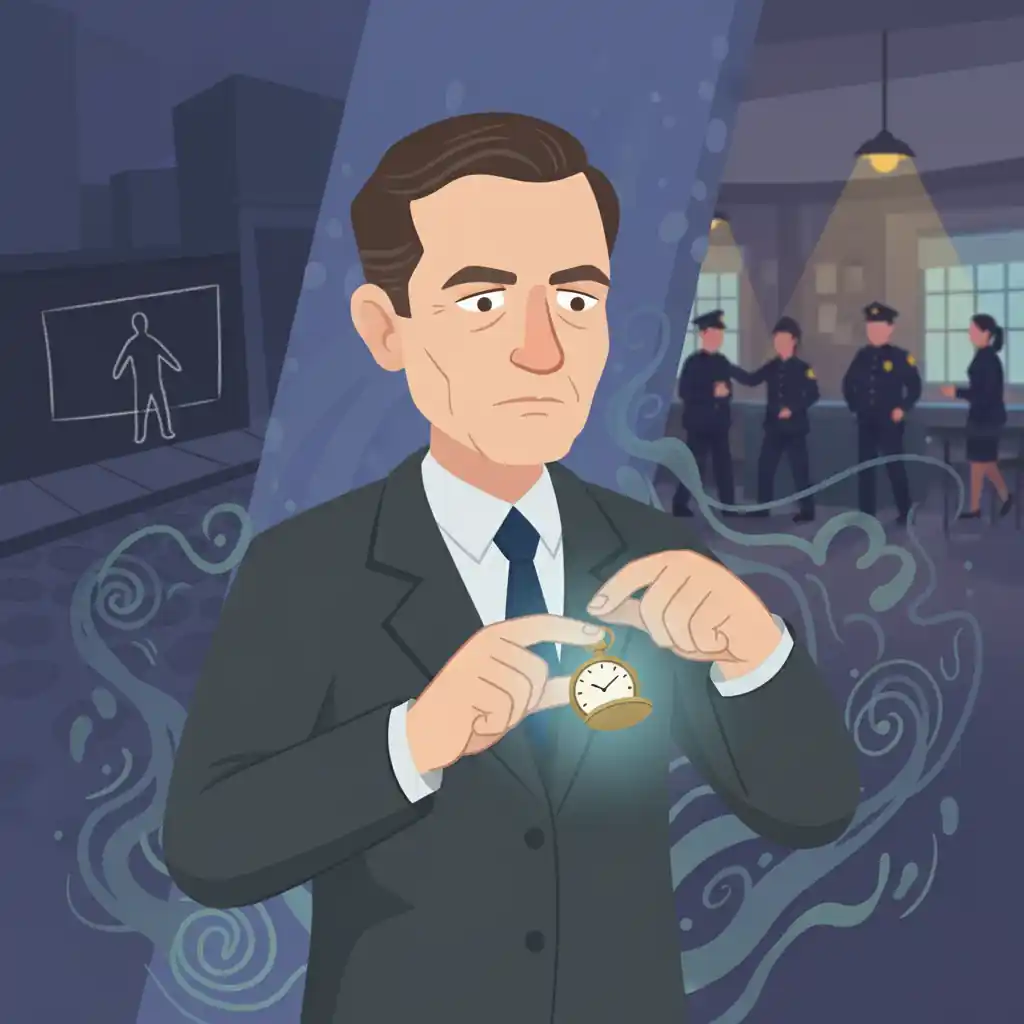
When he awoke in the hospital, something was profoundly different. The world, he insisted, had gained an extra dimension. He could 'see' things – not with his eyes, but with a new, jarring clarity. The doctor, a stern man, held out a watch. Hurkos touched it and gasped, describing the doctor’s dead father, the accident that killed him, even the specific make of the car involved. The doctor, initially dismissive, was reportedly stunned into silence. This wasn’t guesswork; it was a revelation.
This was the birth of psychometry, the alleged ability to discern facts about an object or its owner by simply touching it. Hurkos described it as a torrent of images, sounds, and emotions flooding his mind – a chaotic, overwhelming stream of sensory data that he had to learn to filter and interpret. From that fall, a simple painter was transformed into something else entirely: a human sensor, a reluctant oracle, thrust into a world he never imagined.
During his recovery, Hurkos claimed he could hear conversations from miles away and even diagnose ailments by merely looking at people. One story recounts him 'seeing' a nurse's marital troubles and offering specific details about her husband's infidelity, much to her alarm and the hospital staff's bewilderment. His initial abilities were not just psychometric but seemed to encompass clairaudience and clairsentience.
ACT I: FROM DUTCH PAINTER TO GLOBAL PHENOMENON
The immediate aftermath of his 'awakening' was less a miraculous ascent and more a chaotic struggle. Pieter van der Hurk, now Peter Hurkos, found his ordinary life impossible. The constant barrage of information from every object, every person, was disorienting. He couldn’t touch a doorknob without knowing who had last used it or handle money without seeing its previous owners. It was a curse as much as a gift.
His wife, unable to cope with his bizarre new reality, eventually left him. He struggled to hold down jobs, his 'visions' often alienating employers and colleagues. Yet, he persevered, determined to understand and control this new faculty. He began offering readings, first to friends, then to a wider circle, slowly gaining a reputation in post-war Europe.
His initial fame was local, focused on solving minor personal mysteries and finding lost objects. But his story caught the ear of Andrija Puharich, an American parapsychologist and physician with a keen interest in psychic phenomena. Puharich, skeptical yet intrigued, brought Hurkos to the United States in 1956 for extensive testing at the Round Table Foundation in Maine. This was Hurkos's big break, a stage far grander than any Dutch parlor.
Puharich conducted numerous experiments, presenting Hurkos with sealed envelopes containing objects, asking him to identify their owners or history. Hurkos delivered an astonishing hit rate, often providing specific names, dates, and vivid descriptions of events associated with the items. Puharich, initially a skeptic, became a staunch believer, publishing books that championed Hurkos's abilities and catapulting him into the American consciousness.
The American media, always hungry for the sensational, embraced Hurkos. He appeared on television shows, his thick Dutch accent and earnest demeanor adding to his mystique. Life Magazine featured him prominently, describing his incredible claims and the growing body of anecdotal evidence. He wasn't just a psychic anymore; he was a phenomenon, a man who could supposedly unlock the secrets held within inanimate objects, a potential key to solving the unsolvable. His journey from a common painter to a celebrity 'Psychic Detective' had officially begun.
One of Hurkos's most dramatic early tests involved a pair of cufflinks belonging to a missing person. Hurkos reportedly held them and described not only the man's disappearance but also the exact location and manner of his death, which was later corroborated by police. These kinds of precise hits were what initially convinced many, including seasoned scientists, of his unique abilities.
ACT II: THE PSYCHIC ON THE POLICE BEAT – HIGH-PROFILE CASES AND CRITICAL GLANCES
The late 1950s and 1960s saw Peter Hurkos at the zenith of his notoriety, his phone ringing off the hook with requests from grieving families and desperate police departments. His modus operandi was deceptively simple: give him an object linked to a crime – a victim’s garment, a murder weapon, a photograph – and he would 'read' it. He became a fixture in the burgeoning field of forensic psychics, a figure of both hope and intense skepticism.
One of his most publicized engagements was with the Boston Strangler case in the mid-1960s. After thirteen women had been brutally murdered, Hurkos was brought in by authorities who were at their wits' end. He famously held objects belonging to the victims and described the killer as a 'short man, with curly hair, who had been in and out of institutions.' He also provided details about the killer's apartment and specific pieces of furniture. While Albert DeSalvo eventually confessed to the murders, matching some of Hurkos's descriptions (though not all), the case remained controversial, with many questioning the true extent of Hurkos's contribution and the ultimate accuracy of his 'vision'.
Another high-profile case involved the gruesome Sharon Tate murders by the Manson Family in 1969. Hurkos claimed he could identify the killers and provided a description of a 'short, dark-haired man' and a 'woman with dark hair.' While these details eventually aligned loosely with Charles Manson and his followers, critics pointed out the vagueness of the descriptions and the fact that basic police work, not psychic insight, ultimately led to the arrests. Still, the media loved the narrative of the psychic consultant on such notorious crimes.