
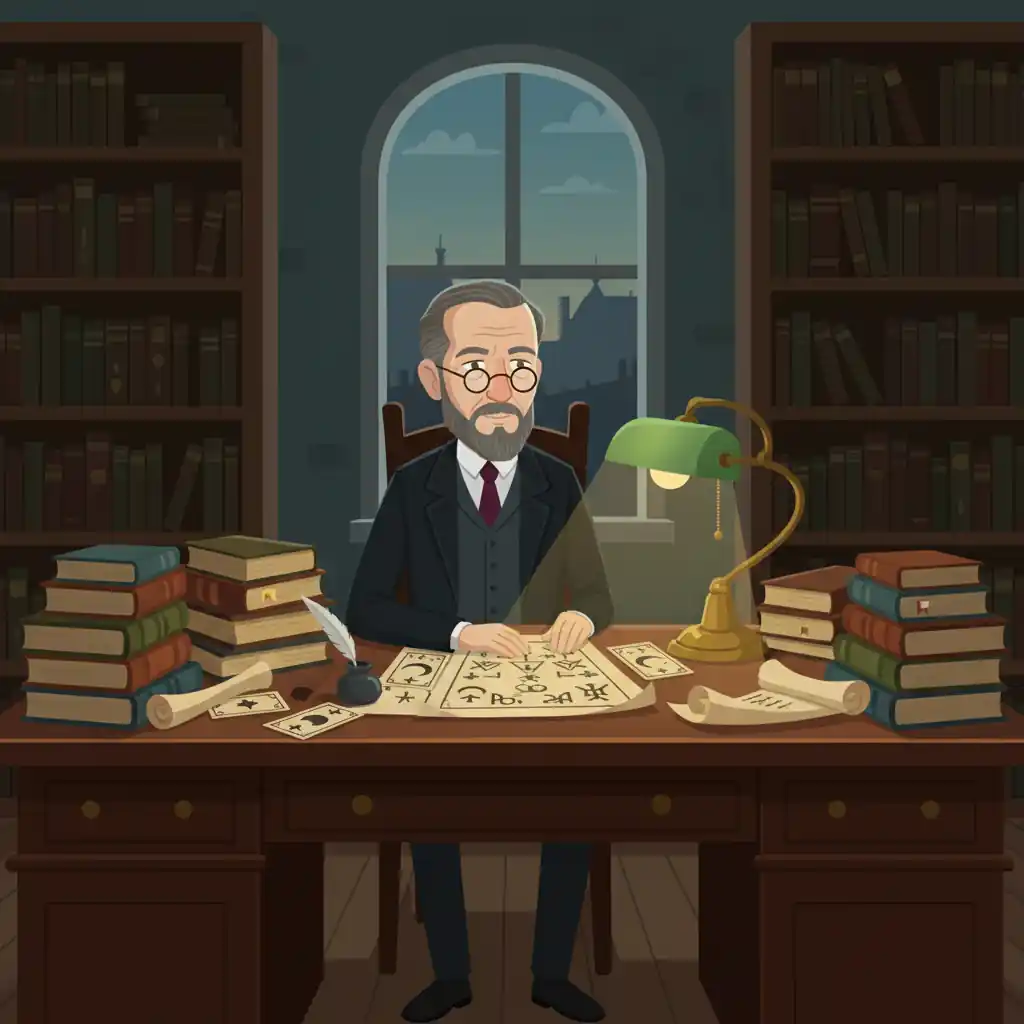
PROLOGUE: THE SOLITARY SCHOLAR
The esoteric world of the late 19th and early 20th centuries was a swirling cauldron of charlatans, genuine mystics, and fervent seekers. Amidst this chaos, one figure stood out, not for his dramatic rituals or public pronouncements, but for his quiet, almost monastic dedication to scholarship. He was Arthur Edward Waite, a man often described as a 'hermit' of the occult, whose intellectual rigor would eventually shape how millions perceived ancient wisdom. His most enduring legacy would not be found in dusty grimoires of his own making, but in a deck of seventy-eight cards that, almost by accident, became the global standard.
Waite was an enigma: a figure who preferred the musty silence of libraries to the theatrical drama of secret societies, yet he became a pivotal force within them. He sought a 'true' spiritual path, rejecting what he saw as the superficiality and self-aggrandizement of many contemporary occultists. His life was a relentless quest to distill genuine mystical knowledge from the dross of superstition, a journey that led him to codify a system of visual symbolism that remains ubiquitous today.
This is the story of a man born into mystery, driven by an insatiable hunger for ancient truths, who, from the solitude of his study, provided a visual language for the soul that would transcend his own reclusive existence. It is the story of The Hermit of the Tarot, the intellectual powerhouse behind the Rider-Waite deck, whose profound impact on modern esotericism is often felt, but rarely fully attributed.
ACT I: AN ORPHAN'S JOURNEY INTO THE ESOTERIC
Arthur Edward Waite’s life began shrouded in a peculiar ambiguity. Born in Brooklyn, New York, in 1857, his origins were less a cradle of comfort and more a tapestry of unanswered questions. His father, a ship’s captain named Charles F. Waite, was said to have died when Arthur was very young. Some accounts suggest a darker, more dramatic end: that Charles vanished or committed suicide. Whatever the truth, the lack of a paternal figure profoundly marked Waite, instilling a lifelong search for foundational truths and origins.
His mother, Emma Lovell, a devout Irish Catholic, soon returned to her native England with her two children, Arthur and his sister, Frederica. They settled in London, a city then pulsating with the intellectual ferment of late Victorian society and the burgeoning interest in the occult. Despite his mother's traditional faith, she also harbored a strong fascination with spiritualism, a common, if controversial, pursuit of the era.
Young Waite was largely self-educated. He possessed a voracious appetite for knowledge but detested formal schooling, rejecting what he saw as its rigid, uninspired curriculum. He spent countless hours in the British Museum Library, devouring texts on mysticism, alchemy, Christian Cabala, and Hermetic philosophy. His early intellectual curiosity was less about seeking power or personal gain, and more about uncovering the universal spiritual truths he believed lay hidden beneath layers of religious dogma and esoteric jargon.
This deep dive into ancient wisdom was not without its internal struggles. While sympathetic to his mother's spiritualist leanings, Waite quickly grew suspicious of the prevalent séances and mediumistic displays. He saw them as theatrical, prone to fraud, and ultimately distracting from genuine spiritual insight. His skepticism, however, fueled a desire to separate authentic tradition from mere charlatanism, a distinction that would become a defining characteristic of his entire life's work.
Waite's own 'conversion' to the esoteric path was not a sudden revelation but a gradual unfolding. He later described it as an encounter with a 'spiritual force' at the age of 21, which intensified his quest for direct spiritual experience rather than mediated or ritualistic ones. This blend of intellectual rigor, spiritual longing, and a keen eye for deceit made him a unique figure, destined to become both a participant in and a stern critic of the occult revival that swept through England.
Fun Fact: Despite his towering intellect and vast knowledge, Arthur Edward Waite never attended university. He was a true autodidact, his vast erudition forged in the quiet halls of libraries rather than lecture theatres, proving that profound wisdom can emerge from self-directed passion rather than institutional validation.
ACT II: THE GOLDEN DAWN AND THE GREAT SCHISM
By the 1880s, London had become the epicenter of the Western Esoteric Tradition, a magnet for those seeking hidden wisdom. Among the most influential and secretive of these organizations was the Hermetic Order of the Golden Dawn, founded in 1888. It promised a structured path to magical and spiritual attainment, blending Kabbalah, astrology, alchemy, tarot, and Enochian magic into a complex, multi-tiered initiatory system. Arthur Edward Waite, ever the seeker, found himself drawn to its intellectual gravity, joining the Isis-Urania Temple in 1891.
Initially, Waite was captivated. The Golden Dawn offered a synthesis of the very traditions he had studied in isolation. Its elaborate rituals, theoretical depth, and the promise of direct contact with divine forces resonated with his intellectual and spiritual aspirations. He quickly advanced through the grades, mastering the intricate symbolism and theoretical underpinnings of the Order. However, his scholarly and deeply spiritual nature soon clashed with the more overtly magical and, to his mind, less profound elements within the Order.
Waite became increasingly disillusioned with what he perceived as the Order's drift towards ceremonial magic for personal gain, its internal power struggles, and the lack of genuine spiritual focus. He saw many members, particularly those focused on practical magic, as 'dabblers' or, worse, charlatans. This simmering discontent erupted into open conflict during the infamous 'Golden Dawn Schisms' of the late 1890s and early 1900s.
The Order was tearing itself apart. Personal rivalries, accusations of fraud, and fundamental disagreements over doctrine plagued its leadership. The most sensational figure to emerge from this turmoil was Aleister Crowley, a flamboyant and controversial individual whom Waite deeply disliked. Waite saw Crowley as a dangerous egomaniac, whose 'Black Magic' excesses epitomized everything he detested in the occult world. The two men, intellectual titans, became bitter rivals, their philosophies representing two divergent paths within esotericism: Waite's path of Christian mysticism and scholarly pursuit versus Crowley's path of libertine Thelemic 'Magick' and self-deification.
Waite, ever the reformer, attempted to 'purify' the Golden Dawn, steering it away from ceremonial magic and towards a more mystical, Christian Cabalistic path. He published critical essays, exposed perceived weaknesses, and eventually led a faction of the Order, renaming it the 'Independent and Rectified Rite of the Golden Dawn,' or later, the 'Fellowship of the Rosy Cross.' His efforts, while driven by genuine conviction, ultimately contributed to the fragmentation and eventual decline of the original Golden Dawn as a cohesive magical order.
Fun Fact: Waite, despite his deep involvement, became one of the Golden Dawn's fiercest critics. He was one of the first to publish a detailed, albeit veiled, account of the Order's rituals and internal workings in his 1909 book, The Secret Tradition in Goëtia, a move considered scandalous by his former magical brethren and further cementing his reputation as a controversial, albeit brilliant, figure.
ACT III: THE BIRTH OF THE MODERN TAROT
By the early 20th century, tarot decks existed, primarily as playing cards or rudimentary divinatory tools. However, most decks, especially those used for occult purposes, suffered from a crucial limitation: while the Major Arcana cards typically featured rich symbolic imagery, the Minor Arcana (the suits of Swords, Wands, Cups, and Pentacles) were often 'pip' cards—simple numerical arrangements of their respective suit symbols, much like modern playing cards. They lacked the narrative depth that made the Majors so evocative, making them difficult to interpret intuitively without extensive memorization or obscure texts.
Arthur Edward Waite recognized this glaring deficiency. Driven by his belief that the tarot held profound mystical and ethical truths, not merely fortune-telling capabilities, he envisioned a deck where every card, from the Fool to the Ace of Cups, was fully illustrated with symbolic scenes. This, he believed, would make the deck's esoteric wisdom accessible, allowing intuition and contemplation to unlock its deeper meanings, even for those not initiated into complex Hermetic traditions. It was a revolutionary idea.
In 1909, Waite approached William Rider & Son, a London publisher specializing in occult books. The publisher agreed to his ambitious project, but Waite himself was no artist. He needed a collaborator capable of translating his intricate symbolic vision into compelling imagery. He found her in Pamela Colman Smith, a prodigious artist and fellow Golden Dawn member (though she was of a less controversial, more artistic temperament than Waite).
Smith, affectionately known as 'Pixie,' was a remarkable talent. Born in England but raised partly in Jamaica, she was a professional illustrator and theatre designer with a unique, whimsical, and highly imaginative style. Crucially, she possessed a rare gift for 'synesthesia'—she claimed to 'see colors' and 'hear sounds' as she drew, allowing her to imbue her work with an almost living quality. Working at breakneck speed, Smith completed all seventy-eight illustrations in just six months, a monumental artistic feat for which she was paid a pittance and, for decades, barely credited beyond the initials 'P.C.S.' on the cards themselves.