
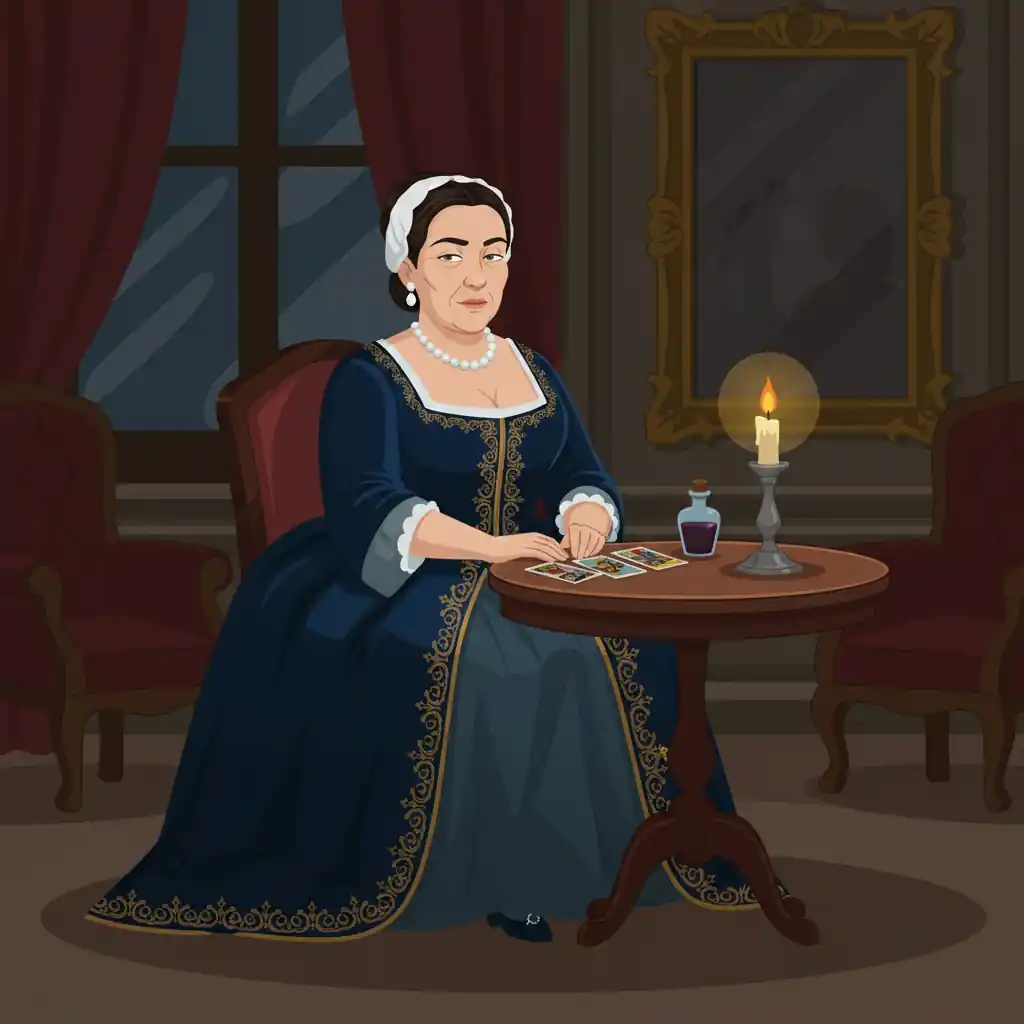
PROLOGUE: PARIS, 1670s – WHERE GRACE MET GRIT
Beneath the glittering chandeliers of Versailles, where Louis XIV, the Sun King, held court in unparalleled splendor, a much darker, far more volatile undercurrent pulsed through the streets of Paris. This was an age of paradox: of scientific awakening coexisting with rampant superstition, of rational philosophers rubbing shoulders with charlatans and alchemists. For every grand salon discussing Descartes, there was a hidden chamber where desperate souls sought solace—or revenge—from the shadows. And at the heart of this shadowy world sat a woman of formidable will and chilling ambition: Catherine Deshayes, better known to her anxious clientele as La Voisin.
La Voisin was no ordinary fortune-teller. She was a reflection of her age’s hidden fears and desires, a midwife to both life and death, a confidante to courtesans and duchesses alike. Her story is not just a tale of poison and black masses, but a gritty social commentary on the lengths to which the Parisian elite would go to secure love, wealth, and power in an era where societal grace often masked moral decay. Imagine a world where a whisper in a dimly lit room could shatter a reputation, or a drop in a goblet could end a life, and you begin to understand the lethal glamour of 'The Affair of the Poisons'.
The City of Shadows and Gold
Paris in the late 17th century was a city of stark contrasts. The streets were often little more than open sewers, teeming with poverty and disease, yet grand mansions stood proudly, their windows glowing with the warmth of wealth. Life for many was short and brutal, making people susceptible to any promise of a better future, or a quick solution to their earthly problems. From the lowest ranks of society to the highest echelons of the aristocracy, everyone was a potential customer for someone like La Voisin. The royal court itself, despite its unparalleled sophistication, harbored a deep fascination with astrology, omens, and secret potions. Even the Sun King, a symbol of enlightenment, had his own court astrologers. The line between accepted science and outright sorcery was incredibly thin, blurred by fear, hope, and an insatiable human appetite for control over an unpredictable world.
ACT I: THE MIDWIFE WHO BECAME A SORCERESS
Catherine Deshayes, born around 1640, started her life far from the opulent court of Versailles. Her beginnings were mundane: she married a silk merchant named Antoine Monvoisin (hence 'La Voisin,' meaning 'the neighbor'), and together they had several children. But Antoine, it turned out, was a poor businessman, and the family quickly found themselves facing financial ruin. This desperation proved to be the crucible in which La Voisin's formidable talents—and dark ambitions—were forged.
From Cradle to Curse
La Voisin initially trained as a midwife, a profession that gave her unique insight into the intimate lives of Parisian women, from peasant to noble. But her skills soon expanded. She developed an uncanny ability for palmistry, physiognomy, and fortune-telling, quickly gaining a reputation for startling accuracy. Her small house in the Rue de la Tannerie, and later in the Rue Beauregard, became a clandestine hub where clients from all social strata sought her counsel. She claimed to possess the 'Gift of God' for uncovering secrets and predicting futures.
Her 'clinic' became a one-stop shop for life's complicated woes. Women struggling with unwanted pregnancies came to her for abortifacients—her midwifery knowledge proving invaluable here. Others sought love potions to win back wayward lovers or secure advantageous marriages. Husbands and wives sought to rekindle faded affections or, more ominously, to rid themselves of inconvenient spouses. La Voisin, with her shrewd understanding of human psychology and her network of informants, built an empire on people's desperation. She charged exorbitant fees, quickly pulling her family out of poverty and into a life of comfortable, if illicit, luxury.
The Shifting Sands of Morality
What began as fortune-telling and minor charms quickly escalated. La Voisin understood that mere predictions weren't enough; her clients wanted results. Her repertoire expanded to include more potent—and dangerous—solutions. She began providing love filters, supposedly ensuring fidelity, which often contained toxic ingredients like Spanish fly (cantharides), a powerful aphrodisiac that in larger doses was a deadly poison. As her reputation grew, so did the boldness of her clients' requests. The boundaries blurred: from seeking love, they moved to seeking control, then to seeking destruction. La Voisin, ever the astute businesswoman, simply adapted to the market.
Fun Fact: La Voisin's network was surprisingly sophisticated. She employed a team of some twenty assistants, including astrologers, alchemists, and 'readers of faces.' Her client list reputedly included over 2,500 people, a veritable 'who's who' of Parisian society. Her popularity stemmed not just from her claimed magical abilities, but from her genuine talent for dispensing practical, albeit often unscrupulous, advice.
ACT II: THE POISONS AND THE 'BLACK MASSES'
As La Voisin’s influence grew, so did the darker aspects of her trade. Her clients, often members of the jaded Parisian aristocracy, found themselves trapped in loveless marriages, stifled by ancient inheritance laws, or consumed by rivalries for power and affection. They didn't just want love charms; they wanted solutions, and sometimes, those solutions involved death. La Voisin, with a pragmatism that bordered on terrifying, became their purveyor of 'inheritance powders' or 'succession powders'—slow-acting poisons designed to eliminate troublesome obstacles subtly and discreetly.
The Chemistry of Murder
Arsenic was her poison of choice: colorless, tasteless when mixed with food or drink, and its symptoms mimicked natural illnesses. But she also dabbled with belladonna, hemlock, and other toxic concoctions. She wasn't an alchemist in the traditional sense, but she understood chemistry well enough to procure and prepare these deadly substances. Her suppliers were numerous, including corrupt apothecaries, disgruntled monks with access to monastery herb gardens, and other practitioners of the occult who saw an opportunity for profit. Her home became a laboratory of death, discreetly catering to the murderous impulses of the elite.
The Infamous 'Black Masses'
The most sensational—and chilling—allegations against La Voisin involved the performance of 'black masses.' These horrific rituals, detailed in confessions from her arrested associates (often extracted under torture), were said to be presided over by renegade priests like Étienne Guibourg. The purpose was to invoke demonic forces, cast powerful spells, or ensure the efficacy of poisons and charms. The 'altar' for these masses was allegedly a naked woman, and a chalice of wine mixed with the blood of sacrificed infants was consumed. The infants were reportedly either stillborns provided by her midwifery contacts or purchased from desperate mothers. The blood, mixed with pulverized human bones and other gruesome ingredients, was said to be the ultimate ingredient for the most potent love potions or curses.
It is crucial to note that these accounts of black masses and infant sacrifice largely came from witnesses under extreme duress or torture. While the belief in such rituals was certainly prevalent and fueled public panic, the extent to which they were regularly performed as described remains a subject of intense historical debate. However, the accusations themselves became a central, horrifying pillar of the 'Affair of the Poisons,' painting La Voisin as a truly satanic figure. Whether literal truth or sensational exaggeration, these stories cemented her legend as a queen of depravity.
Oddity: One of La Voisin's associates, a man named Adam Lesage, claimed to possess a special powder that made people invisible. He was often employed as a lookout during illicit activities. The fact that high-ranking clients would even consider such a claim highlights the fervent belief in magic at the time.
ACT III: THE KING'S MISTRESS AND THE ROYAL STAIN
The glittering court of Louis XIV, the 'Sun King,' was a hotbed of intrigue and rivalry. Among the many figures orbiting the monarch, none shone brighter—or fell harder—than Françoise-Athénaïs de Rochechouart, Marquise de Montespan. She was the King’s maîtresse en titre, a woman of breathtaking beauty, sharp wit, and immense influence. For years, she reigned supreme, producing several children with Louis and wielding power that rivaled that of the Queen. But by the late 1670s, the Sun King's affections were notoriously fickle. His eye began to wander, notably towards Madame de Maintenon, the governess of Montespan's own children.
Montespan's Desperation
Terrified of losing her position, her power, and her access to the King, Montespan grew desperate. Her love for Louis was genuine, but her hold on him was slipping. It was in this state of profound vulnerability that she, like so many other Parisian aristocrats, turned to La Voisin. What started as requests for simple love potions to rekindle the King's passion soon escalated into far darker territory. Montespan allegedly sought more potent magic, spells to ensure Louis's unwavering devotion, to 'charm' him away from rivals, and even to make him despise those who threatened her standing.
The accusations against Montespan were truly shocking: she was alleged to have participated in—or at least commissioned—several 'black masses' performed by the Abbé Guibourg and La Voisin. These rituals were supposedly designed to secure the King’s love, with prayers to Lucifer and other demons. There were also whispers that she used La Voisin's love potions, which allegedly contained potent—and perhaps deadly—ingredients, and even, horrifyingly, that she had considered administering poison to rival mistresses or even to the King himself to control his will.
A Stain on the Sun King's Court
Montespan's involvement, whether real or exaggerated, threatened to cast an indelible stain upon the absolute monarchy. The idea that the King's chief mistress, the mother of his illegitimate children, might be consorting with sorcerers and poisoners was an unthinkable scandal. This connection was the crucial, terrifying link that transformed a series of isolated criminal investigations into a full-blown royal crisis. The whispers of witchcraft and poison reached the highest echelons of power, eventually compelling the King himself to act. The Sun King, who cultivated an image of divine authority and absolute order, could not allow his court to be seen as a den of depravity and murder.