
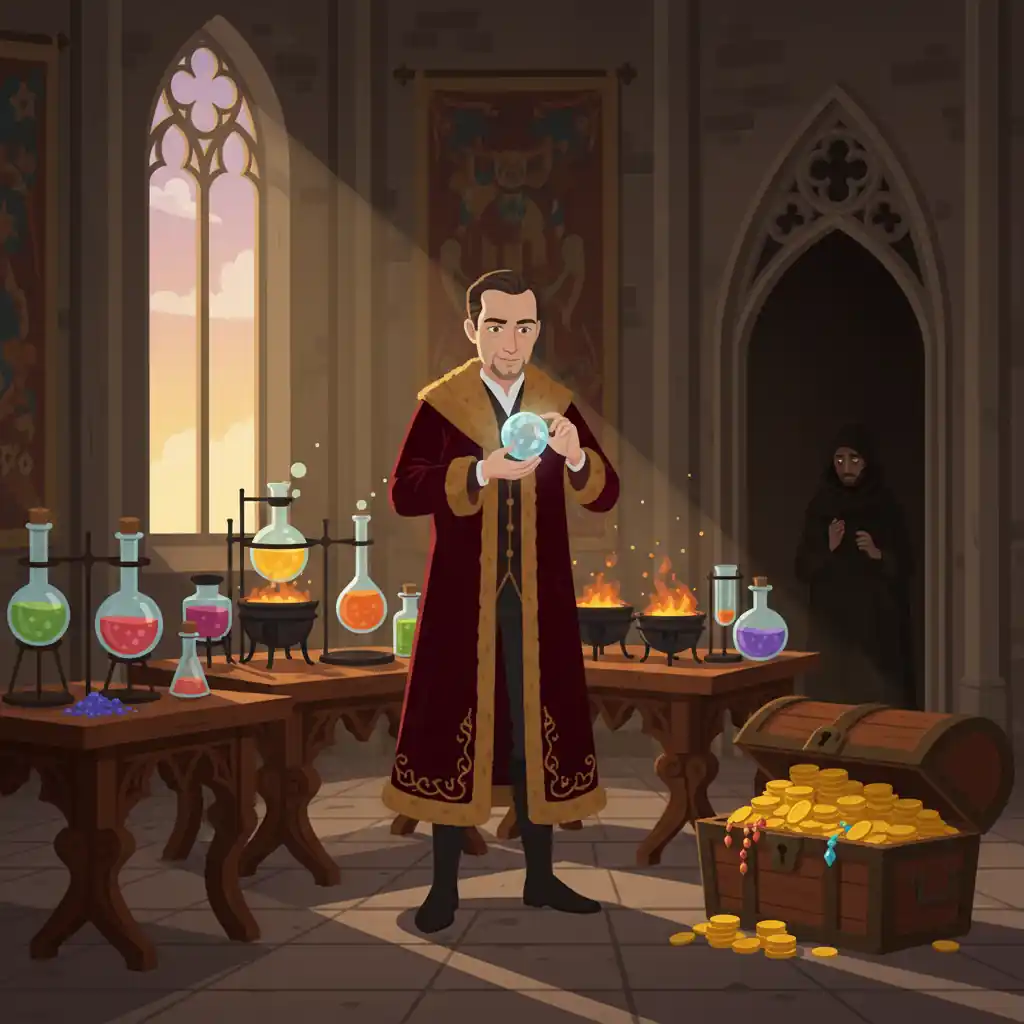
PROLOGUE: THE MARK OF THE CHARLATAN
The year is 1582. Elizabethan England, a tapestry woven with threads of fervent religious reform and burgeoning scientific discovery, also pulsated with a deep-seated belief in the supernatural. Astrologers advised queens, alchemists promised untold riches, and a new breed of mystic sought to converse directly with angels. Into this heady mix stepped a man who would become one of history’s most audacious and enigmatic figures: Edward Kelley.
Kelley was no nobleman, no university scholar. His past was murky, steeped in whispers of illicit activities and dark magic. Before he ever set foot in the hallowed halls of John Dee’s library, his name was already synonymous with infamy, particularly in the unforgiving streets of Lancaster. There, rumor had it, Kelley had faced the grim justice of the pillory, his ears cropped for forgery or coining offenses – a branding that would follow him like a shadow, a physical scar signifying a deeper moral one.
This was the man who, by some twist of fate or design, found himself knocking on the door of Dr. John Dee, the Queen's astrologer, mathematician, and magus. Dee was a true polymath, a man whose intellect spanned the known universe, yet whose greatest yearning was to pierce the veil between worlds. He sought not earthly power, but divine wisdom, a direct channel to God's angels, believing they held the keys to all knowledge: mathematics, medicine, even the Philosophers’ Stone.
Dee had spent years attempting to communicate with these celestial beings, but he lacked a crucial talent: the ability to 'scry' – to gaze into a crystal ball or mirror and discern the visions and messages sent by spirits. He had tried numerous scryers, all failures. What he needed was a pure conduit, an unblinking eye to the angelic realm. He found it in Edward Kelley, a man whose tarnished past seemed an unlikely credential for divine communion, yet whose singular, unsettling gift would bind their fates together, leading them on a perilous journey across Europe, chasing gold and god through the blackest arts.
Ear cropping, or 'pillorying,' was a common punishment for forgery, perjury, or sedition in Elizabethan England. While Kelley denied it, the persistent rumors suggest he wore a small cap or wore his hair long to conceal this tell-tale mark throughout his life. It was a permanent badge of his criminal past, yet he managed to charm his way into royal courts.
ACT I: THE ANGELIC DICTATIONS
John Dee was a titan of the Elizabethan intellect, a man of profound learning whose library at Mortlake was the largest in England, save for the Queen’s. He had advised explorers, coined the term 'British Empire,' and meticulously charted the heavens. Yet, for all his terrestrial accomplishments, his soul yearned for the celestial. He believed that humanity had lost the original divine knowledge bestowed upon Adam, and only direct communion with angels could restore it, unlocking the secrets of creation itself.
Dee’s quest for angelic knowledge was methodical. He possessed the perfect scrying objects: a large, flawless crystal globe and obsidian mirrors, gifts from foreign potentates. What he lacked was a reliable 'seer.' His previous attempts had yielded little more than static and frustration. Then came Kelley, presenting himself not as a scryer, but as a man of great occult knowledge, even claiming to have found a 'magical book' and a vial of alchemical powder near Glastonbury Abbey.
When Kelley was invited to try his hand at scrying, something remarkable—or remarkably manipulative—happened. He claimed to see figures, hear voices, and interpret symbols within Dee’s crystal. Dee, desperate for validation, was instantly convinced. For the next seven years, from 1582 to 1589, Kelley became Dee’s indispensable 'medium,' the human interface to the divine.
The bulk of Dee’s celebrated 'Enochian Magic' stems from these intensely strange sessions. Kelley, gazing into the crystal, would relay complex angelic messages, often delivered in a unique language that Dee meticulously recorded. This 'Enochian' language was a revelation to Dee – a structured, grammatical tongue, unlike anything he had encountered. It had its own alphabet, its own vocabulary, and its own syntax, supposedly the language spoken by God to Adam.
The content of these angelic dictations was vast and bewildering. They included intricate magical sigils, detailed instructions for constructing ritualistic tables and 'holy books,' prophecies of impending doom, moral exhortations, and even personal advice. Dee, a man of unwavering piety, believed every word, convinced that he was witnessing the dawn of a new, purified age through divine intervention. Kelley, however, remained a figure of ambiguity, his motives always shrouded. Was he genuinely blessed with a supernatural gift, or was he an ingenious con artist, improvising a complex fantasy on the fly, feeding a brilliant man's deepest desires?
The 'Enochian Tablets' dictated by the angels were incredibly complex. They consisted of grids of letters, which, when properly interpreted, were supposed to unlock profound magical secrets. Modern linguists have studied Enochian and found it possesses consistent grammatical structures, making it difficult to dismiss as mere gibberish. This sophistication has led some to speculate Kelley was a secret polyglot, or perhaps even genuinely channeling something beyond human understanding.
ACT II: THE MAGUS AND THE EMPEROR
England was growing weary of Dee’s esoteric pursuits. Queen Elizabeth I, while initially tolerant, harbored suspicions, and the public branded him a dangerous sorcerer. Furthermore, the angelic pronouncements dictated through Kelley began to suggest a divine mission abroad. The 'angels' commanded them to leave England and seek patronage elsewhere, to spread their sacred knowledge across a continent hungry for mystical revelation. This suited Kelley perfectly; an ocean away, his past indiscretions would be easier to conceal.
In 1583, Dee and Kelley, along with their families, packed their belongings and embarked on a grand, perilous journey across Europe. Their destination was the court of Emperor Rudolf II in Prague, the heart of the Holy Roman Empire, and a veritable magnet for mystics, alchemists, and eccentric intellectuals. Rudolf II was a singular monarch: deeply melancholic, largely uninterested in mundane politics, but obsessively devoted to the arts, sciences, and—most importantly—the occult.
Rudolf II maintained an elaborate 'Kunstkammer'—a cabinet of curiosities—filled with scientific instruments, rare artifacts, and every conceivable piece of alchemical apparatus. His greatest desire was to uncover the Philosophers' Stone, the legendary substance capable of transmuting base metals into gold and bestowing eternal life. He saw alchemy not as mere greed, but as a path to divine wisdom, a reflection of God’s own transformative power. Thus, Dee and Kelley, with their claims of angelic contact and alchemical secrets, were perfectly positioned to captivate the Emperor.
Initially, Dee presented their angelic work, hoping to impress Rudolf with divine prophecy. However, it was Kelley's more earthly claims that truly caught the Emperor's attention. Kelley began to perform demonstrations, producing small samples of gold from what he claimed were base metals, using the mysterious red powder he supposedly found at Glastonbury. These were not mere parlor tricks; the gold was demonstrably real, convincing both Rudolf and his pragmatic advisors.
With the promise of untold riches, Kelley’s star began to rise, eclipsing even Dee’s. Rudolf II showered Kelley with lavish gifts, lands, and titles. He was granted a substantial estate, afforded a noble lifestyle, and in 1590, was officially knighted as 'Sir Edward Kelley of Libeň.' The man who once had his ears cropped for forgery now stood as a knight of the Holy Roman Empire, a testament to his audacious confidence and the Emperor’s desperate belief in the power of gold.
Rudolf II's court in Prague was so renowned for its embrace of the esoteric that it became known as a 'magical capital.' In addition to Kelley and Dee, figures like Tycho Brahe (the astronomer) and Johannes Kepler (who served as Rudolf's imperial mathematician) also found patronage there, often blurring the lines between science and mysticism. Rudolf even consulted astrologers on matters of state, and his fascination with the occult was so intense that it bordered on abdication of his real-world duties.