
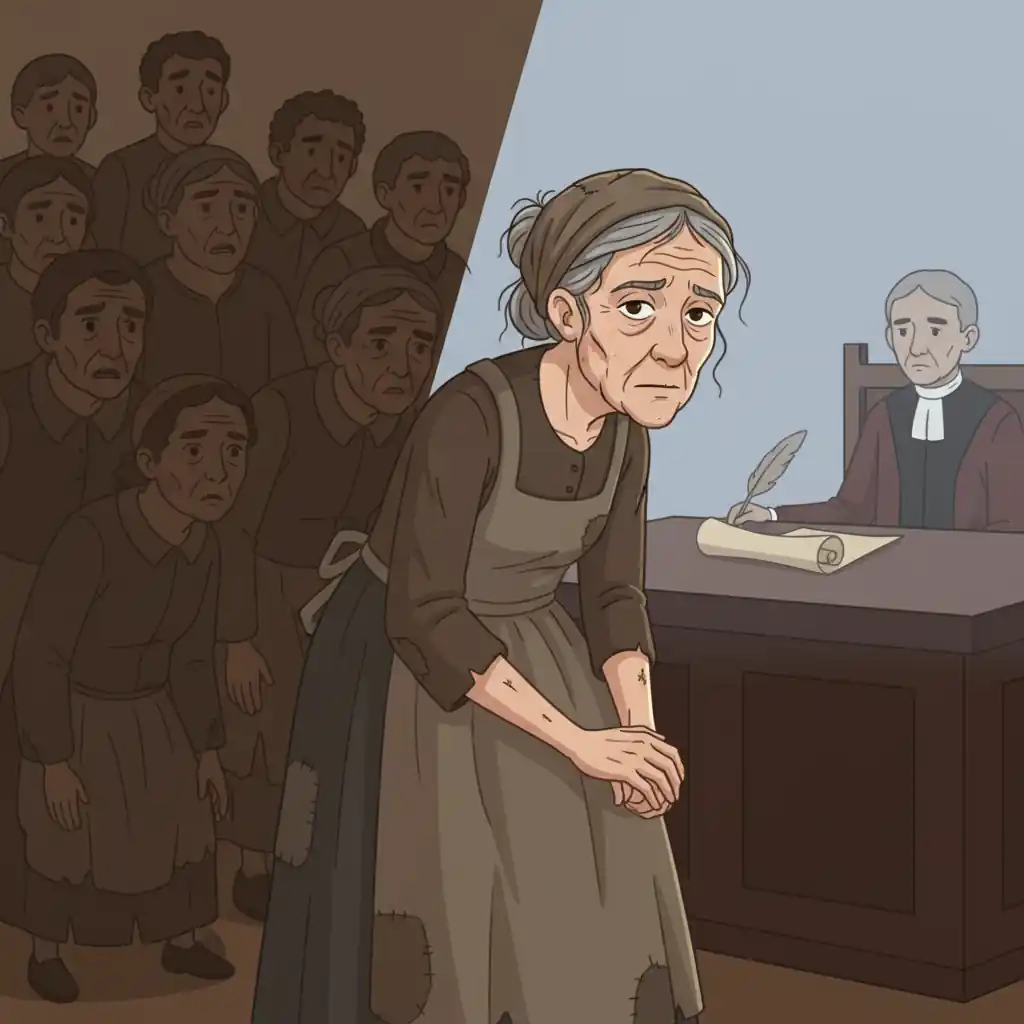
PROLOGUE: THE LAST FLICKER OF THE FLAME
The year is 1712. In the bustling coffee houses of London, Enlightenment ideals are taking root. Scientists like Isaac Newton have demystified the heavens, and philosophers champion reason over superstition. Yet, just a short distance away, in the isolated, muddy villages of rural England, another reality holds firm: the Devil still walks among us, and his disciples, the witches, are still a tangible, terrifying threat. This is the paradoxical stage upon which a poor, elderly widow named Jane Wenham would inadvertently play the starring role in a drama that would effectively close the curtain on England's centuries-long witch hunt.
Hers was not the most spectacular trial, nor the most brutal. By this late date, the bonfires had largely cooled, and the notorious 'Witchfinder General,' Matthew Hopkins, was long dead. But Jane Wenham’s case in Hertfordshire stands as a crucial historical pivot—the final, emphatic gasp of a dying era of legal persecution, and a stark illustration of how deeply entrenched fear and ignorance could remain, even as the world around them began to embrace a new age of reason. It was a trial that pitted local hysteria against a nascent judicial skepticism, and in doing so, offered a definitive judgment on the very notion of witchcraft itself.
She was poor. She was old. She was unpopular. And she was about to be branded the 'Last Witch of England' in a legal battle that would unravel the logic of an entire worldview. Her story is a testament not just to human cruelty, but to the slow, arduous march towards a more rational justice system.
ACT I: THE VILLAGE OF WALKERN AND THE WHISPERS OF MALICE
Walkern, Hertfordshire, was a typical English village of the early 18th century. Life was hard, harvests were fickle, and every misfortune, from a sick cow to a child’s fever, needed an explanation. Often, that explanation wasn't a microbe or a misstep, but malevolent forces at play. In this insular world, Jane Wenham was an easy target. A widow past her sixties, she was a pauper, living off parish charity, blunt in speech, and known for her occasional outbursts. Such a person, existing on the fringes of society, often became the convenient scapegoat for the inexplicable.
The spark that ignited the bonfire of accusations was utterly mundane: a dispute over a paltry bundle of straw. Jane Wenham, needing material for her pig, had approached Matthew Bragge, a local farmer and churchwarden, for some straw. Bragge's servant, Ann Thorne, denied her the request, leading to a heated exchange where Wenham reportedly muttered some angry words. A common quarrel, easily forgotten in a modern village, but in Walkern, 1712, it set the stage for terror.
Shortly after this squabble, Ann Thorne began to experience strange and violent fits. She screamed, barked like a dog, and suffered severe convulsions. She claimed she saw Wenham’s specter, sometimes as a cat, sometimes as a headless woman. When local remedies and 'doctors' proved useless, the villagers, including Matthew Bragge and his brother, Reverend Francis Bragge, quickly concluded the obvious: Ann Thorne was bewitched, and Jane Wenham was the culprit. The Reverend Bragge, far from being a voice of reason, was a fervent believer in witchcraft, further validating the villagers' growing panic. In Walkern, a simple insult had become a curse, and a poor woman's temper, the sign of a pact with the Devil.
It’s a chilling reminder that many historical witch hunts began not with elaborate rituals or dark covens, but with everyday grievances, property disputes, and the potent brew of poverty, illiteracy, and fear, all stirred by the slightest suggestion of the supernatural.
ACT II: THE PARADE OF 'POSSESSED' AND THE PIN PRICKS
Ann Thorne's bizarre affliction was just the beginning. The paranoia, once unleashed, spread like wildfire. Soon, other women in Walkern began to exhibit similar, dramatic symptoms. Anne Streete claimed she was unable to say her prayers, Mary Hale suffered fits and claimed a witch tried to drown her, and even Rebecca Bragge, Matthew Bragge's daughter, began to convulse, allegedly vomiting pins and feathers—classic 'evidence' of bewitchment.
The collective hysteria was amplified by the 'evidence' presented against Wenham. Villagers claimed to have seen her transform into a cat or a dog. More disturbing were the physical examinations: Wenham was stripped and searched for 'witch's marks'—supposed insensitive spots on the body where a witch’s familiar (an imp or demon) would suckle. Finding such a mark was considered undeniable proof. Though no definitive mark was found, the very act of this humiliating public examination underscores the barbarity of the beliefs.
A common 'test' for witches was to stick pins into their body; if they showed no pain or bled little, it was taken as confirmation of their unholy nature. Wenham was subjected to this and other cruel rituals designed to elicit a confession or 'proof.' The local constable, John Chapman, a man seemingly eager to believe every fantastical claim, spearheaded her arrest, even bringing a local 'witch expert' from a neighboring town, one Daniel Foot, to perform further examinations. Foot, predictably, declared Wenham to be 'a perfectly made witch.' With the local authority figure and a 'professional' validating their fears, Walkern’s conviction of Wenham’s guilt solidified, and she was committed to Hertford Gaol, ready to face the full force of the law.
It’s a grim tableau: a community gripped by fear, turning on its weakest member, fueled by anecdotal 'evidence' and a desperate need to explain the unexplainable. The stage was set for a trial that would either cement these ancient fears or finally expose their absurdity.
ACT III: THE HERTS ASSIZES: SUPERSTITION MEETS SKEPTICISM
The trial of Jane Wenham was held at the Hertford Assizes on March 4, 1712. On one side stood the prosecution, spearheaded by the credulous Reverend Bragge, presenting a parade of villagers who swore under oath to Wenham’s malevolent acts. They recounted Ann Thorne’s fits, the mysterious pins and feathers vomited by Rebecca Bragge, the strange transformations of Wenham into a cat, and even claims that her specter had pulled people from their beds.
The defense for Wenham was meager, often just her own bewildered pleas of innocence. How could one refute claims of ghostly apparitions or invisible torments? But presiding over this theater of superstition was Judge Sir John Powell, a man whose legal mind operated on a different plane than the fearful villagers. Powell was a judge of the Queen’s Bench, a product of a legal system increasingly influenced by nascent Enlightenment thought. Unlike many of his predecessors who had readily condemned accused witches, Powell was deeply skeptical of the 'evidence' presented.