
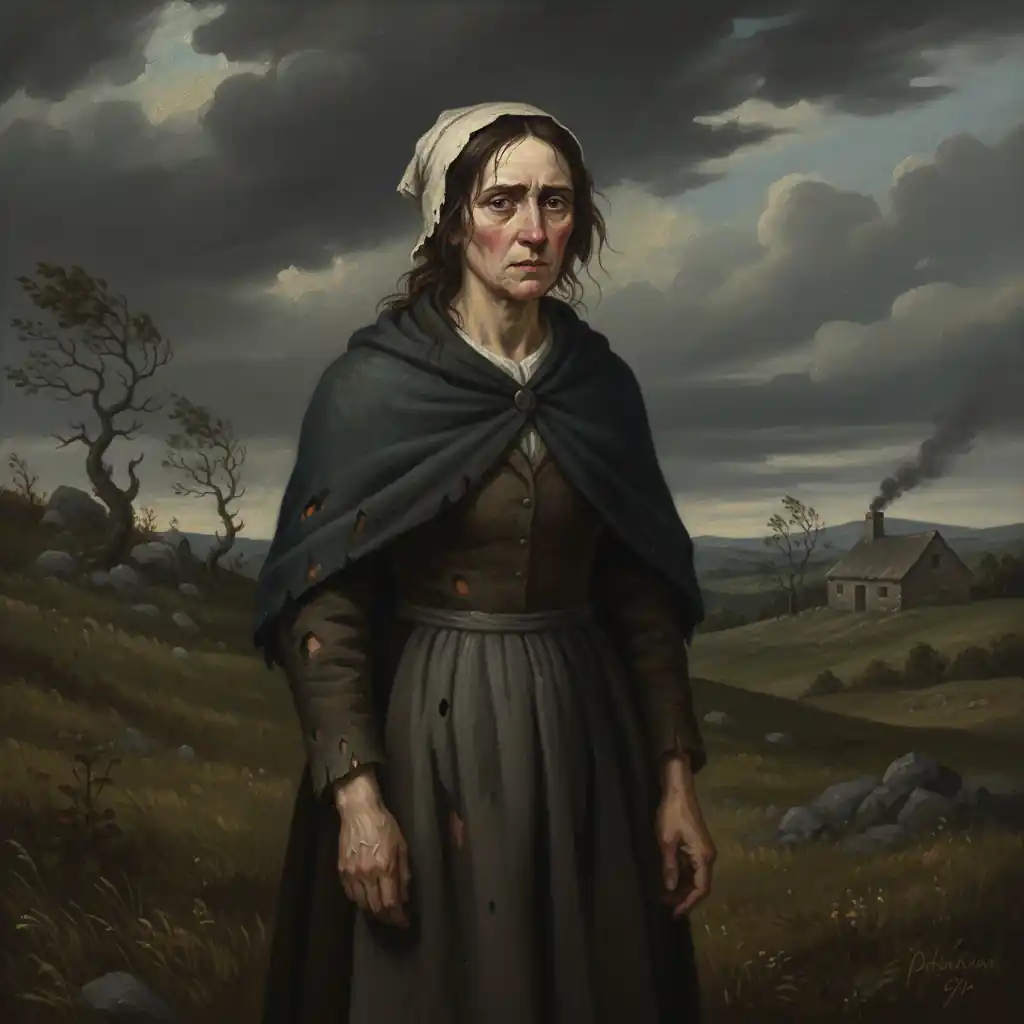
PROLOGUE: THE LOOMING SHADOW OF PENDLE HILL
The year is 1612. In the remote, desolate reaches of Lancashire, England, an unspoken terror grips the hearts of a superstitious populace. Here, beneath the brooding mass of Pendle Hill, poverty was rife, and life was a brutal, daily struggle against the elements and an indifferent world. It was a place where folklore clung to the landscape like the morning mist, where ancient beliefs in cunning folk, curses, and malevolent spirits intertwined with a fervent, newly Protestant Christianity.
This was not a gentle land. The people of Pendle Forest were known for their rugged independence, their clannish loyalty, and a deep-seated distrust of outsiders and formal authority. Without a strong parish church structure, traditional healers, charm-makers, and curse-layers – often women – filled the void, becoming vital, if sometimes feared, figures in their communities. These were the 'cunning folk,' sometimes called 'white witches,' whose practices blurred the lines between healing and hexing.
But the year 1612 brought a new, far deadlier fear: the fear of the diabolical witch. King James I, a man obsessed with witchcraft, had recently published his treatise, Daemonologie, a terrifying guide on how to identify and prosecute those in league with the Devil. His influence trickled down, turning local anxieties into a national obsession, transforming village squabbles into accusations of satanic pacts.
Into this crucible of fear, faith, and destitution steps Elizabeth Device, a woman whose life had been one long, hard scrabble. She was a mother, a daughter, a grandmother, part of a sprawling family known locally as the Demdikes. They lived on the fringes, eking out a living through begging, petty thievery, and practicing forms of folk magic. They were poor, often despised, and already suspected of maleficium—harmful witchcraft.
What followed in the summer of 1612 was not just a series of trials, but a descent into madness fueled by a potent cocktail of fear, poverty, and shocking familial betrayal. The Pendle Witch Trials, with Elizabeth Device at their dark heart, would become one of the most infamous and brutal witch hunts in English history, leaving an indelible stain on the landscape and the collective memory of a nation.
ACT I: THE MATRIARCHS AND THEIR BROODS
The story of Pendle is intrinsically linked to two rival families: the Demdikes and the Chattoxes. They were two ancient houses, both poor, both practicing the 'cunning' trade, and both nursing long-standing grudges that simmered beneath the surface of village life. They lived in abject poverty, often resorting to begging, and were easy targets for local suspicion when misfortune struck.
At the head of the Demdike clan was Old Demdike (born Elizabeth Southerns), Elizabeth Device’s mother. She was a fearsome figure, nearly eighty years old, blind, and bent with age, but with a reputation that preceded her. For fifty years, she had been a known cunning woman, dispensing charms and curses in equal measure. She was the quintessential image of a witch: old, withered, and rumored to have a 'familiar spirit' named Tibb, a shapeless imp that sucked her blood. Her very presence evoked dread.
Her nemesis was Old Chattox (Anne Whittle), the matriarch of the rival family. She was similarly old and infamous, her family also implicated in sorcery. The feud between the Demdikes and Chattoxes was legendary, a tapestry of petty thefts, stolen butter, and muttered curses that had festered for generations. They were two warring tribes, united only by their shared reputation as dangerous folk.
Elizabeth Device, often called 'Squinting Lizzie' due to a deformity of one eye, was Old Demdike’s daughter. She was a widow with four children: James, Alizon, Jennet, and a younger unnamed child. The Device family lived in a wretched hovel, a stark testament to their poverty. Elizabeth herself was depicted as physically unappealing and prone to fits of temper. Like her mother, she practiced folk magic, but her reputation was perhaps more brazen. She was known to be loud, aggressive, and often involved in local disputes, making her a prime candidate for accusations.
Fun Fact: The nickname 'Squinting Lizzie' not only described Elizabeth Device's physical appearance but also played into the prevailing superstitions. A 'squint' or a 'gleyde eye' was often interpreted as a mark of evil or a sign that one could cast an 'evil eye,' a powerful curse believed to be able to inflict illness, bad luck, or even death with just a glance.
Within this dysfunctional Demdike household, her children were raised amidst the tales of charms and curses, privy to their grandmother’s and mother’s 'arts.' This would prove to be their undoing, particularly for the youngest, nine-year-old Jennet, whose intimate knowledge of her family's rituals would become the most damning evidence of all.
ACT II: THE SPARK — JOHN HALE'S AFFLICTION AND THE WHIRLWIND BEGINS
The fuse of the Pendle trials was lit by a seemingly trivial encounter on a cold March day in 1612. Elizabeth Device’s daughter, Alizon Device, a young woman in her twenties, was out begging on the road near Colne. She approached a pedlar named John Hale, asking him to buy some pins. Hale refused, probably roughly, a common response to beggars in that harsh era.
What happened next would ignite a firestorm. As Hale walked away, Alizon reportedly cursed him. Moments later, Hale collapsed, suffering a paralytic stroke that left him unable to speak or move one side of his body. To the villagers, it was undeniable: he had been bewitched. Alizon, terrified, later confessed to her grandmother, Old Demdike, that she had indeed cursed him, and that her familiar, a dog-like creature, had appeared and offered to help her. This 'confession' was not a legal admission but a desperate, superstitious explanation for an old man's stroke.
Word of Hale’s affliction and Alizon’s alleged curse quickly reached the ears of Roger Nowell, a local Justice of the Peace. Nowell was an ambitious man, eager to prove his diligence to the Crown, particularly given King James's personal interest in stamping out witchcraft. He ordered Alizon's arrest, a standard procedure for a suspected witch. But Nowell didn't stop there. He launched a full-scale investigation, summoning the entire Device family to his home, Malkin Tower, for interrogation.
At Malkin Tower, the pressure was immense. Nowell subjected the family to intense questioning, playing on their fears and animosities. It was here, in this initial round of interrogations, that the first seeds of family betrayal were sown. Under duress, and perhaps fearing for her own life, Alizon implicated her own grandmother, Old Demdike, and the rival matriarch, Old Chattox, as witches. She claimed her grandmother had taught her magic and that Old Chattox had a familiar spirit named Fancie, a spirit that had reportedly caused the death of John Nutter’s cows.
The most significant development was the arrest and interrogation of James Device, Elizabeth’s son, and Alizon’s brother. James, a troubled young man, initially resisted but eventually broke, providing gruesome and detailed testimony. He claimed he had seen his grandmother and mother communing with the Devil, describing familiars in vivid detail, and recounting acts of maleficium—including his mother's supposed involvement in the deaths of various villagers through witchcraft. He further implicated a family gathering at Malkin Tower on Good Friday, where, he claimed, a feast of stolen mutton was shared among a coven of witches who plotted further mischief.
The floodgates had opened. What began as a single accusation against Alizon Device quickly spiraled into a mass hunt. Roger Nowell now had enough 'evidence' to arrest not just Old Demdike, Old Chattox, and Alizon Device, but also Elizabeth Device, James Device, and a host of other individuals implicated by their frantic confessions and accusations. The very structure of the family unit, under the relentless pressure of suspicion and interrogation, began to unravel, setting the stage for the most chilling betrayal of all.