
PROLOGUE: THE ULTIMATE ESCAPE ARTIST'S FINAL ACT
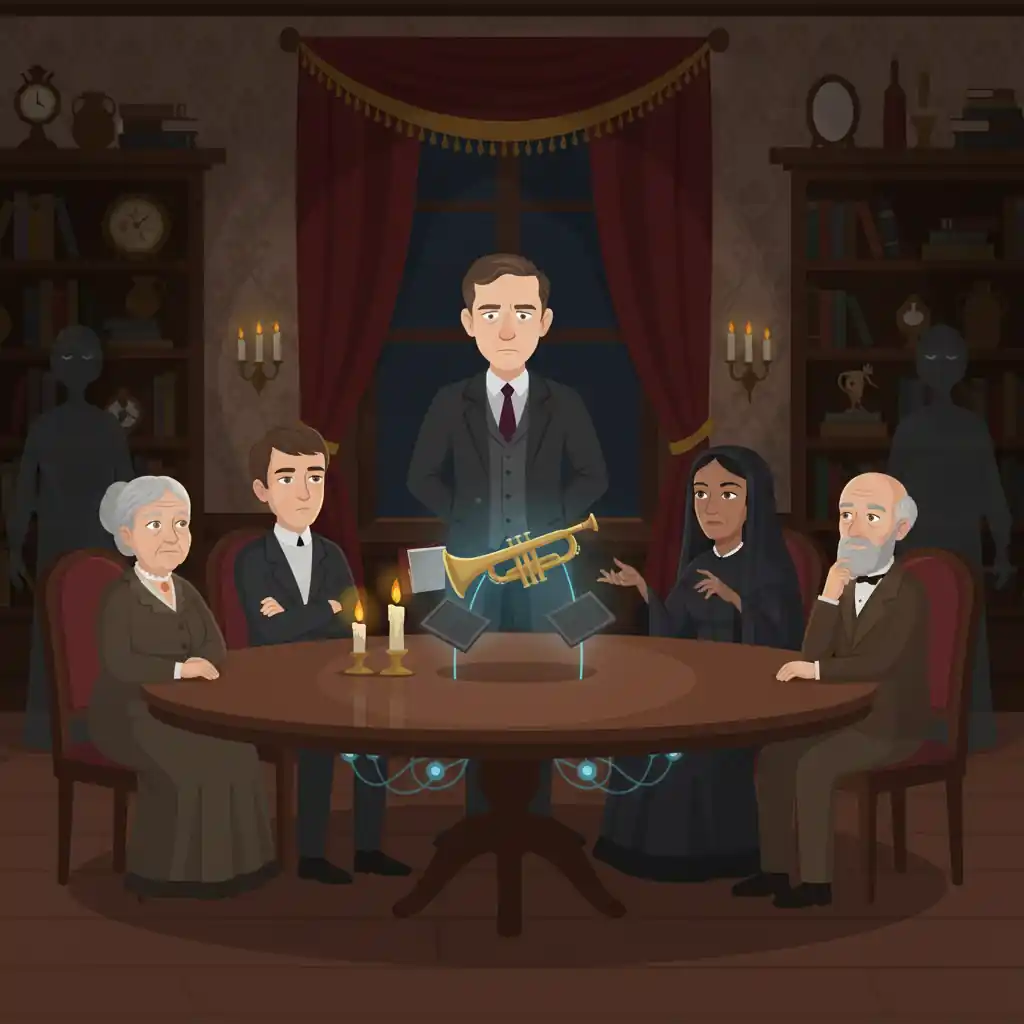
The year is 1926. In the hushed, velvet-draped confines of a darkened séance room, a woman with a theatrical air claims to channel the spirits of the departed. A trumpet floats, a bell rings, and disembodied voices whisper from the ether. The sitters, grief-stricken and desperate for a sign, are mesmerized.
But one man at the table is not fooled. His eyes, usually alight with a showman's sparkle, are now cold, dissecting every shadow, every subtle movement. This is Harry Houdini, the world-famous escape artist, master illusionist, and self-proclaimed 'Ghost Hunter.' He isn't here to commune with the dead; he's here to expose the living who prey on the vulnerable.
For the last decade of his life, the man who defied death in chains and submerged coffins had found a new, deeply personal crusade: battling the booming industry of fraudulent spiritualism. He knew their tricks because he invented better ones. And he vowed to use his unparalleled knowledge of deception to tear down the veil of the pseudo-séance, one charlatan at a time.
This wasn't just a performance for Houdini; it was a mission born from a broken heart, a betrayal of trust, and a fierce dedication to truth. The master of illusion would become the nemesis of delusion, the ultimate skeptic in a world yearning for ghosts.
ACT I: THE SON, THE MOTHER, AND THE CRACK IN THE VEIL
Born Erik Weisz in Budapest, Hungary, in 1874, the man who would become Harry Houdini was a prodigy of prestidigitation and a phenomenon of physical endurance. But beneath the bravado of the stage magician lay a deeply sentimental soul, bound by an almost obsessive love for his mother, Cecilia.
Cecilia Weiss (the family name was Americanized) was the anchor of Houdini’s universe. He showered her with gifts, wrote to her daily when on tour, and even threw a lavish 72nd birthday party for her in New York, attended by prominent figures. When she fell ill, he dropped everything, canceling shows at the height of his career to be by her side.
Her death on July 17, 1913, shattered him. It was a grief so profound, so disorienting, that it opened a crack in even his logical, illusionist's mind. For a time, the ultimate skeptic became a seeker. He desperately wanted to believe that her spirit lingered, that he could communicate with her one last time.
He began attending séances, quietly, hopefully. He consulted famed mediums and obscure psychics. He yearned for a sign, a message, any scrap of evidence that his beloved mother was still connected to him from beyond the grave. He was, in essence, the perfect client: grieving, famous, and willing to pay for solace.
Houdini carried a framed photograph of his mother with him everywhere he went. He would often speak to it, especially before a daring escape, as if seeking her blessing or courage. His emotional dependency on her was a poorly kept secret among his inner circle.
But the messages never came. Or rather, they came, but they were always wrong. The 'spirit' of his mother, who spoke only Yiddish and Hungarian in life, would often 'speak' perfect English. She would reveal facts that were publicly known, or simply utter platitudes. The specific, intimate details he yearned for were conspicuously absent. Each failed séance chipped away at his hope, replacing it with a growing suspicion.
ACT II: THE ILLUSIONIST TURNS INVESTIGATOR
Houdini's unique genius wasn't just in escaping chains; it was in understanding how the human mind could be deceived. He was a master of misdirection, a savant of suggestion. As he attended more séances, he began to see through the fog of grief and hope to the mechanics of the deception.
He recognized familiar theatrical techniques: the clever use of darkness, hidden compartments, confederates, trapdoors, and simple sleight of hand. The 'spirits' manifesting in the séance room weren't supernatural; they were simply bad magicians. And Houdini, the best magician in the world, was uniquely positioned to expose them.
His initial sadness turned to a simmering anger. He saw not just hoaxes, but a cruel exploitation of human vulnerability. Mediums were preying on the deepest pain of others, offering false comfort for real money. This was not harmless entertainment; it was emotional larceny.
By the mid-1920s, Houdini had fully committed to his new role as a 'spiritualism investigator.' He published books and articles, gave lectures, and offered public demonstrations revealing how common séance tricks were performed. He challenged mediums to produce genuine phenomena under controlled conditions, often offering substantial sums for anyone who could prove their claims.
Houdini was so dedicated that he would sometimes disguise himself, grow a beard, or adopt an accent to attend séances incognito, ensuring the medium wouldn't recognize him and adjust their performance. He was the ultimate 'undercover boss' of the paranormal.
He even collaborated with Scientific American magazine, which in 1922 offered a $2,500 prize (a considerable sum then, equivalent to over $45,000 today) to any medium who could demonstrate genuine psychic abilities under strict scientific supervision. Houdini was part of their investigative committee, and his expertise proved invaluable. No medium ever claimed the prize.
The message from the ultimate illusionist was clear: if he, a human being, could replicate a 'supernatural' effect through mundane means, then the burden of proof was on the medium to demonstrate otherwise. And they consistently failed.
ACT III: THE GHOST HUNTER’S ARSENAL
Houdini approached spiritualism like an intricate puzzle, and he had all the pieces. His understanding of human psychology, misdirection, and mechanical trickery gave him an unparalleled advantage over the mediums he investigated. He developed a formidable arsenal of techniques to expose their frauds.
He would arrive at a séance unannounced or disguised, often demanding that the medium be searched and restrained. He sometimes carried hidden equipment – a small flashlight, a concealed camera, even a custom-made pencil that would mark the medium's position in the dark without them knowing. His methods were meticulous, born of years perfecting his own deceptions.
Houdini categorized the common tricks of the séance room, dissecting them for his audiences and readers:
- The Floating Trumpet/Levitating Objects: Often achieved by a confederate, or by the medium using a telescopic rod hidden under their clothing or a toe-loop attached to a thread.
- Slate Writing: Messages appearing on slates were usually written beforehand with invisible ink or a tiny piece of chalk attached to the medium's finger or toe, quickly applied in the dark.