
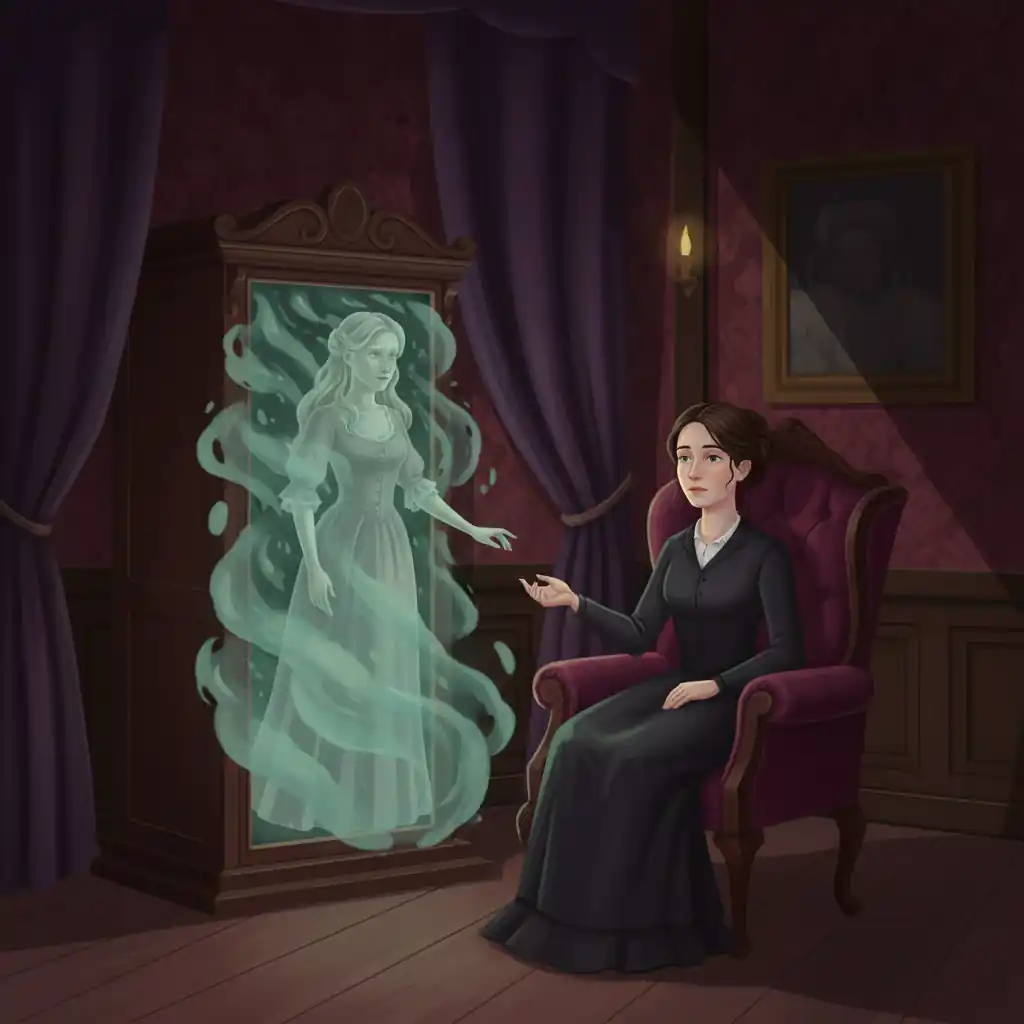
PROLOGUE: THE VEIL BETWEEN WORLDS
Victorian England, a crucible of industrial revolution and scientific enlightenment, paradoxically harbored a fervent obsession with the unseen. The roaring steam engines and grand scientific discoveries coexisted with a society gripped by spiritual anxiety. Death, rampant and often sudden, left a gaping void in countless homes, a void that science couldn't fill. Enter Spiritualism, a burgeoning movement promising direct communication with the departed. Its promise was seductive: your loved ones weren't gone, merely on the 'other side,' and certain gifted individuals—mediums—could bridge the chasm.
In this fertile ground of grief, hope, and credulity, a quiet phenomenon was taking root. From the bustling, gas-lit streets of London, whispers began to circulate about a remarkable young woman. She wasn't an exotic prophetess or a theatrical performer, but a seemingly ordinary, working-class girl from Hackney. Her name was Florence Eliza Cook, and she was about to become the epicenter of one of the most astonishing and controversial chapters in the history of spiritualism.
Barely into her teens when her abilities first manifested, Florence possessed an innocence that disarmed skeptics and captivated believers. While many mediums produced mere raps, table-tilts, or vague messages, Florence was said to conjure something far more audacious, something that defied all rational explanation: full-body materialization. A solid, breathing, talking spirit, visible to all, emerging from the ethereal mist of the séance room. Her gift, or her elaborate deception, would challenge the very foundations of scientific thought and human perception, casting a long, spectral shadow over the intellectual giants of the age.
ACT I: THE MARVEL OF MILLER'S TERRACE
Florence Cook’s journey into the world of spiritualism began almost accidentally. Born in 1856, she was just a schoolgirl when strange phenomena started occurring around her. Objects moved, disembodied voices spoke, and inexplicable raps echoed through her family home in Miller's Terrace, Hackney. These early manifestations were not unique; many aspiring mediums exhibited similar phenomena. What set Florence apart was the intensity and rapid progression of her abilities. By the age of fifteen, she was regularly holding séances, attracting local attention, and refining her craft, whatever its true nature might be.
The core of Florence's mediumship revolved around the "materialization cabinet." This was typically a small, curtained enclosure where the medium would sit in a trance. The theory was that the medium's energy, or "ectoplasm," was somehow used by spirits to form temporary physical bodies. Most materialization mediums produced only partial forms—a disembodied hand, a face in the gloom. But Florence claimed to manifest a complete, autonomous spirit entity.
This spirit introduced herself as "Katie King," a boisterous, often playful entity who claimed to be the daughter of the infamous buccaneer, Sir Henry Morgan. Katie was no demure ghost. She would walk among the sitters, engage in conversation, even allow herself to be touched, offering handshakes that felt solid and real. Spectators described her as possessing a distinct personality, a lively sense of humor, and a physical form strikingly beautiful yet ethereal. Crucially, Katie was said to appear outside the cabinet, often while Florence, in a deep trance, remained supposedly visible inside the cabinet, still bound or observed. This was the audacious claim that truly set Florence Cook apart and drew the attention of a society hungry for miracles. The idea of two distinct, living bodies existing simultaneously was a monumental challenge to logic and science.
ACT II: THE SCIENTIST AND THE SPIRIT
The sheer audacity of "Katie King's" materializations eventually reached the ears of one of Victorian England's most respected scientists: Sir William Crookes. A Fellow of the Royal Society, a brilliant chemist, and the discoverer of thallium, Crookes was no credulous spiritualist. He was a pioneer in vacuum tubes, radiant matter, and the Crookes radiometer. His interest in spiritualism, particularly the physical phenomena of séances, stemmed from a genuine scientific curiosity and a desire to apply rigorous empirical methods to claims of the supernatural. He believed that if such phenomena were real, they deserved scientific investigation, not outright dismissal.
Crookes began his extensive investigation of Florence Cook in 1872. He installed her in his own London home, setting up a laboratory for séances under conditions he believed to be watertight. He employed various controls: placing phosphorescent paint on Florence's hands, monitoring her pulse, using electrical contacts to ensure she remained in the cabinet. He even used photographic plates, attempting to capture the spirit form. This was cutting-edge technology for the time, and Crookes believed his methods were beyond reproach.
Over several months, Crookes conducted numerous séances with Florence. His reports detailed astonishing observations: Katie King emerging from the cabinet while Florence was seemingly visible within; Katie changing height and appearance; Katie speaking to sitters, sometimes even holding objects. In a particularly famous account, Crookes described witnessing both Florence and Katie simultaneously. He claimed to have seen Katie standing outside the cabinet while Florence, clad in velvet, lay unconscious inside. He even reported touching Katie, verifying her pulse and physical presence.
In 1874, Crookes published his findings, declaring Florence Cook's materializations to be genuine. His conclusion, coming from such a distinguished scientific figure, sent shockwaves through both the scientific and spiritualist communities. For believers, it was irrefutable proof; for skeptics, it was an intellectual capitulation of the highest order. Crookes's reputation lent immense credibility to Florence, transforming her from a simple medium into a scientific marvel, even as it tarnished his own standing in the eyes of many peers. His experiments, however, were conducted with a degree of trust in Florence, and a lack of the total isolation and body searches that later became standard for investigating mediums.
ACT III: SHADOWS AND SUSPICION
Despite Sir William Crookes's scientific endorsement, skepticism around Florence Cook and Katie King never truly abated. The Victorian era was rife with mediums, and many were demonstrably fraudulent, often using simple stage magic or confederates to produce their effects. This climate of deception inevitably cast a long shadow over even the most celebrated mediums.