
PROLOGUE: THE STORMS OF FEAR
The year is 1590. A formidable storm rages across the North Sea, battering the royal fleet. On board, King James VI of Scotland, a man simultaneously fascinated and terrified by the occult, shivers not just from the cold, but from a burgeoning conviction: this is no mere act of nature. This is a targeted assault, an act of 'maleficium' by dark forces, aimed squarely at his life and the legitimacy of his reign. He would later write, in his treatise Daemonologie, that 'the compasse of the sea... being naturally but of a narrow bound in our country... can be no wayes stirred up, but by the permission of God, to punish the sinnes of the people, or by the power of the divell, as God shall arme him.'
James VI was an anomaly among monarchs: an intellectual obsessed with theological debate, a nascent authoritarian convinced of his divine right, and a man whose personal insecurities metastasized into an unshakeable belief in the active conspiracy of witches against him. He saw threats everywhere – from rebellious nobles to the very elements themselves. The 'Great Storm' that threatened his return from Denmark, where he had collected his bride, Anne, was the spark that ignited one of the most brutal and bizarre chapters in Scotland's history: The North Berwick Witch Trials.
It was a period when the lines between folk medicine and dark magic were blurred, when a 'wise woman's' healing touch could, in a heartbeat, be reinterpreted as a pact with the Devil. Fear was the currency, and King James VI, with his intellectual vanity and deeply ingrained paranoia, was both its biggest consumer and its most zealous distributor. His quest to unmask the authors of his misfortune would soon ensnare dozens, including a respected elderly midwife named Agnes Sampson, dragging her into a maelstrom of torture, confession, and unspeakable cruelty.
ACT I: THE MIDWIFE AND THE KING'S OBSESSION
Agnes Sampson was a woman of substance in the small Scottish burgh of Nether Keith. An older woman, described by contemporary chroniclers as 'a grave matron,' she was a renowned midwife, a skilled healer, and a 'wise woman'—a crucial figure in a society lacking formal medical care. For generations, such women were the backbone of rural communities, relied upon for everything from delivering babies and mending bones to concocting herbal remedies and offering advice on matters of love or luck. Their knowledge was passed down through oral tradition, a blend of practical experience, superstition, and ancient lore. They understood the power of herbs, the rhythms of nature, and the psychological needs of their neighbours. This very power, however, made them dangerous in the eyes of an increasingly zealous state and a fear-stricken monarch.
King James VI, in stark contrast, was a man of the books, not of the earth. His education had imbued him with a rigid Calvinist worldview, wherein God's absolute sovereignty was mirrored by the King's absolute authority. Any challenge to his person, be it political dissent or an ill wind, could only be understood as a direct assault on the divine order. His journey to Denmark to fetch his bride, Anne, was marred by a series of violently turbulent voyages. The initial trip was so severe that Anne’s ship was forced to return to port. James, impatient, then sailed to Denmark himself, only to face more harrowing storms on the return journey with his new Queen. For James, these repeated meteorological calamities could not be random. They were, he concluded, the work of 'devillish, ungodlie creatures,' specifically employed to prevent his righteous, divinely ordained marriage and, by extension, to destabilise his kingdom.
His Daemonologie, published in 1597, was not merely a scholarly work; it was a personal manifesto born of this experience. In it, he meticulously detailed his belief in the literal existence and malevolent activities of witches, describing how they formed pacts with the Devil, held 'conventicles,' and, crucially, had the power to raise storms at sea to sink ships. The King’s treatise, a chilling blend of theology, demonology, and personal anecdote, would become a chillingly influential text, justifying the most extreme measures against suspected witches throughout Scotland and, later, England when he ascended to the English throne as James I. The stage was set for a royal witch hunt, and a respected midwife was about to become its most famous victim.
ACT II: THE WHISPERS OF CONSPIRACY
The inferno of the North Berwick trials was not ignited by Agnes Sampson directly, but by a seemingly innocuous servant girl named Geillis Duncan. She worked for David Seton, the Laird of Tranent, who grew suspicious of her sudden ability to heal the sick and her unexplained nocturnal absences. Her employer reportedly tortured her with a pair of pincers until she confessed to witchcraft. Under duress, Geillis began to name names, a terrifying cascade of accusations that implicated dozens of innocent people across the Lothian region.
Geillis Duncan’s confession included the astonishing detail that she, along with others, had met with the Devil. She claimed to have been part of a vast coven plotting against the King. Her story, though almost certainly extracted under extreme duress, was compelling enough for the authorities. It provided the first real 'evidence' of the coordinated, malevolent conspiracy James VI so vehemently believed in. The details of her 'confession' were quickly amplified by others similarly broken by interrogation. She even played a 'merry dance' on a Jew's harp, which she claimed to have done at a witches' sabbath in the company of the Devil.
It was through this chain reaction of forced testimony that Agnes Sampson’s name surfaced. Perhaps she had offended a neighbour, or perhaps her reputation as a 'wise woman' simply made her an easy target for frightened, tortured individuals desperate to appease their tormentors. Being a midwife and a healer, Agnes possessed knowledge and influence that could easily be twisted into evidence of dark dealings. Her ability to ease pain or predict the outcome of a birth, once seen as a gift, now became proof of an unholy pact.
The accusations against Agnes Sampson were grave and detailed: she was said to have used enchantments to cause the turbulent storms that plagued the King's ships. She was accused of consulting with the Devil, of creating wax effigies of the King to bring about his death, and of participating in grand, blasphemous sabbats at the North Berwick Kirk, where the witches allegedly plotted the demise of the monarch. The very idea of the Devil and his earthly agents directly assaulting the King—God's chosen representative—was an affront to James VI's deeply held convictions. This was not just a crime; it was an act of cosmic treason, validating every fear that had gripped him since his harrowing sea voyages.
ACT III: THE ART OF EXTRACTION (TORTURE)
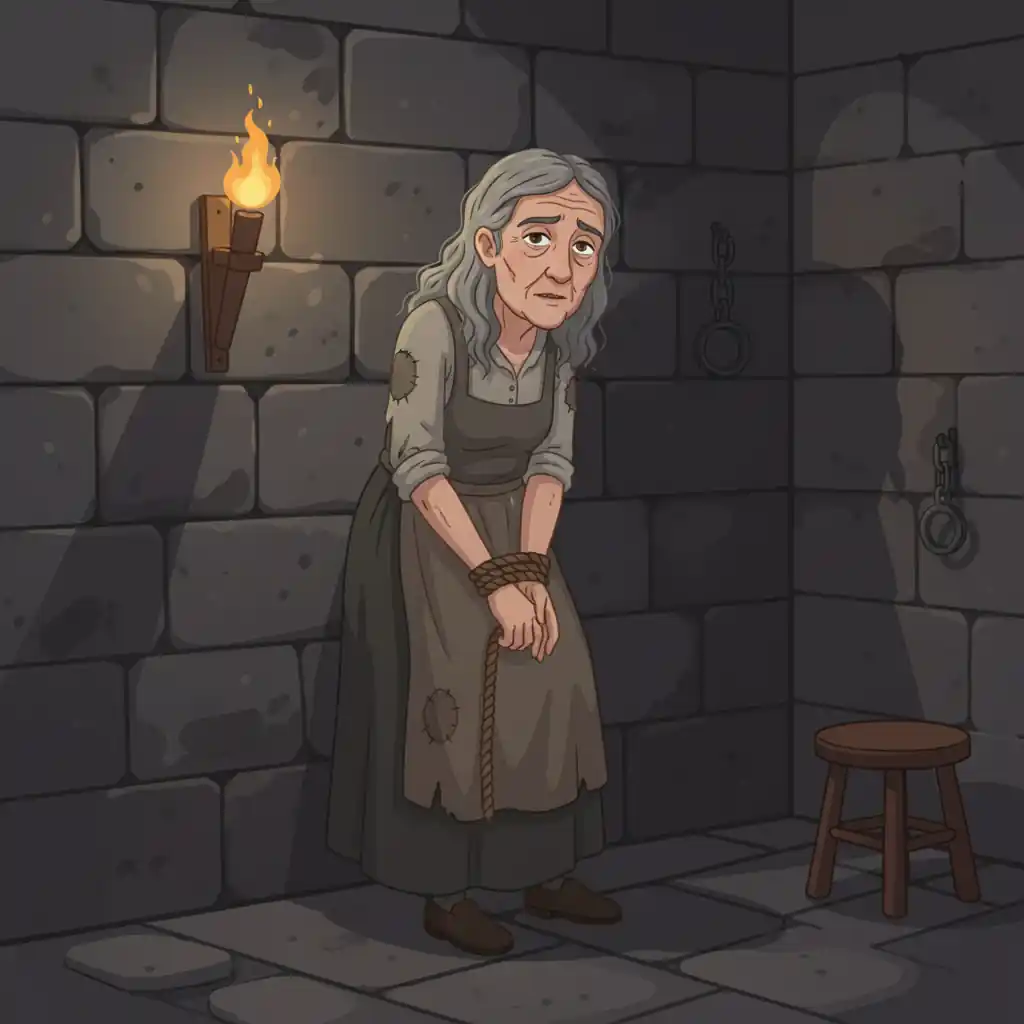
Agnes Sampson’s arrest marked the beginning of her descent into a hellish ordeal. Initially, she vehemently denied all accusations, clinging to her innocence. But in 16th-century Scotland, particularly when the King himself was convinced of your guilt, innocence was a luxury few could afford. The methods employed to extract confessions were not subtle; they were designed to break the body and shatter the mind, leaving no room for defiance. Agnes was subjected to the full repertoire of 'judicial' torture sanctioned by the era.
One of the most infamous instruments used was the Witch's Bridle (or 'scold's bridle'). This was an iron muzzle with four sharp spikes that were forced into the mouth, two pressing against the tongue, and two against the palate. It was secured around the head, making speech agonizingly painful and preventing any intake of food or drink. This alone was enough to induce immense suffering, but it was often combined with other torments, such as sleep deprivation. Agnes was kept awake for days on end, constantly interrogated, her mind slowly unraveling under the relentless assault of sleeplessness and pain. Guards would prod her, force her to stand, and deny her even a moment of respite, until her will was completely eroded.
In a further act of degradation, her entire body, including her private parts, was shaved clean. This was done to find the fabled 'Devil’s Mark' – a supposed insensitive spot on the body where the Devil had touched his supplicant, making the flesh impervious to pain. The search for this mark was conducted by 'prickers' who would repeatedly jab sharp needles into her skin, seeking an area that would not bleed or cause her to flinch. Every mole, wart, or skin blemish became potential evidence of a demonic pact. The psychological impact of such an intimate and public violation, on an older, respected woman, would have been profound, designed to strip her of dignity and self-possession.