
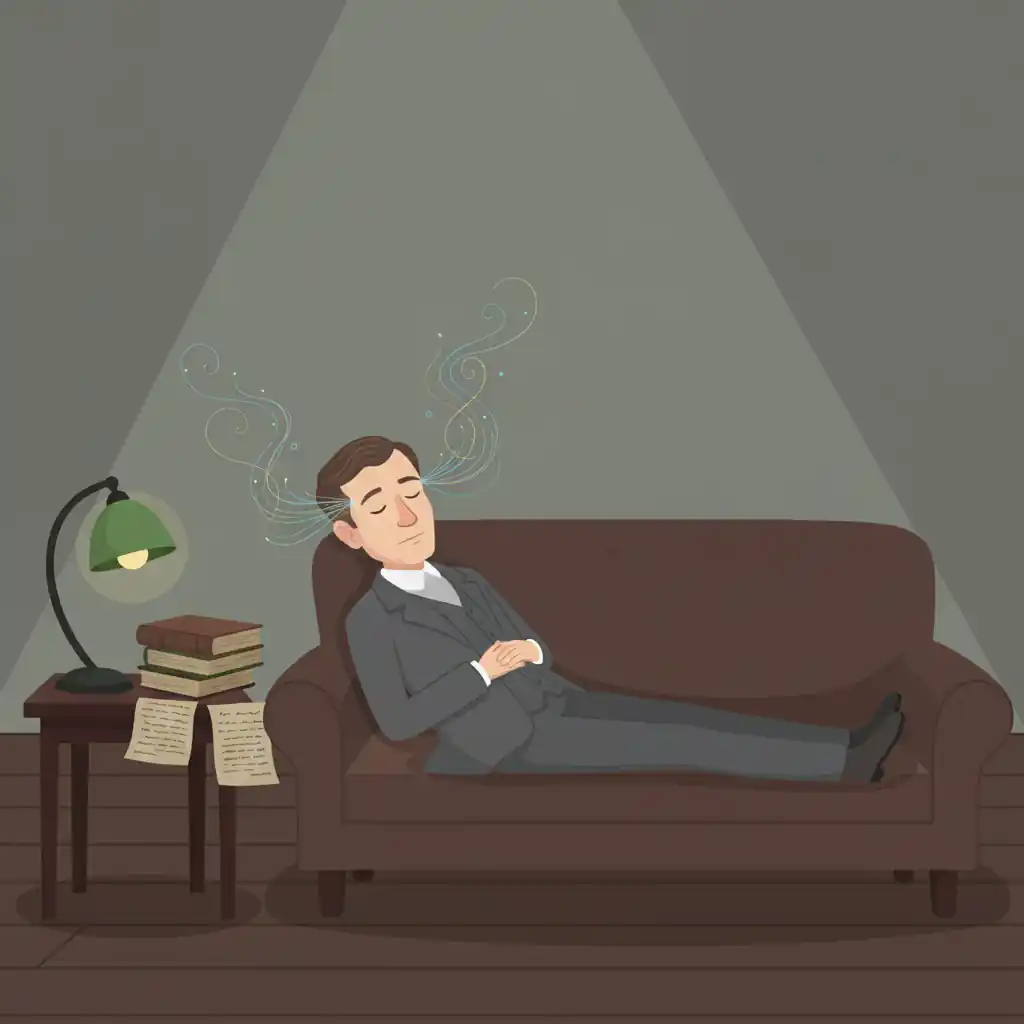
PROLOGUE: THE BOY WHO TALKED TO ANGELS
The year is 1877. The place: a small, unassuming farm in Hopkinsville, Kentucky. This was not a landscape prone to mystic visions or prophetic utterances. It was a world of dirt, sweat, and hardscrabble existence. Yet, it was here that Edgar Cayce, a quiet, almost painfully shy farm boy, would emerge as one of the most enigmatic figures of the 20th century. He was neither formally educated nor intellectually inclined in the traditional sense. His passion was simple: the Bible, which he claimed to have read cover-to-cover a dozen times by age ten.
From a young age, oddities clung to Edgar like the Kentucky dust. He would speak to 'imaginary friends' that only he could see, claiming they were 'people who came to play.' His parents, devout but practical Baptists, dismissed it as a child's fancy. But there was something more. Edgar sometimes saw auras around people. He had an unusual ability to absorb the content of a book simply by sleeping on it, awakening with its knowledge seemingly imprinted upon his mind. A curious party trick, perhaps, but a foreshadowing of the profound gift that lay dormant.
The pivotal moment, the true 'spark' of his gift, arrived when he was thirteen. A baseball struck him, rendering him speechless. Not a temporary concussion, but a complete aphonia – a total loss of voice, lasting for nearly a year. Local doctors, mystified, could offer no cure. They were stumped. His parents were desperate.
One day, a local 'magnetic healer' named Al Layne, a sort of frontier hypnotist, suggested an unconventional approach. Layne put young Edgar into a trance. In this deep, self-induced sleep, the boy's conscious mind, with its stammering fears and limited vocabulary, vanished. A clear, authoritative voice, speaking in complex medical terms, emerged from his lips. This 'sleeping Edgar' diagnosed his own condition: a psychic paralysis of the vocal cords, stemming from the trauma. He then prescribed a detailed remedy: a specific herbal poultice to be applied to his throat and a regimen of mild electric current to stimulate nerve endings.
The instructions were followed precisely. Within days, Edgar Cayce's voice returned. The silence was broken. His family and the handful of witnesses were left with a chilling, undeniable truth: a power resided within this unassuming boy, a power he could only access when fully unconscious. It was a gift that would both define and torment him for the rest of his life, pulling him between the spiritual reverence of a prophet and the public scrutiny of a carnival act.
ACT I: THE AWAKENING OF THE SLEEPING PROPHET
News of the 'sleeping boy' who could diagnose himself spread through rural Kentucky. Initially, Edgar used his gift sparingly, helping local farmers with their ailments or locating lost animals. He felt deeply conflicted. His Baptist faith taught him that such abilities could only come from God or the Devil. He prayed ceaselessly, seeking guidance, fearing he was dabbling in something unholy.
The actual 'readings' were a peculiar ritual. Edgar would lie down, typically on a couch or bed, loosen his tie, and enter a self-induced trance, often with a facilitator giving a simple cue like, 'You are now going to sleep.' His breathing would deepen, his skin would become pale, and a profound stillness would settle over him. Only then could the questions begin. The request was always simple: the full name and location of the person needing help. Once given, the 'sleeping Edgar' would begin to speak, often in a monotone, detached voice, describing the subject's body as if it were a transparent machine.
His early facilitator was Dr. Wesley Ketchum, a skeptical but open-minded homeopathic physician. Ketchum, upon observing Cayce, initially suspected a hoax. But the precision of the diagnoses and the specificity of the remedies, often involving obscure herbs, dietary changes, or osteopathic adjustments, began to chip away at his doubt. Cayce, in trance, would use medical terminology far beyond his waking education, describing conditions like 'hepatic portal congestion' or 'lymphatic stasis' with unnerving accuracy.
One notable early case involved A. C. Gray, a young woman suffering from a debilitating paralysis. Doctors were baffled. Cayce, in trance, detailed a spinal subluxation and prescribed specific osteopathic manipulations, along with dietary changes. Against all odds, Gray regained movement and eventually walked again. Such cases, meticulously documented by Ketchum and later by Cayce’s wife, Gertrude, began to build an undeniable record.
The central oddity was the glaring disconnect between the two Edgars. The waking Edgar was a mild-mannered, struggling photographer, a devoted husband and father, a Sunday school teacher who barely finished the eighth grade. The sleeping Edgar was a medical savant, a diagnostic genius who could pinpoint the root cause of complex diseases and suggest remedies often centuries ahead of their time. And crucially, the waking Edgar had no memory whatsoever of what transpired in the trance state. This cognitive separation was, for him, a blessing; it allowed him to maintain his religious convictions without feeling personally responsible for the unorthodox information flowing through him. He saw himself not as the source, but as a conduit, a simple switchboard operator for an unseen intelligence. This detachment, however, also meant he was entirely dependent on others to transcribe, record, and interpret the very gift that defined his life.
ACT II: THE SOUL'S JOURNEY: KARMA AND REINCARNATION
For years, Cayce’s readings remained largely medical, focusing on physical ailments. But in 1923, a significant and profoundly controversial shift occurred. Two individuals, Arthur Lammers, a wealthy printer and student of Theosophy, and Morton Blumenthal, a New York broker, requested readings that went beyond physical health. They wanted insights into their lives – their purpose, their pasts, and their spiritual trajectory. Cayce, a strict Christian, was deeply uncomfortable. His unconscious self, however, had other plans.
The first 'life reading' for Lammers was a bombshell. The sleeping Cayce described Lammers’ 'soul journey,' speaking of past lives in ancient Egypt and Persia, explaining how the actions and choices made in those distant eras were influencing his present personality and challenges. Concepts like reincarnation and karma, anathema to traditional Christianity, flowed effortlessly from Cayce’s lips. When he awoke and was told the content, Edgar was horrified. He accused those around him of tricking him, of attempting to lead him astray from his faith.
He wrestled with this new revelation for weeks, praying for guidance. His wife, Gertrude, who was often the scribe for his readings, eventually convinced him: 'If it’s from God, it must be true. If it’s not, it will stop.' Edgar reluctantly agreed to continue, but only if the information proved constructive and helpful. And it did. These 'life readings' explained recurring patterns, phobias, talents, and relationships in a way that conventional psychology could not, linking present difficulties to unresolved issues from previous incarnations.
The 'readings' suggested that human souls cycle through lifetimes, accumulating experiences and learning lessons. Karma was presented not as punishment, but as a cosmic law of cause and effect, an opportunity for growth and correction. If one was tyrannical in a past life, they might struggle with authority or feel trapped in the present. If they used their intellect for selfish gain, they might face intellectual challenges in a subsequent life. The overarching message was always one of spiritual evolution, service to others, and aligning with divine will.
This expansion of his gift alienated some of his initial supporters, particularly those from conservative religious backgrounds. But it simultaneously attracted a new, broader audience of spiritual seekers, philosophers, and those interested in metaphysical concepts. It was these 'life readings' that truly established him as the 'Sleeping Prophet' and led to the formation of the Association for Research and Enlightenment (A.R.E.) in 1931, an organization dedicated to preserving, researching, and disseminating his insights. The Akashic Records, a cosmic database of all thought, word, and deed, was frequently mentioned by Cayce as the source from which his unconscious mind drew this profound, personal history.