
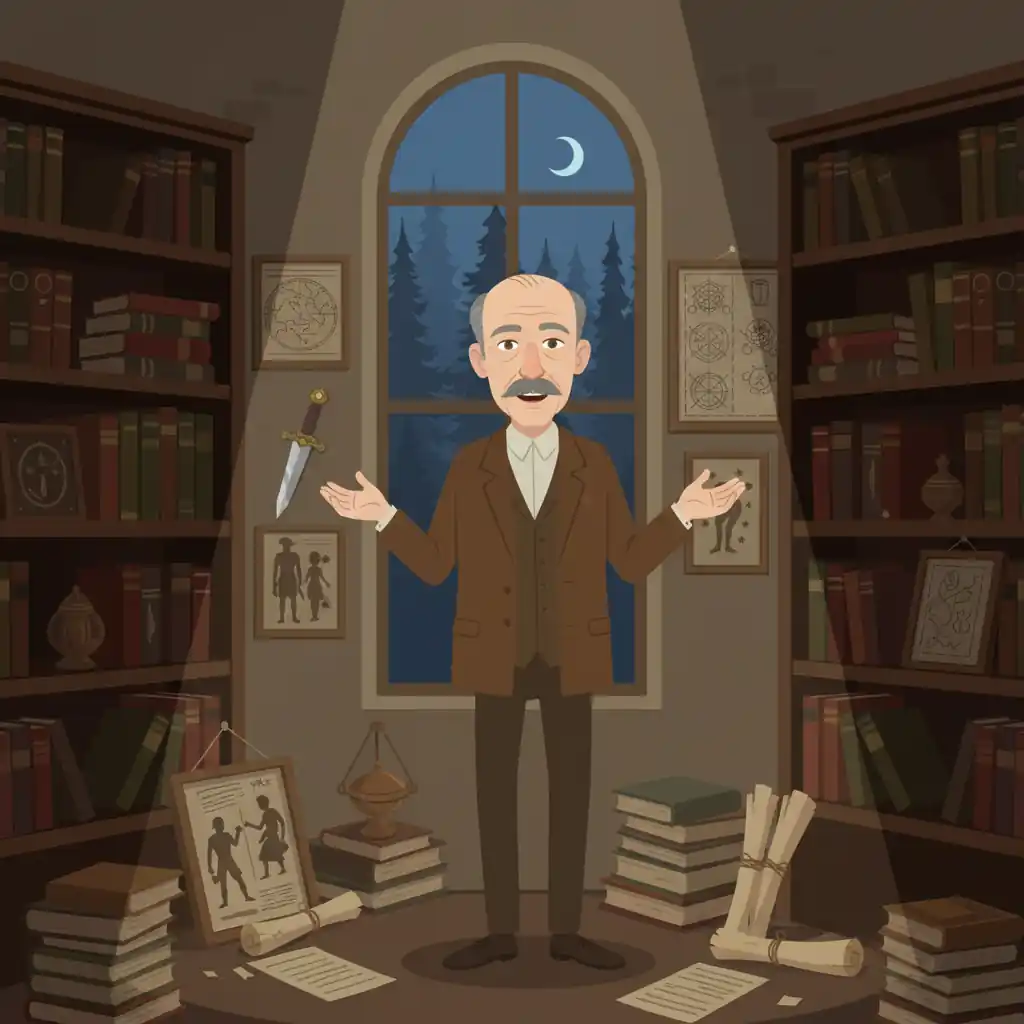
PROLOGUE: THE MAN WHO BUILT MAGIC
Before the internet, before the New Age boom, before 'Hocus Pocus' or 'Sabrina the Teenage Witch,' there was a man who single-handedly conjured a new religion into existence. He was a retired British civil servant, a dedicated nudist, and an unabashed eccentric who claimed to be the last link to an ancient, unbroken lineage of witches. This was Gerald Brosseau Gardner, the improbable architect of modern Wicca.
For centuries, the word 'witch' evoked images of persecution, fear, and dark superstition. By the early 20th century, the witch-hunts were long over, but the stigma remained, often reduced to children's tales or theatrical villains. Yet, in the quiet villages surrounding England's ancient New Forest, an audacious transformation was brewing. A man with a twinkle in his eye and a ceremonial dagger up his sleeve was about to blow the lid off what he insisted was a surviving pagan tradition, not as a force of evil, but as a nature-revering, life-affirming path.
Gardner’s story is a fascinating blend of meticulous anthropology, theatrical showmanship, genuine spiritual quest, and calculated controversy. He was a man steeped in arcane knowledge from across the globe, a seasoned traveler who synthesized Eastern mysticism, Western esotericism, and a dash of British folklore into something entirely new, yet presented as profoundly old. He didn’t just revive witchcraft; he reimagined it, offering a compelling alternative to conventional spirituality at a time when the world was reeling from two global wars.
To understand the 'Witch of the New Forest,' we must delve into the life of a man who wasn’t born into magic, but who painstakingly discovered and then constructed it, inviting millions to follow him into the enchanted woods.
ACT I: THE CURIOUS CASE OF THE COLONIAL CIVIL SERVANT
Gerald Gardner's journey into the occult began not in misty English glades, but under the searing sun of the British Empire. Born in 1884 into a wealthy Liverpudlian family, Gardner was plagued by severe asthma, which led to a rather unconventional upbringing. Instead of formal schooling, he was taken abroad by his family's Irish nursemaid, Josephine McCombie, at the age of five. This early exposure to diverse cultures in the Canary Islands, Madeira, and France instilled in him a lifelong wanderlust and an open-mindedness to foreign customs.
At 19, his travels led him to Ceylon (modern-day Sri Lanka) and then to British Malaya (modern-day Malaysia), where he spent nearly three decades as a civil servant, primarily as a customs officer and rubber planter inspector. This was hardly the typical career path for a future 'witch-father.' Yet, it was in these exotic locales that Gardner's fascination with anthropology, local folklore, and secret societies truly blossomed.
He immersed himself in the cultures of the region, studying the indigenous customs of the Malay people and the Orang Asli tribes, witnessing their magic, spiritual practices, and shamanism firsthand. He wasn’t merely an observer; he was a participant, eager to learn and integrate himself. This hands-on anthropological approach set him apart from many armchair scholars of the era.
Beyond the indigenous magic, Gardner also found himself drawn into the secretive world of Western esoteric orders that flourished among the European expatriates. He joined Freemasonry, eventually reaching the Third Degree, which introduced him to ritual structure, symbolism, and a sense of fraternal community. He was also a member of the Theosophical Society, founded by Helena Blavatsky, a group renowned for its eclectic blend of Eastern philosophy and Western esotericism. These were not mere hobbies; they were serious intellectual and spiritual pursuits that shaped his understanding of the hidden forces at play in the world.
His time in the East provided him with a unique toolkit: a blend of disciplined ritual from Freemasonry, mystical syncretism from Theosophy, and a deep appreciation for animistic and folk magic gleaned from indigenous cultures. These threads, woven together over decades, would become the very fabric of the spiritual tapestry he would later present to the world as 'Wicca.'
Gardner was a keen amateur archaeologist and ethnologist. While in Malaysia, he became an expert on traditional Malay *kris* daggers and even excavated ancient aboriginal tools and settlements. His collection of artifacts was so significant that he eventually donated it to the Sarawak Museum in Borneo, where it remains a valuable part of their collection.
ACT II: FROM EASTERN TEMPLES TO WESTERN LODGES
Gardner's life in the colonies wasn't just about civil service; it was a deep dive into the labyrinthine world of secret societies and esoteric traditions. His journey through Freemasonry provided him with a template for ritual work, hierarchical structures, and the use of allegorical drama. He learned about grips, passwords, and the importance of initiation – elements that would later feature prominently in his own Craft.
But Freemasonry was just the beginning. Gardner explored various offshoots and associated orders. He was particularly drawn to the Ordo Templi Orientis (O.T.O.), an international fraternal and religious organization founded at the beginning of the 20th century. While some O.T.O. lodges practiced high ceremonial magic, others were more concerned with esoteric sexuality and the teachings of its infamous leader, Aleister Crowley.
Gardner never met Crowley in person but was deeply influenced by his writings and the principles of Thelema ('Do what thou wilt shall be the whole of the Law'). He became a prominent member of an O.T.O. lodge in England, even holding the IX° (ninth degree) for a time. Crowley's emphasis on personal will, ritual power, and the divine feminine (often expressed through the 'Babalon' figure) resonated with Gardner's evolving spiritual perspective. He would later incorporate many Crowleyan elements—or elements he believed were influenced by Crowley—into his own Craft rituals, including aspects of magical self-initiation and the use of specific ritual tools.
Beyond formal orders, Gardner developed a profound interest in Theosophy, an esoteric movement blending elements of Hindu and Buddhist philosophy with Western occultism. Theosophy emphasized universal brotherhood, the investigation of nature's hidden powers, and the spiritual evolution of humanity. This provided a framework for understanding diverse spiritual traditions as facets of a single, underlying truth, a concept that appealed greatly to Gardner's syncretic mind.
His return to England in 1936, after a lifetime abroad, was not a retirement into quiet domesticity. Instead, it was a prelude to the most audacious chapter of his life. He settled in Highcliffe, near the ancient New Forest in Hampshire, an area steeped in folklore and alleged witch traditions. Here, his accumulated knowledge from Eastern shamans, Masonic lodges, Theosophical lectures, and Crowleyan texts began to coalesce into a singular, compelling vision. He was an outsider, a man who had seen the world and now sought to bring a piece of its forgotten magic back to his homeland.
Gardner was not only a spiritual seeker but also a natural nudist. He frequently attended nudist camps and believed that ritual nudity was a vital part of ancient pagan practices, embodying purity and closeness to nature. This conviction would later become a controversial, yet defining, characteristic of early Gardnerian Wicca.
ACT III: THE COVEN IN THE NEW FOREST AND THE REPEAL
Upon his return to England, Gardner, now in his mid-fifties, immersed himself in local esoteric circles. He joined the Crotona Fellowship, a Rosicrucian theater group based in Christchurch, Dorset. It was through this group, he claimed, that he encountered a clandestine, hereditary coven of witches. This encounter, in 1939, would become the cornerstone of his entire legacy.
Gardner's account describes his initiation into what he called the 'New Forest Coven' or sometimes the 'Brushwood Coven.' The central figure in this coven, according to Gardner, was an enigmatic woman he referred to as 'Old Dorothy' or 'Dafo' (Dorothy Clutterbuck). She was a wealthy, elderly spinster and landowner who, Gardner maintained, was the hereditary High Priestess of a lineage stretching back centuries. This was no casual joining; it was a full, ritual initiation into a supposedly unbroken pagan tradition that had survived the witch-hunts in secret.
The timing of this alleged initiation was fraught with peril. The Witchcraft Act of 1735 was still in effect, making it illegal to claim to have the power of witchcraft or to accuse others of it. While active persecution had waned, the law remained a dormant threat, effectively forcing any self-proclaimed 'witch' into deep secrecy. Gardner, however, was about to challenge this status quo.