
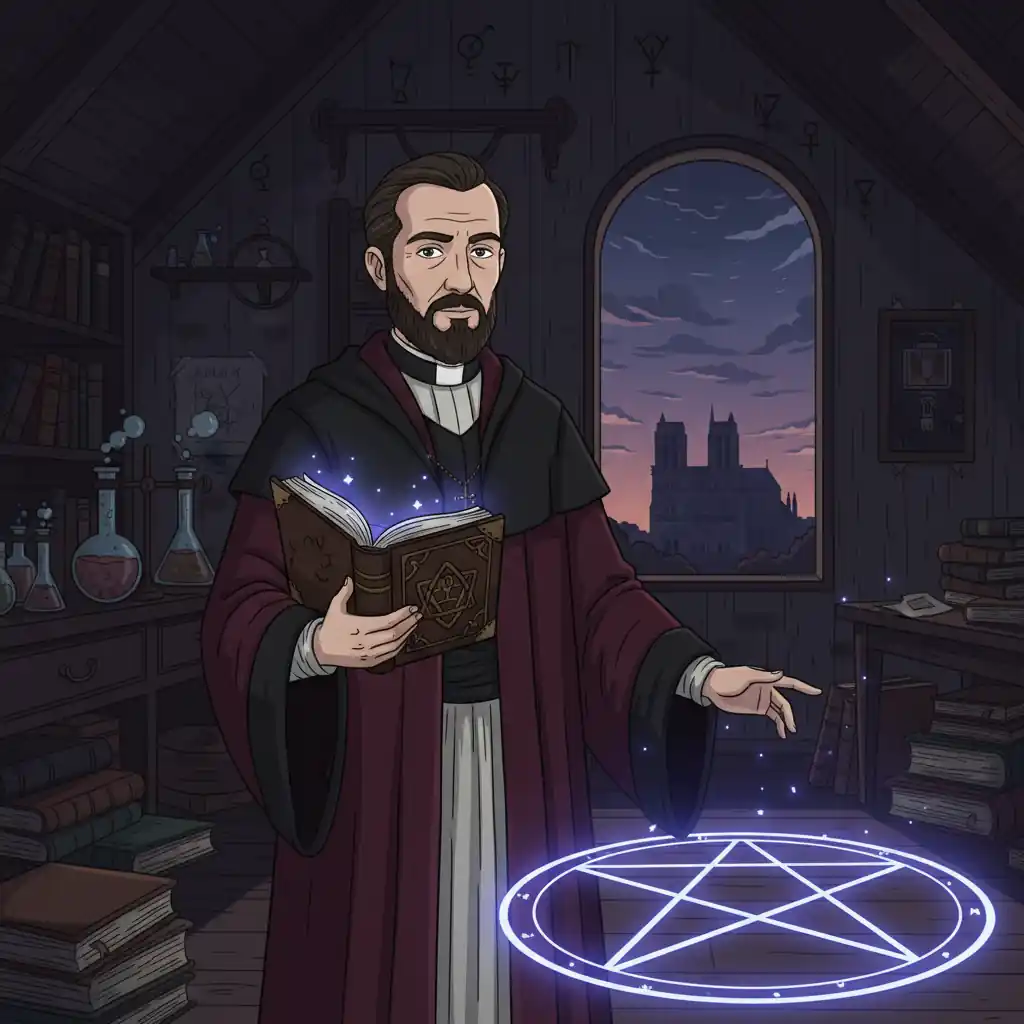
PROLOGUE: THE SHADOW OF THE GUILLOTINE AND THE SPIRIT OF REVOLUTION
The very ground beneath France in the late 18th and early 19th centuries was scorched earth, having been violently churned by the French Revolution. It was an era of unprecedented rationalism, bloody terror, and the dismantling of old hierarchies. Yet, paradoxically, this period of enlightenment and revolutionary fervor also became fertile soil for a profound resurgence of esoteric thought—a spiritual counter-revolution born from the ashes of monarchy and church. It was into this crucible of chaos and nascent modernity that Alphonse Louis Constant, later known as Eliphas Levi, was born. His life would become a bridge, spanning the chasm between the guillotine's shadow and the resurgence of ancient mystical knowledge.
Levi, far from being a peripheral figure, was a product of this tumultuous legacy. He would synthesize fragmented mystical traditions from Kabbalah and Hermeticism to Tarot and ceremonial magic, forging a coherent system that would define modern Western occultism. He saw the French Revolution not just as a political upheaval, but as a grand, alchemical transformation—a violent, historical Gnostic event necessary to purge the old and usher in a new, albeit spiritually perilous, age. His work provided the intellectual framework for generations of occultists, making him the undisputed godfather of a movement that sought to reclaim magic as a spiritual science, not mere superstition.
Imagine a scholar, cloaked in the austere wisdom of ancient texts, yet with eyes that have witnessed the brutal efficiency of the Reign of Terror. This man, an almost forgotten child of revolutionary Paris, would decode the esoteric currents flowing beneath the surface of history, revealing that even in the age of reason, the hidden forces of the universe continued their silent, potent dance.
ACT I: FROM SEMINARY TO SOCIALISM: THE MAKING OF A MYSTIC
Alphonse Louis Constant was born in Paris on February 8, 1810, just a few hundred yards from the site of the demolished Bastille, a geographical detail heavy with symbolic weight for a future revolutionary of thought. His father, a shoemaker, ensured a modest but stable upbringing. However, young Alphonse displayed an intellectual precocity that set him apart. His talents were recognized, and he was sent to the seminary of St. Sulpice to study for the priesthood—a common path for bright, working-class boys in post-revolutionary France.
The seminary was a crucible of rigorous theological study, Latin, Greek, Hebrew, and philosophy. Constant excelled, absorbing vast amounts of knowledge. Yet, beneath the cassock, a restless spirit simmered. He was brilliant, but also fiercely independent and prone to questioning dogma. He became fluent in a multitude of subjects, demonstrating a mind capable of both profound scholarship and radical speculation. The dogmatic constraints of the Catholic Church increasingly chafed against his burgeoning intellectual freedom.
His path diverged sharply in 1836. He fell in love with a young woman, Adèle Allenbach, which, as a sub-deacon under vows of celibacy, was a scandal. He was expelled from St. Sulpice, his ecclesiastical career abruptly ended. Cast adrift in Parisian society, he found himself drawn to the nascent socialist movements of his time, particularly the utopian visions of figures like Charles Fourier and Henri de Saint-Simon. He saw in socialism a promise of justice and equality that the Church seemed unwilling or unable to deliver.
For nearly two decades, Constant was a vocal and prolific advocate for social reform. He penned socialist pamphlets like 'La Bible de la Liberté' (The Bible of Liberty) and 'La Mère de Dieu' (The Mother of God), which led to repeated arrests and imprisonments for 'attacks on religion' and 'incitement to rebellion.' He even wrote a dictionary of philosophical terms. This period highlights his deep engagement with societal issues and his unwavering belief in profound transformation. His journey from priestly aspirant to revolutionary firebrand was a precursor to his later, even more radical transformation into Eliphas Levi, the magus who sought to revolutionize the human spirit itself.
The Fickle Fortunes of a Radical
Life as a socialist writer was hardly lucrative. Constant endured periods of profound poverty, often surviving on the charity of friends or the meager earnings from occasional teaching. His personal life was also tumultuous; he eventually married Marie-Noémie Cadiot, but the marriage was short-lived and unhappy, ending in separation. Despite these personal hardships, his intellectual curiosity never waned. The same drive that led him to critique the Church and society would soon lead him to explore the hidden architectures of the universe, searching for a deeper truth beyond political ideologies.
ACT II: THE FRENCH REVOLUTION'S ESOTERIC GHOSTS
To truly understand Eliphas Levi’s groundbreaking work, one must first grasp the esoteric undercurrents that pulsed beneath the French Revolution, a connection often overlooked by conventional historians. While the Revolution is primarily seen as a triumph of reason and the guillotine, it also unleashed a spiritual vacuum and a fascination with hidden knowledge that Levi would later systematize. The Enlightenment, designed to dispel superstition, inadvertently created a hunger for the irrational, the mystical, and the secret.
Before the storming of the Bastille, France was already a hotbed of esoteric activity. Figures like the notorious Count Alessandro di Cagliostro, a self-proclaimed alchemist and healer, captivated the Parisian elite. Franz Mesmer introduced his theory of 'animal magnetism,' a precursor to hypnotism, suggesting invisible forces at work within and between individuals. Secret societies flourished: the Rosicrucians, various alchemical circles, and, most significantly, the Freemasons. Many prominent revolutionary figures, including Lafayette, Danton, and even Marat, were Masons, drawn to its ideals of liberty, equality, and fraternity, which resonated with the philosophes' critique of absolutism.
The Revolution itself, in Levi’s later analysis, was a manifestation of universal occult laws—a grand alchemical process of dissolution and renewal. The wholesale destruction of the old regime, the desacralization of the Church, and the violent iconoclasm were, to Levi, symbolic acts of a Gnostic 'pruning.' The Reign of Terror, in his view, was the 'black phase' of the alchemical work, purifying the collective psyche, however brutally. Even Robespierre’s short-lived 'Cult of the Supreme Being' hinted at a desperate attempt to fill the spiritual void left by the collapse of Catholicism with a state-sanctioned deism.
The Hermetic Connection
The philosophical seeds of revolution also had deep esoteric roots. The Hermetic axiom 'As above, so below' found a political echo in the idea that earthly governance should reflect divine, natural law. The pursuit of 'liberty' could be seen as an aspiration towards spiritual emancipation, and 'equality' as a recognition of the inherent divine spark in all humans. Levi would later argue that the principles of magic, understood as the manipulation of subtle forces through trained will, were precisely what drove such profound societal shifts.
Levi perceived the Revolution not merely as a political phenomenon but as a colossal ritual of global transformation, a chaotic but necessary step in the spiritual evolution of humanity. The failure of revolutionary idealism to usher in a true golden age only cemented his belief that external political change was insufficient without an internal, spiritual revolution. This conviction would eventually lead him to abandon his socialist crusades and dedicate his life to the 'High Magic' he believed could truly transform the human spirit and, through it, the world.
ACT III: THE GRIMOIRE AND THE PENTAGRAM: THE BIRTH OF ELIPHAS LEVI
By the late 1840s, Constant grew increasingly disillusioned with the political path. The brutal suppression of the 1848 Revolution and the subsequent rise of Louis-Napoleon Bonaparte solidified his belief that purely secular political movements were ultimately incapable of achieving true societal or individual liberation. He realized that the 'liberty' he sought would not be found in the streets of Paris but in the hidden chambers of the soul and the forgotten texts of ancient wisdom. This marked the pivotal turning point in his life, a profound shift from political activism to esoteric scholarship.