
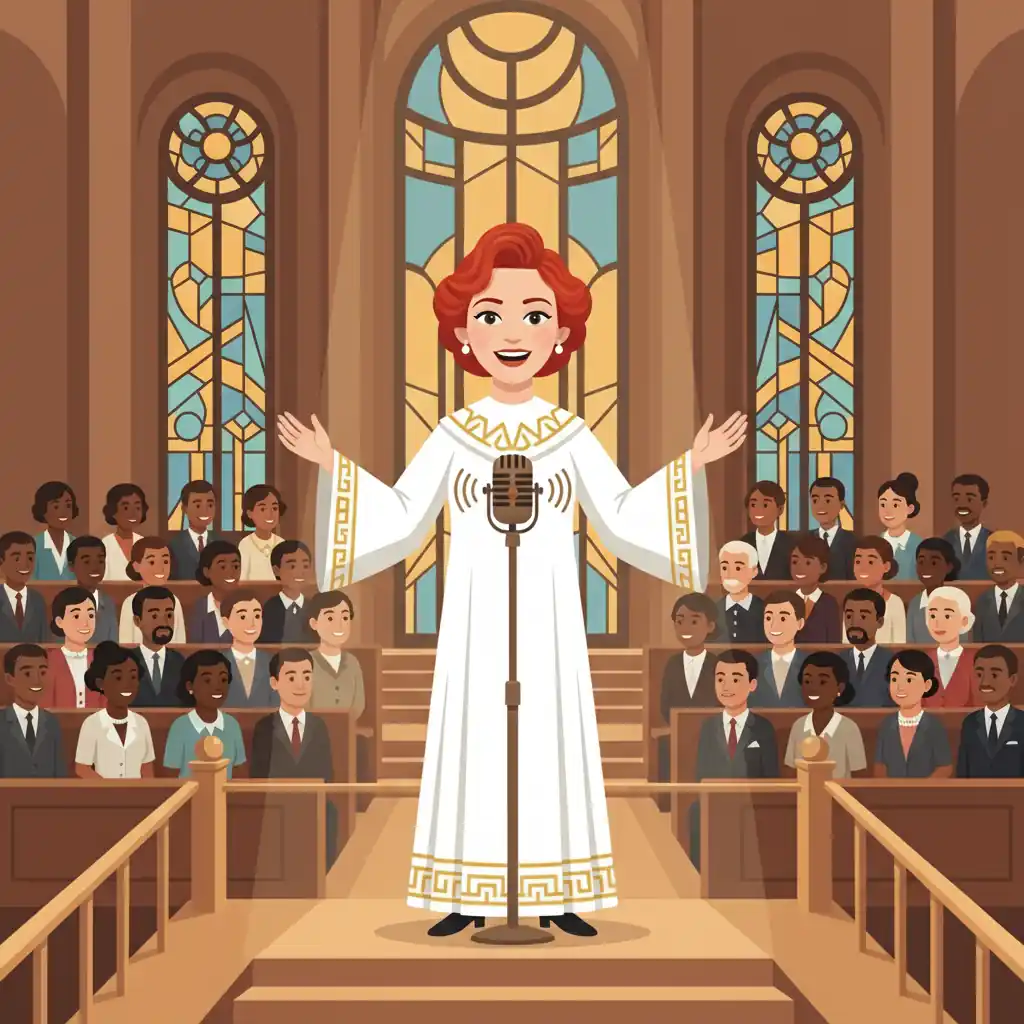
PROLOGUE: THE ROARING '20s AND THE DIVINE DIVA
The 1920s in America were a wild, contradictory symphony. Flappers danced the Charleston while Prohibition fueled underground speakeasies. Science advanced at a dizzying pace, yet a profound spiritual hunger gripped a nation still reeling from the Great War and the Spanish Flu. It was an era of mass media taking root – radio, motion pictures, daily newspapers – creating a vast, eager audience. And into this tumultuous, glittering, and often anxious landscape stepped a figure unlike any other: a woman who embodied the era's contradictions, a prophetess with the showmanship of a Broadway star, and a personal drama that rivaled any Hollywood blockbuster.
This was Aimee Semple McPherson, known to millions simply as 'Sister Aimee.' She wasn't just an evangelist; she was a phenomenon. Before Billy Graham, before Joel Osteen, she perfected the art of spiritual spectacle, drawing crowds that dwarfed political rallies. She promised salvation, delivered 'miracle healings,' and used every tool of modern showmanship to spread her message. But it wasn't just her fiery sermons or her magnetic charisma that etched her into history. It was a scandal so bizarre, so sensational, that it captivated the entire nation, blurring the lines between divine intervention and a meticulously staged disappearance.
Her story is a deep dive into the American psyche of the early 20th century: a blend of genuine faith, cynical manipulation, profound charity, and unadulterated celebrity worship. She was a master of the media, crafting her own narrative even as the press voraciously consumed her every move. She built an empire, inspired millions, and then, at the height of her fame, vanished into thin air, only to reappear with a story so fantastic that it left a trail of questions that linger to this day. This is the tale of 'The Voice of the Great Beyond,' a woman who understood, perhaps better than anyone, that in the age of spectacle, even God needed a good publicist.
ACT I: FROM CANADIAN TENT TO CALIFORNIA TEMPLE
Born Aimee Elizabeth Kennedy in Salford, Ontario, Canada, in 1890, her path to spiritual stardom was anything but conventional. Her mother, Minnie, was a devout Salvation Army captain, while her father was a gentle, unchurched farmer. This dual influence would define Aimee: the theatrical passion of revivalism coupled with a grounded, practical sensibility. Initially drawn to secular interests like theater and swimming, a fiery Pentecostal revival meeting at age 17 radically altered her course. She experienced a dramatic conversion, speaking in tongues and committing her life to Christ.
It was at this revival that she met and married Robert Semple, a handsome, Irish-born Pentecostal evangelist. Their early years were marked by missionary zeal and hardship. They embarked on a fateful mission trip to Hong Kong in 1910, where both contracted malaria. Robert tragically died, leaving a 20-year-old Aimee a widow with an infant daughter, Roberta. This traumatic experience, however, only solidified her conviction in divine purpose. She returned to the U.S., weak and grieving, but with an unshakeable belief that God had spared her for a reason.
A brief, unhappy second marriage to accountant Harold McPherson produced a son, Rolf. But domestic life could not contain her burgeoning spiritual calling. She described experiencing a profound vision where a giant hand pointed to the world, whispering 'Go!' In 1915, despite her husband's objections, she packed her two children into a dilapidated 'Gospel Car' – a touring automobile with 'Jesus Is Coming Soon – Get Ready' painted on the side – and hit the 'sawdust trail' of tent revivals across the American South and East Coast. This was her proving ground, where she honed the dynamic, emotional, and intensely personal style that would become her trademark.
Aimee Semple McPherson was a pioneer in using modern technology for evangelism. Her 'Gospel Car' was one of the earliest examples of a mobile ministry. Later, she would establish one of the first Christian radio stations, KFSG ('Kall For Saving Grace'), in 1924, broadcasting her sermons directly from Angelus Temple.
Her sermons were less lectures, more performances. She'd preach from atop an old packing crate, her red hair blazing, her voice a powerful instrument that could soar with passion or drop to a whisper. She used vivid imagery, simple parables, and dramatic gestures. Her appeal was direct, emotional, and aimed squarely at the common person. Stories of miraculous healings – of the blind seeing, the lame walking – began to precede her, drawing ever-larger crowds. By 1918, she had arrived in Los Angeles, a city swelling with new arrivals and ripe for a charismatic spiritual leader. She immediately recognized its potential as the perfect stage for her burgeoning ministry.
ACT II: THE ANGELUS EMPIRE AND THE FOURSQUARE GOSPEL
Los Angeles in the early 1920s was a magnet for dreamers and seekers, a burgeoning metropolis where anything seemed possible. Aimee Semple McPherson arrived in this crucible of ambition and spiritual longing, and she found her destiny. Initially holding revivals in tents and rented auditoriums, her magnetism quickly became undeniable. She needed a permanent home, a cathedral worthy of her vision. In 1923, after an audacious fundraising campaign that appealed directly to the masses (selling 'faith bonds' and asking for small donations from thousands), she opened Angelus Temple in Echo Park.
Angelus Temple was no ordinary church. It was a massive, 5,300-seat edifice, complete with a massive rotating illuminated cross atop its dome. Architecturally, it was a blend of Spanish Colonial Revival and Art Deco, designed for maximum theatrical impact. But its true innovation was its multi-faceted purpose: it wasn't just a place of worship. It included a 24-hour prayer tower, a commissary, a massive 'Storehouse' for distributing food and clothes to the needy, and even a Bible college (L.I.F.E. Bible College) to train new ministers. It was a self-contained spiritual and social welfare empire, deeply embedded in the community.
Inside the temple, Sister Aimee transformed evangelism into spectacle. Her services were legendary. She’d preach with elaborate costumes – a police officer one Sunday, a firefighter the next, a deep-sea diver emerging from a tank of water to illustrate a sermon on 'the perils of sin.' She used movie projectors, orchestras, choirs, and even live animals. Once, she rode a motorcycle down the aisle; another time, she preached as David, throwing a stone at a giant Goliath cutout. These 'illustrated sermons' were as entertaining as any Broadway show, drawing not just the devout, but the curious and the skeptical. People often came to Angelus Temple for the 'show,' and stayed for the salvation.
McPherson was a master of public relations. She often staged photo opportunities, like leading a parade of orphans through the streets of Los Angeles, or personally distributing food to thousands during the Great Depression. She understood the power of visual media and used it to cement her image as a compassionate, dynamic leader.
At the heart of her theological teaching was the 'Foursquare Gospel,' a simple, accessible doctrine that proclaimed Jesus Christ as: 1. The Savior (who saves from sin), 2. The Great Healer (who heals the body), 3. The Baptizer with the Holy Spirit (who empowers for service), and 4. The Soon-Coming King (who will return again). This straightforward message, combined with her charismatic delivery and the dramatic 'miracle services' where she claimed to heal the sick and lame, drew hundreds of thousands to her ministry. Angelus Temple became a spiritual Mecca, and Aimee Semple McPherson, 'The Voice of the Great Beyond,' was arguably the most famous woman in America, her sermons broadcast across the nation via her own radio station, KFSG.
ACT III: THE VANISHING ACT AT VENICE BEACH
May 18, 1926. The height of Aimee Semple McPherson’s fame. Angelus Temple was thriving, her radio broadcasts were reaching millions, and her every move was front-page news. On this fateful day, she drove to Venice Beach, a popular seaside resort near Los Angeles, accompanied by her secretary. She told her secretary she wanted to go for a swim to cool off, a common practice for her. Handing her a note to read over, Aimee walked into the Pacific Ocean. She never returned.