
PROLOGUE: THE CRUCIBLE'S SPARK
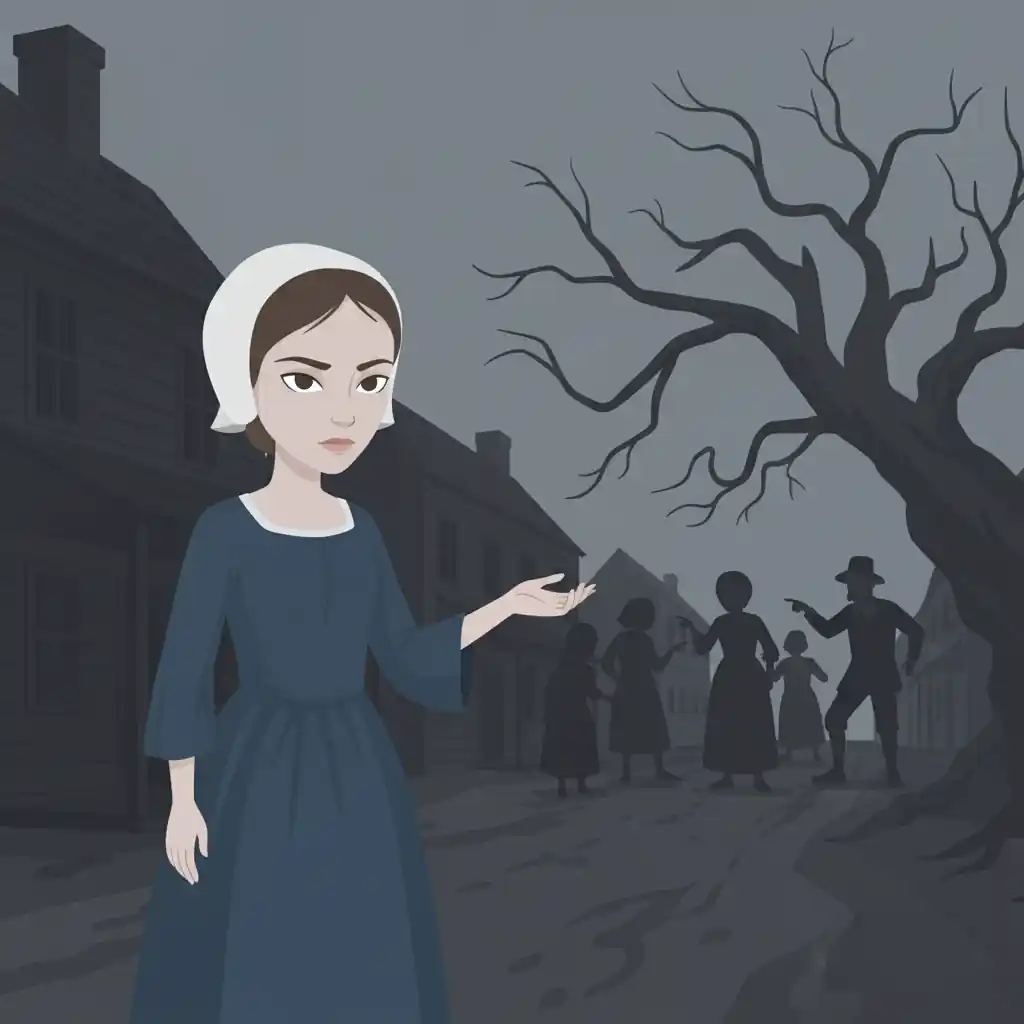
Imagine Salem Village, 1692. Not the idyllic New England postcard, but a harsh, isolated Puritan outpost, clinging precariously to the edge of an untamed wilderness. For its inhabitants, the world was a battleground between God and the Devil, with the dark forests representing the dominion of Satan himself. Fear was a constant companion: fear of disease, fear of Native American attacks, and most terrifying of all, fear of spiritual corruption from within.
Into this pressure cooker stepped Reverend Samuel Parris, the village minister. He was a controversial figure, often locked in bitter disputes with his congregation over salary and church resources, sowing seeds of division and resentment. His household, a microcosm of the village's tensions, included his nine-year-old daughter Betty, his orphaned niece Abigail Williams, aged about eleven or twelve, and two enslaved people from Barbados, Tituba and John Indian.
The Secret Circle
In the long, cold, and dark winter evenings of 1692, with little to distract from the austere Puritan life, Betty and Abigail, along with other local girls—Ann Putnam Jr., Mercy Lewis, Mary Walcott, and Elizabeth Hubbard—would gather in the Parris kitchen. It was here, away from the watchful eyes of their elders, that they found a thrilling, forbidden escape.
Tituba, with her Caribbean origins, became their unofficial storyteller and entertainer. She introduced the girls to fortune-telling techniques, such as dropping an egg white into a glass of water to reveal the shape of their future husbands or even spirits. This was strictly taboo in their rigid society, a dangerous flirtation with practices vehemently denounced as witchcraft.
Oddity: These seemingly innocent parlor games were a profound act of rebellion against the stifling Puritan existence, offering a tantalizing glimpse into a world of magic and prediction that their elders had demonized. The fascination with the forbidden, coupled with the crushing religious and social pressures, created a volatile mix. The girls, starved for agency and entertainment, found a potent thrill in Tituba's stories, a thrill that would soon spiral into something far more sinister than anyone could have imagined.
ACT I: THE FIRST FITS
The playful, if illicit, gatherings in the Parris kitchen took a dark turn in late January 1692. Nine-year-old Betty Parris began exhibiting alarming symptoms. She would fall into inexplicable fits, her body contorting into unnatural positions, uttering guttural sounds, screaming uncontrollably, and then lapsing into deafening silence, seemingly deaf and unresponsive to those around her. She complained of invisible pinpricks and burning sensations, as if tormented by an unseen force.
Abigail Williams quickly began displaying similar bewildering afflictions. Soon after, Ann Putnam Jr., a spirited twelve-year-old from a prominent village family, also joined the growing circle of the 'afflicted.' The community watched, confused and terrified, as the children suffered. Initially, people sought medical explanations, convinced it was a physical ailment. But no known remedy or diagnosis seemed to fit.
Dr. William Griggs, the local physician, was summoned to examine the girls. He performed various medical assessments, but could find no discernible physical cause for their violent fits and erratic behavior. After exhausting his knowledge of colonial medicine, Dr. Griggs delivered a chilling diagnosis that would forever alter the course of Salem's history.
Gritty Fact: Dr. Griggs's professional medical opinion was that the children were suffering from the influence of 'an Evil Hand.' In the fervent Puritan worldview, this immediately translated to one thing: witchcraft. This pronouncement was not merely a medical conclusion; it was a spiritual declaration of war, officially shifting the crisis from a perplexing illness to a direct attack by the Devil's agents within the community.
With the medical explanation exhausted, the girls' fits only intensified, becoming more dramatic and public. They would bark like dogs, make strange gurgling noises, and complain of being bitten, pinched, or choked by invisible entities. The entire village was urged to pray and fast, but the afflictions persisted, seemingly immune to spiritual intervention.
Under immense pressure from their parents, the local ministers, and the increasingly terrified villagers, the girls were relentlessly questioned: Who is afflicting you? Who is sending these spirits to torment you? They were trapped in an impossible situation, caught between the terrifying manifestations they either experienced or expertly feigned, and the dire implications of naming a 'witch.' The unspoken fear that they themselves might be accused if they failed to identify their tormentors was a powerful, insidious motivator.
ACT II: THE ACCUSATIONS BEGIN
For weeks, the 'afflicted' girls resisted naming names, perhaps out of genuine confusion, fear of repercussion, or even a nascent understanding of the power they had stumbled upon. But the pressure mounted inexorably, particularly from influential figures like Reverend Samuel Parris and the powerful Putnam family, whose own daughter, Ann Jr., was now dramatically afflicted.
Finally, at the end of February 1692, under relentless interrogation from magistrates John Hathorne and Jonathan Corwin, the dam broke. The girls made their first accusations. They pointed their trembling fingers at three women, all of whom were marginalized figures in the rigid Puritan society:
- Tituba: Samuel Parris's enslaved woman, an easy target due to her outsider status, her non-Christian beliefs, and her acknowledged role in their forbidden fortune-telling games. Her vulnerability made her an immediate scapegoat.
- Sarah Good: A homeless, pipe-smoking beggar, reviled and ostracized by the community. Her poverty, social defiance, and generally un-Puritan demeanor made her a convenient, almost expected, target for communal anxieties.
- Sarah Osborne: An elderly, sickly woman who rarely attended church and had previously caused a minor scandal by living with an indentured servant before officially marrying him. She was an easy target for moral judgment and had few defenders.
The Power of Confession
During her public examination, Tituba—perhaps realizing the mortal peril of denial and hoping to save herself—delivered a spectacular, vivid confession. She spoke of flying through the air on a broomstick, seeing black dogs and red cats, and signing the Devil's book with her own blood, revealing other names she claimed to have seen in the infernal ledger. She described in graphic detail how a 'tall man from Boston' had commanded her to hurt the children.
Eccentricity: Tituba's testimony was a masterclass in theatrical performance, a compelling blend of Puritan fear and Barbados folklore, possibly informed by the dramatic fits of the girls themselves. She wove a tapestry of dark magic, complete with specific, terrifying details that validated the deepest fears of the Puritan elders. Her coerced and likely fabricated confession inadvertently legitimized the girls' claims and gave the emerging hysteria its terrifying, 'proof-positive' framework. To the Salem authorities, it definitively proved that witches were not just real, but actively operating within their God-fearing community.
Both Sarah Good and Sarah Osborne steadfastly maintained their innocence, but their denials were quickly drowned out by the girls' theatrical outbursts and Tituba's sensational confession. They were swiftly condemned in the court of public opinion and by the magistrates. The stage was now grimly set for a full-blown witch hunt, propelled forward by the 'afflicted' girls, with Abigail Williams often leading the charge, her performances in the courtroom becoming increasingly convincing and chilling.
ACT III: THE SPREADING FIRE
With Tituba's 'confession' providing a horrifying blueprint for the Devil's work in Salem, and the initial, easy convictions of the marginalized, the dam of reason burst. Abigail Williams and the other 'afflicted' girls quickly transformed into the most powerful figures in Salem Village. Their every gesture, scream, and whispered accusation was taken as divine, unimpeachable proof of witchcraft, capable of condemning anyone to the gallows.