
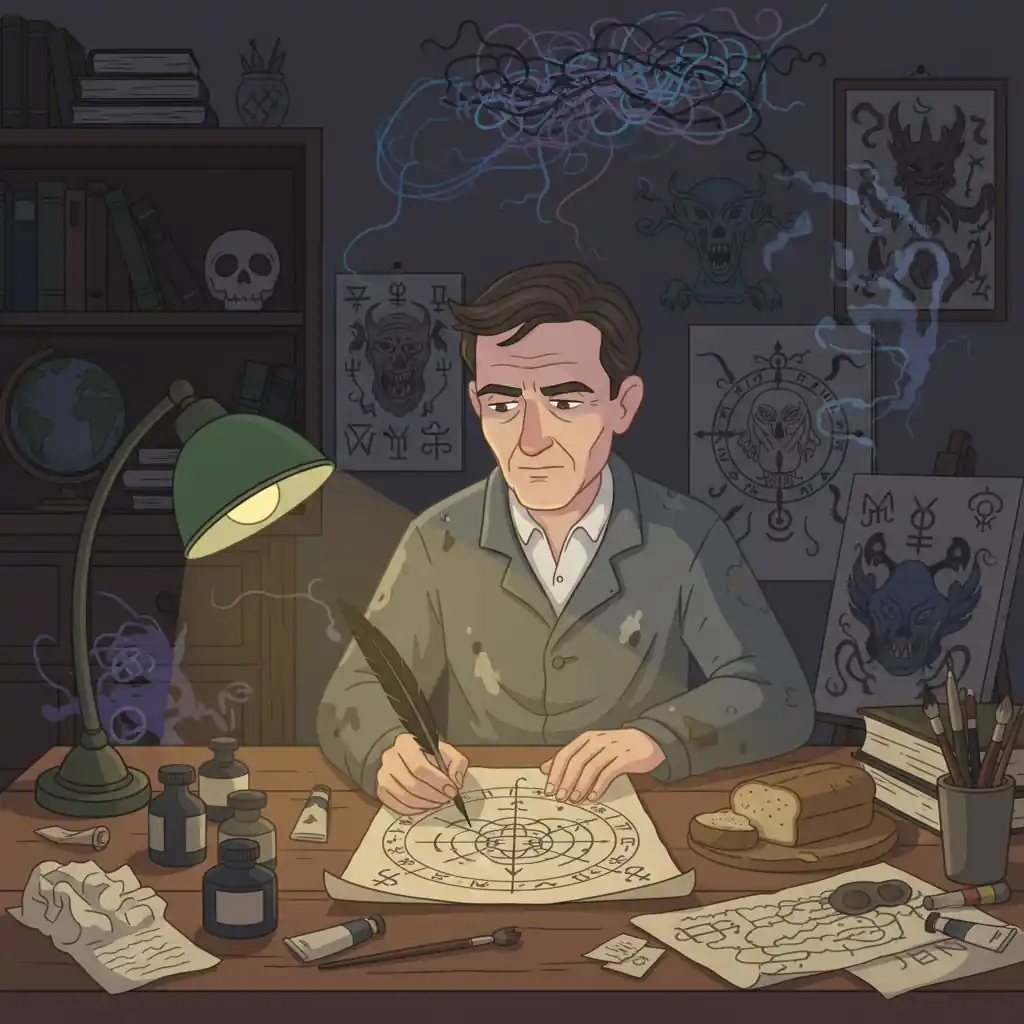
PROLOGUE: THE CURIOUS CASE OF THE COCKNEY WIZARD
Picture a grimy, fog-laced street in Edwardian London. Not the grand avenues of Westminster, but the working-class lanes of Walworth, Southwark. Here, among the soot-stained brick and gaslight glow, a boy named Austin Osman Spare was growing up. He was no ordinary child. From a young age, he saw things, drew things, and understood connections that most people dismissed as mere superstition or childish fantasy. He was destined to become a forgotten master, an artistic genius, and a sorcerer who would quietly revolutionize the very fabric of modern occultism, long after his death.
Spare was the quintessential outsider. Born in 1886 to a London city policeman, he arrived in an era obsessed with spiritualism, esoteric societies, and the dramatic pronouncements of self-proclaimed 'magicians' like Aleister Crowley. Yet, Spare would carve his own path, one deeply rooted in the subconscious, in the power of symbols, and in a deeply personal, often solitary, communion with forces that defy easy categorization. He rejected dogma, elaborate rituals, and the public spectacle that defined much of early 20th-century occultism. Instead, he sought direct, visceral experience, often found in the mundane and the grotesque.
He was an artist whose work was too unsettling for the polite galleries, a mystic whose methods were too direct for the stuffy lodges, and a man whose brilliance was obscured by his fierce independence and preference for the company of cats, local pub-goers, and the spirits he claimed to converse with daily. The techniques he developed, born of intuition and a deep understanding of the human psyche, would later coalesce into what is now known as Chaos Magic—a pragmatic, results-oriented magical philosophy that would shake the foundations of esoteric thought decades after his quiet passing. This is the story of the man they called 'the Magician of Chaos,' a true Cockney wizard who drew power from the everyday and the abyssal.
ACT I: THE BOY WHO SAW THROUGH VEILS
Austin Osman Spare's artistic talent manifested early and explosively. By the age of 13, his drawings—filled with unsettling, detailed figures, often grotesque and sexually charged—were so striking that he was granted a scholarship to the Royal College of Art in London. This was an unprecedented achievement for a working-class boy from Southwark. His work at this nascent stage already showed a distinct break from convention, an interest in the subconscious, and a fascination with bizarre, almost alien anatomies that hinted at deeper, unseen realities.
His early influences included William Blake for his visionary intensity, and Aubrey Beardsley for his intricate, decadent line work. But Spare's vision quickly surpassed mere imitation. His art was often a conduit for what he termed the 'Kia'—his interpretation of the universal magical current or the 'Self' beyond ego. He pioneered what he called 'automatic drawing,' a technique where he would enter a trance-like state and allow his hand to move freely, channeling images directly from his subconscious or, as he believed, from other dimensions. This was decades before Surrealism would popularize similar concepts, marking Spare as a true artistic pioneer.
His formal education was brief; he found the academic confines stifling. Instead, he immersed himself in esoteric literature and sought out practical experience. He frequented séances and became deeply involved with spiritualist circles. Spare claimed that his earliest magical instruction came from an elderly woman named Mrs. Paterson, a former professional medium he met in London. He described her as a direct link to ancient Egyptian deities, claiming she could shapeshift and communicate with 'familiars' that manifested physically. These experiences, however fantastical, cemented his belief in a living, permeable boundary between the conscious and unconscious, the seen and unseen.
Spare’s first exhibition in 1907 at the Bruton Galleries caused a sensation. Critics were divided: some hailed him as a prodigy, others denounced his work as morbid and perverse. The Bystander magazine famously declared him 'the most powerful draughtsman in England.' It was during this period of burgeoning fame that he briefly crossed paths with the infamous ceremonial magician, Aleister Crowley. Crowley, ever keen to absorb rising talents into his O.T.O. (Ordo Templi Orientis), was impressed by Spare's artwork and invited him to join. Spare's tenure was notoriously short-lived. He found Crowley's elaborate rituals, self-aggrandizement, and rigid systems utterly unappealing and ultimately ineffective. He dismissed Crowley's magic as 'old-fashioned rubbish' and quickly departed, cementing his reputation as an independent, anti-dogmatic figure.
His early published works, Earth Inferno (1905) and A Book of Satyrs (1907), were self-published and demonstrated his unique blend of art and esoteric philosophy. These books were not merely illustrations; they were visual grimoires, filled with aphorisms, bizarre glyphs, and images that explored themes of death, rebirth, sensuality, and the hidden currents of existence. They were stark, uncompromising, and offered a glimpse into a mind already plumbing depths that others barely acknowledged. Spare was not just an artist; he was mapping the uncharted territories of the soul with pen and ink.
Despite his later reclusive nature, Spare once designed a political poster for the suffragette movement, depicting a stylized woman shattering chains. This brief foray into activism highlighted his unconventional and rebellious spirit, showing he was willing to lend his unique artistic vision to causes outside the esoteric.
ACT II: THE SIGIL AND THE SUBMERSION
Spare's true genius, the innovation that would reverberate through the occult underground for decades, lay in his development of sigilization. Before Spare, magical rituals were often complex, lengthy affairs involving specific tools, invocations, and celestial timings—a tradition stretching back centuries. Spare saw this as a labyrinthine waste of time, a system that obscured the direct, raw power of the subconscious mind. He sought to distill desire, to bypass the critical conscious filter, and implant intentions directly into the 'Kia' or the unconscious, where he believed true magical power resided.
The method was deceptively simple, yet profoundly effective. First, a clear statement of intent was formulated (e.g., 'I desire wealth,' 'I will heal'). Then, all repeated letters were removed from the statement. The remaining letters were then stylized, rearranged, and interwoven into a single, abstract glyph or symbol – the sigil. This abstract nature was crucial; it rendered the original meaning unintelligible to the conscious mind.
The next, and most vital, step was 'charging' the sigil. Spare taught that this was achieved by staring at the sigil during a moment of profound Gnosis—an altered state of consciousness where the conscious mind is temporarily overwhelmed or distracted. This could be achieved through intense sexual arousal, extreme exhaustion, ecstatic dancing, deep meditation, or even the 'Death Posture'—a contorted body posture designed to induce a form of sensory deprivation and trance. In this heightened state, the sigil, now devoid of conscious meaning, would be 'fired' directly into the subconscious.
Finally, and perhaps most unconventionally, came the 'forgetting.' Once charged, the sigil was to be deliberately forgotten, its original purpose banished from conscious thought. Any conscious dwelling on the desire, Spare argued, would drag the intention back into the realm of the ego, preventing the subconscious from manifesting it freely. This process of intentional amnesia was radical, emphasizing the direct, non-rational pathway to manifestation.
His magnum opus explaining these ideas was The Book of Pleasure (Self-Love), published in 1913. This extraordinary work, filled with his intricate line drawings, aphorisms, and esoteric philosophy, laid bare his entire system. It introduced concepts like the 'Alphabet of Desire'—a set of archetypal sigils representing fundamental desires and forces, to be drawn with the non-dominant hand. Spare believed these were universal keys to unlocking deeper aspects of the self and the cosmos.
This was a profound shift in magical thought. Spare moved away from complex external rituals to an internal, psychological magic. He argued that the 'gods' and 'spirits' were not external entities but rather complexes within the human psyche, activated through symbols and focused intent. This wasn't just magic; it was an early form of practical psychology, tapping into the creative power of the unconscious long before Jungian archetypes became mainstream. His approach democratized magic, suggesting that anyone, without years of study or elaborate apparatus, could wield potent transformative power if they understood the mechanisms of their own mind.
ACT III: THE HERMIT OF THE SOUTHWARK CELLAR
As the roaring twenties gave way to the bleak interwar years, Austin Osman Spare gradually retreated from the art world and the nascent occult scene. He found the commercialism of galleries distasteful and the intellectual posturing of most occultists unbearable. He chose obscurity, embracing a life of deliberate poverty and reclusiveness in South London. His primary residence for decades became a series of humble, often damp, basement rooms or small studios in areas like Borough and Kennington, far from the fashionable districts.