
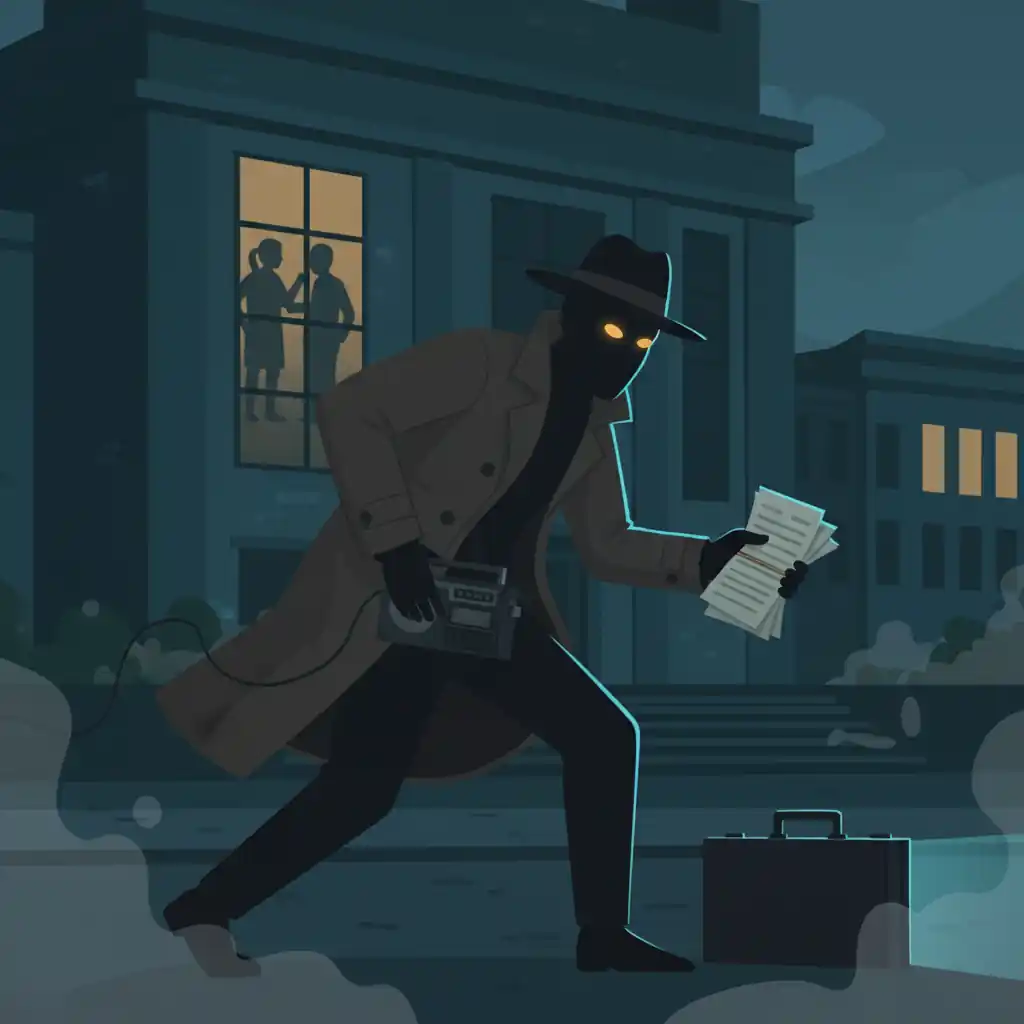
The Watergate Break-In
Five men are arrested for breaking into the Democratic National Committee headquarters at the Watergate complex, setting off a chain of events.
Campaign Finance Link
A $25,000 cashier's check, intended for Nixon's re-election campaign, is linked to one of the Watergate burglars, beginning to unravel the cover-up.
Initial Convictions
Former Nixon aides G. Gordon Liddy and James McCord are convicted of conspiracy, burglary, and wiretapping, but McCord soon signals he will cooperate with investigators.
White House Resignations
Key White House figures, including Chief of Staff H.R. Haldeman, Domestic Affairs Advisor John Ehrlichman, and Counsel John Dean, resign amidst mounting pressure.
Senate Hearings Begin
The Senate Watergate Committee, led by Senator Sam Ervin, begins televised public hearings, captivating the nation with dramatic testimony.
The Taping System Revealed
Former White House aide Alexander Butterfield reveals the existence of a secret taping system in the Oval Office, dramatically escalating the scandal.
The Saturday Night Massacre
President Nixon orders Attorney General Elliot Richardson to fire Special Prosecutor Archibald Cox. Richardson and Deputy Attorney General William Ruckelshaus resign rather than comply.
Supreme Court Ruling
The U.S. Supreme Court rules 8-0 in *United States v. Nixon*, compelling the President to release the unedited Oval Office tapes.
Nixon's Resignation
Facing imminent impeachment, Richard Nixon announces his resignation, becoming the only U.S. president to do so.
Ford's Pardon
President Gerald Ford issues a controversial pardon to Richard Nixon for all federal crimes he 'committed or may have committed' during his presidency.
PROLOGUE: THE SILENT ALARM
This story draws on historical investigations, journalism, and academic research. Some events described were the subject of public controversy or legal investigation. Allegations and interpretations are presented as reported claims rather than definitive conclusions. The Watergate scandal became a defining controversy of its time, revealing significant concerns about executive power and government transparency.
In the early hours of June 17, 1972, a seemingly minor incident unfolded in the heart of Washington D.C. At the sprawling Watergate Hotel and Office Building complex, a security guard noticed something peculiar. A door latch, leading from a parking garage to the Democratic National Committee (DNC) headquarters, was taped open. He removed the tape. Minutes later, on his next round, the tape was back. This tiny, almost comical, detail would become the frayed thread that, when pulled, unraveled a presidency.
The guard, Frank Wills, promptly called the police. What began as a routine burglary call soon escalated into one of the most significant political scandals in American history. Five men, clad in suits and armed with sophisticated bugging equipment, were found inside the DNC offices. Their arrest didn't just expose a 'third-rate burglary,' as the White House initially claimed; it revealed a deep, systemic campaign of political espionage, sabotage, and an unprecedented cover-up that reached the highest levels of power, ultimately forcing a sitting president to resign.
This narrative explores the key figures, peculiar decisions, and sheer audacity that characterized the Watergate scandal, examining how a seemingly minor break-in exposed the dark underbelly of Cold War-era political tactics and forever changed the relationship between the American public and its leaders.
ACT I: THE BURGLARY AND THE BADGES
The scene at the DNC headquarters on June 17, 1972, was a study in amateurish blunders mixed with high-tech ambition. The five men arrested—James McCord, Bernard Barker, Frank Sturgis, Eugenio Martínez, and Virgilio González—were not common criminals. Four of them were Cuban exiles with ties to the CIA, seasoned in anti-Castro operations. The fifth, James McCord, was a former CIA officer himself, serving as security coordinator for the Committee for the Re-election of the President (CRP, or 'CREEP' as critics dubbed it).
Their mission, according to later investigations, was to repair a faulty wiretap planted weeks earlier and to photograph documents. They had successfully broken in once before, but this second attempt was plagued by missteps. The famous tape on the door latch, initially removed by security guard Frank Wills, was quickly replaced by the burglars, reportedly to allow easier re-entry. It was this simple, almost arrogant oversight that triggered the alarm.
When police arrived, they found the men dressed in business suits, wearing surgical gloves, and carrying walkie-talkies, cameras, and more than $2,000 in sequential $100 bills—a detail that would later prove crucial in tracing the money trail. The sight of these oddly equipped, well-dressed men, caught in the act of burgling a political office, immediately signaled that this was no ordinary break-in. It was, as journalists would soon reveal, a politically motivated operation.
The immediate question that arose was: who sent them? The five men initially remained silent, refusing to cooperate with police. However, the presence of a former CIA operative and campaign security coordinator among them made it difficult for the Nixon White House to dismiss the incident as an isolated act. Official statements from the White House, however, did just that. Press Secretary Ronald Ziegler famously labeled it a 'third-rate burglary attempt,' insisting it had no connection to the White House.
Yet, even in those first hours, the clues pointed upward. One of the burglars, Bernard Barker, carried a check made out to him, signed by E. Howard Hunt, Jr., a former White House consultant. Hunt, along with G. Gordon Liddy, a former FBI agent and general counsel to CRP, were soon identified as masterminds behind the operation. This connection directly tied the seemingly isolated burglary to the re-election campaign, setting the stage for a dramatic unraveling of what historians would later describe as a vast criminal conspiracy.
One of the more bizarre items found on the burglars was a can of Mace and a bottle of a mysterious liquid that investigators initially suspected was a knockout drug. It was later identified as a hair dye, further adding to the oddity of the 'professional' operation.
ACT II: THE MONEY TRAIL AND THE MYSTERIOUS INFORMANT
While the White House dismissed the break-in as insignificant, two tenacious Washington Post reporters, Bob Woodward and Carl Bernstein, refused to let the story die. Their initial investigations focused on the cash found on the burglars and the mysterious source of their funding. The sequential $100 bills suggested a laundered source, and their pursuit of this money trail proved relentless. Journalists reported that a $25,000 cashier's check, intended for Nixon's re-election campaign, was traced to the bank account of Bernard Barker, one of the arrested burglars.
This discovery, widely reported by The Washington Post in August 1972, directly linked the break-in to the Committee for the Re-election of the President (CRP), undermining the White House's denials. The money, it was revealed, had been funneled through Mexico, a complicated and suspicious route that strongly suggested an attempt to obscure its origin.
Crucial to Woodward and Bernstein's reporting was a secret source known only as 'Deep Throat.' This anonymous informant, whose identity remained a secret for over 30 years, provided vital guidance and confirmation to the reporters, urging them to 'follow the money.' Deep Throat reportedly met Woodward in dimly lit parking garages, offering cryptic but accurate insights that helped the journalists navigate the labyrinthine cover-up. The sheer audacity of an informant within the executive branch feeding information to the press was, according to historians, a major factor in the scandal's progression.
Meanwhile, President Nixon and his top aides, H.R. Haldeman and John Ehrlichman, orchestrated a comprehensive cover-up. Allegedly, they approved 'hush money' payments to the burglars and their handlers, attempted to obstruct FBI investigations, and pressured the CIA to falsely claim that the DNC break-in was a national security operation, thereby justifying a halt to the FBI's inquiry. Internal White House documents, later revealed, show efforts to insulate the presidency from any connection to the crime, framing it as the rogue actions of a few overzealous subordinates.
Despite the mounting evidence and press scrutiny, Nixon's re-election campaign continued relatively unscathed. In November 1972, he won a landslide victory against George McGovern, securing 49 states. However, the whispers of scandal persisted, and as the initial trials of the burglars progressed, the fragile facade of the cover-up began to crack under the pressure of investigation and the persistence of the press. The stage was set for the judicial and legislative branches to take center stage in what was no longer just a 'third-rate burglary.'
ACT III: THE SENATE HEARINGS AND THE TAPING SYSTEM
By early 1973, the Watergate scandal had gained undeniable traction. The trial of the Watergate burglars yielded initial convictions for G. Gordon Liddy and James McCord. However, McCord, reportedly facing a lengthy prison sentence, chose to break his silence. In a letter to Judge John Sirica, McCord claimed that political pressure had been applied to the defendants to remain silent and that others were involved in the conspiracy. This dramatic turn of events prompted the formation of the Senate Select Committee on Presidential Campaign Activities, commonly known as the Senate Watergate Committee.
Chaired by Senator Sam Ervin of North Carolina, the committee's televised hearings, beginning in May 1973, became a national phenomenon. Millions of Americans tuned in daily, watching as a parade of White House officials and campaign operatives testified, often under oath, about the details of the break-in, the cover-up, and widespread campaign dirty tricks. Ervin, a folksy constitutional scholar, became a household name, guiding the proceedings with a mix of gravitas and dry wit.
The testimony was explosive. John Dean, the former White House Counsel, emerged as a star witness. He famously testified that a 'cancer on the presidency' was growing, detailing how he and others had allegedly discussed the obstruction of justice and the payment of hush money to the burglars. Dean's testimony was particularly damaging because he directly implicated Nixon's closest aides, H.R. Haldeman and John Ehrlichman, and suggested the President himself was aware of the cover-up as early as September 1972.