
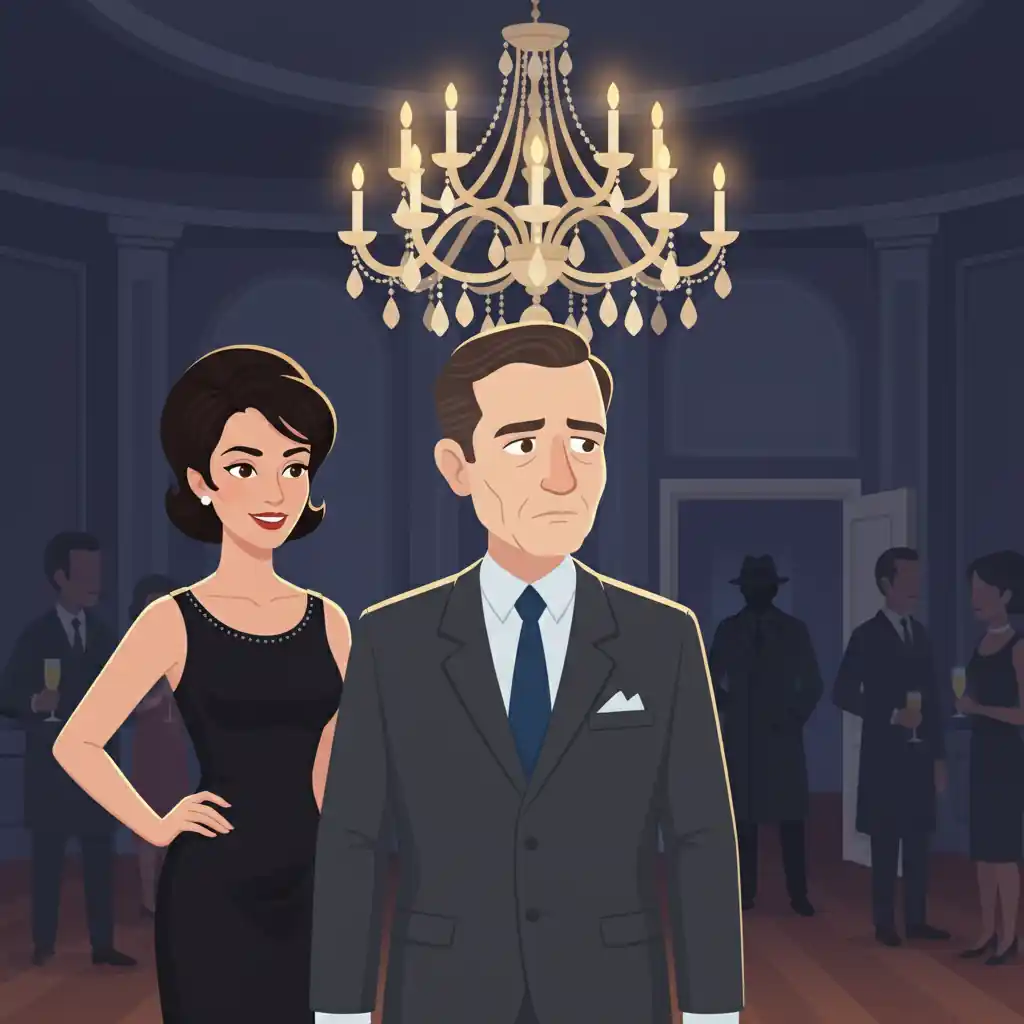
First Meeting
John Profumo, the Secretary of State for War, reportedly meets Christine Keeler at Cliveden, the Astor family's estate.
The Cliveden Parties
The notorious parties at Cliveden House, hosted by Lord Astor, bring together figures from the establishment and the London demi-monde, including Keeler, Profumo, and Soviet attaché Yevgeny Ivanov.
Security Concerns Emerge
MI5 reportedly becomes aware of Keeler's simultaneous relationships with Profumo and Ivanov, prompting an investigation into potential security risks.
Press Speculation Begins
Initial press stories hinting at a scandal involving a minister and a call girl begin to circulate, though without naming individuals.
Profumo's Statement to Parliament
John Profumo makes a personal statement to the House of Commons, denying 'any impropriety whatever' in his relationship with Christine Keeler.
Profumo's Confession and Resignation
Profumo admits he lied to Parliament, resigns from his ministerial post, and gives up his seat, sending shockwaves through the government.
Ward's Trial Begins
Stephen Ward, the osteopath who introduced Keeler and other women to high-profile figures, is arrested and put on trial for living off 'immoral earnings'.
Ward's Death
On the eve of the verdict, Stephen Ward reportedly takes an overdose of barbiturates and dies shortly after, before a jury could deliver its judgment.
Denning Report Published
Lord Denning's official report into the affair is published, concluding that there was no national security breach but criticizing the government's handling of the matter.
PROLOGUE: THE RIPPLE FROM CLIVEDEN
This story draws on historical investigations, journalism, and academic research. Some events described were the subject of public controversy or legal investigation. Allegations and interpretations are presented as reported claims rather than definitive conclusions. The Profumo Affair remains one of Britain's most notorious political scandals, a tale where the hedonism of 'swinging London' collided with the rigid secrecy of the Cold War establishment.
Imagine a specific summer weekend in 1961. The setting is Cliveden House, the grand country estate of Lord Astor, a man of immense wealth and influence. The scene is a pool party, where the cream of the British establishment mingled with the burgeoning bohemian counter-culture. Among the guests were the Secretary of State for War, a rising political star named John Profumo, and a striking 19-year-old model, Christine Keeler.
What began as a fleeting flirtation at a poolside would, within two short years, explode into a national security crisis, bring down a government minister, and shake the very foundations of the Conservative government. It was a scandal that exposed not only the vulnerabilities of Britain's Cold War intelligence but also the hypocrisies simmering beneath the surface of a society on the cusp of radical change.
ACT I: THE PLAYERS AND THE PARTIES
The early 1960s in Britain was a period of stark contrasts. On one side, the staid, post-war Conservative establishment, still clinging to notions of Empire and tradition. On the other, the nascent 'swinging London,' a world of rising pop culture, sexual liberation, and blurred class lines. The Profumo Affair would brutally expose the friction between these two worlds.
John Profumo: The 'Safe Pair of Hands'
John Profumo was, by all accounts, a golden boy of the Conservative Party. A decorated war veteran and an MP since 1940, he ascended to the coveted position of Secretary of State for War in 1960. He was married to the glamorous actress Valerie Hobson and was seen by many as a future Prime Minister. He represented the old guard: respectable, privileged, and seemingly unblemished.
Christine Keeler: The Model and the Mystery
Christine Keeler was Profumo's antithesis. A working-class girl from Middlesex, she had left home at 15, worked as a showgirl, and quickly found herself drawn into the orbit of London's burgeoning 'demi-monde' – a world of models, artists, and wealthy hangers-on. According to journalistic reports, Keeler was a vivacious, uninhibited presence who, at just 19, found herself navigating a complex web of relationships.
Stephen Ward: The Osteopath and the Pimp (Alleged)
Central to the narrative was Stephen Ward, a charismatic osteopath with an extraordinary network of connections. Ward was a society figure who counted politicians, aristocrats, and even members of the royal family among his patients and friends. He also, reportedly, housed and introduced young women like Keeler and Mandy Rice-Davies to his powerful acquaintances. Later investigations alleged that Ward facilitated a lifestyle that blurred the lines between social networking and procuring.
Yevgeny Ivanov: The Soviet Connection
Completing the dangerous triangle was Captain Yevgeny Ivanov, a Soviet naval attaché stationed at the Soviet Embassy in London. According to MI5 reports, Ivanov was a known GRU (Soviet military intelligence) officer. He was also a regular at Stephen Ward's parties and, like Profumo, became involved with Christine Keeler. This simultaneous entanglement with a British war minister and a Soviet spy would ignite the national security firestorm.
The Cliveden parties, hosted by Lord Astor, were a potent symbol of this clash of worlds. Lord Denning's later report described them as places where 'people of different social levels and different habits' mixed, sometimes leading to 'undesirable associations.' It was in this opulent yet permissive atmosphere that the threads of the scandal began to intertwine.
ACT II: THE ENTANGLEMENT AND THE WHISPERS
The infamous Cliveden pool party in July 1961 served as the epicenter. John Profumo reportedly met Christine Keeler after she emerged naked from the swimming pool. Their relationship, according to later press accounts, quickly turned intimate. What Profumo, a married man in a high-profile government position, may not have realized was the full extent of Keeler's connections.
A Dangerous Ménage à Trois
At the same time as her alleged relationship with Profumo, Christine Keeler was reportedly also involved with Captain Yevgeny Ivanov. Ward, according to public reports, introduced Keeler to Ivanov and allegedly even tried to use Keeler to extract information from both men. Journalists later reported that Ward's motives were complex, possibly ranging from a desire for influence to a naive attempt at amateur diplomacy. According to MI5 documents declassified years later, Ward had previously acted as an informal go-between for British intelligence, attempting to glean information from Ivanov.
MI5 Takes Notice
The dual relationships quickly raised red flags within MI5. The British security service, already wary of Ivanov's intelligence activities, reportedly became deeply concerned about a potential national security breach. How could the Secretary of State for War be sharing a lover with a known Soviet intelligence officer? While the Denning Report later concluded there was no evidence of Profumo having passed secrets, the potential for blackmail or compromise was immense.
Security services, according to their own reports, made efforts to warn Profumo. Lord Denning's investigation revealed that MI5 had approached Profumo through the Cabinet Secretary, Sir Norman Brook, in late 1961. Profumo reportedly assured them his relationship with Keeler had ended. This assurance, as subsequent events would reveal, was a critical misstep.
The Escalation of Gossip
Despite official attempts to contain the information, whispers began to circulate in London's social and political circles. Rumors of a minister involved with a 'good-time girl' became increasingly persistent. The story, according to historical accounts, was initially kept out of the mainstream press due to Britain's stringent libel laws and a gentlemen's agreement among editors to protect the privacy of public figures unless national security was overtly at stake.
However, the situation became untenable as Keeler's personal life unravelled further. A highly publicized incident involving a shooting at Stephen Ward's flat, related to Keeler's other relationships, brought her name into the public domain. The dam was about to break.
ACT III: THE DENIAL AND THE UNRAVELING
The public's first major glimpse into the escalating scandal came in March 1963. Questions about Profumo's association with Keeler were raised in the House of Commons by Labour MP George Wigg, who alluded to 'rumours' regarding a prominent minister. The situation forced Profumo to act.
The Fateful Statement
On March 22, 1963, John Profumo made a personal statement to the House of Commons. Standing before his peers, he delivered a categorical denial: 'There was no impropriety whatever in my acquaintanceship with Miss Keeler.' He further stated that he would 'not hesitate to issue writs for libel and slander' against anyone who suggested otherwise. The statement was, according to many political commentators at the time, a bold gamble designed to quash the rumors definitively.
For a brief period, it worked. The political establishment, bound by tradition and a desire to protect one of their own, largely accepted his word. Even the Prime Minister, Harold Macmillan, publicly supported Profumo, reportedly on the basis of assurances given privately by the minister. However, outside the hallowed halls of Parliament, the story refused to die.