
Naval Oil Reserves Established
President William Howard Taft designates federal lands in California and Wyoming as naval oil reserves, intended for future U.S. Navy fuel.
Harding Elected President
Warren G. Harding, a Republican from Ohio, is elected president, ushering in an administration that would become mired in scandal.
Albert Fall Appointed Secretary of Interior
President Harding appoints Albert B. Fall, a former senator from New Mexico with a questionable financial past, as Secretary of the Interior.
Transfer of Naval Oil Reserves to Interior
President Harding, via executive order, transfers control of the naval oil reserves, including Teapot Dome, from the Navy Department to the Department of the Interior.
Secret Leases Awarded
Secretary Fall secretly leases the Teapot Dome reserve to Harry F. Sinclair's Mammoth Oil Company and the Elk Hills reserve to Edward L. Doheny's Pan-American Petroleum and Transport Company.
Investigation Begins
Journalists and senators begin to raise questions about the secrecy and legitimacy of the oil reserve leases, prompting a Senate inquiry led by Senator Thomas J. Walsh.
President Harding Dies
President Warren G. Harding dies suddenly in San Francisco while on a cross-country speaking tour, adding a layer of mystery and tragedy to the unfolding scandal.
Senate Investigation Intensifies
The Senate investigation uncovers evidence of large sums of money changing hands, including a $100,000 'loan' from Doheny to Fall.
Supreme Court Invalidates Leases
The U.S. Supreme Court declares the Teapot Dome and Elk Hills leases fraudulently obtained and therefore invalid, ordering the oil fields returned to government control.
Fall Convicted of Bribery
Albert B. Fall is convicted of accepting a bribe from Edward Doheny, becoming the first U.S. cabinet secretary to be convicted of a felony committed while in office.
Doheny Acquitted of Bribery
Edward Doheny, despite paying the bribe, is acquitted of bribery charges. This outcome sparked public debate about justice for the wealthy.
Sinclair Acquitted of Conspiracy
Harry F. Sinclair is acquitted of conspiracy charges, though he was later convicted for contempt of court and Congress for his handling of evidence.
PROLOGUE: THE WHISPER BEHIND THE ROAR
This story draws on historical investigations, journalism, and academic research. Some events described were the subject of public controversy or legal investigation. Allegations and interpretations are presented as reported claims rather than definitive conclusions. The Teapot Dome Scandal stands as a stark reminder that even amidst an era of unprecedented prosperity, the foundations of American governance could be corroded by greed and illicit deals.
The 1920s roared. Jazz flowed, flappers danced, and America seemed to surge forward on a tide of new technologies and economic optimism. World War I was a fading memory, and the nation embraced a spirit of laissez-faire capitalism. Yet, beneath the glittering surface of the Jazz Age, a darker current ran – a current of unchecked ambition and backroom deals, particularly within the highest echelons of government. It was an era, some historians have argued, ripe for the plucking by those who saw public office not as a trust, but as an opportunity for private enrichment.
At the heart of this unfolding drama was a seemingly innocuous piece of land in Wyoming, a remote expanse of sagebrush and rock formations, one of which resembled a teapot. This wasn't just any patch of dirt; it was one of the nation’s strategically vital naval oil reserves, set aside for the U.S. Navy's future fuel needs. Established in 1912 by President William Howard Taft, these reserves were meant to be sacrosanct, a national insurance policy against future energy shortages for the fleet.
But the path to power often requires strange bedfellows. President Warren G. Harding, a genial, small-town newspaper editor from Ohio, won the White House in 1920 with a promise of a 'Return to Normalcy.' His administration, however, quickly became a magnet for cronies and opportunists, earning the infamous moniker of the 'Ohio Gang.' Among them was a man whose ambition outweighed his ethics, a figure who would orchestrate the most shocking federal corruption scandal the nation had ever witnessed: Albert B. Fall.
The stage was set for a betrayal of public trust, a saga that would unfold in smoky Senate hearing rooms, hushed private meetings, and eventually, the halls of justice. The story of Teapot Dome is not merely a tale of oil and money, but of the precarious balance between private enterprise and public good, and the enduring question of who truly benefits when government assets are privatized under a veil of secrecy.
ACT I: THE COWBOY AND THE 'OHIO GANG'
To fully grasp the mechanics of the Teapot Dome scandal, one must first understand the key players and the political landscape of the Harding administration. President Warren G. Harding, a man described by some historians as ill-suited for the presidency, surrounded himself with a mix of genuine talent and a coterie of old friends from his home state, many of whom were reportedly more interested in self-enrichment than public service. This informal network became known to critics as the 'Ohio Gang,' and their influence reportedly created a climate ripe for corruption.
Central to the unfolding conspiracy was Albert B. Fall, Harding’s Secretary of the Interior. Fall was a former U.S. Senator from New Mexico, a figure with a rough-hewn, cowboy persona and a notorious affinity for fast money. Journalists had previously questioned Fall's financial dealings, noting his history of questionable land speculation and his reported struggles with debt. Despite these concerns, Harding, reportedly valuing loyalty above all, appointed Fall to the powerful Interior Department, granting him stewardship over vast federal lands and resources, including the critical naval oil reserves.
Fall harbored a long-standing belief that the naval oil reserves, particularly Teapot Dome in Wyoming and Elk Hills and Buena Vista in California, were being 'wasted' by lying dormant. He argued publicly that the oil was draining away into neighboring private wells, a claim that was later disputed by Navy experts. According to contemporary reports, Fall advocated for leasing these reserves to private companies, ostensibly for conservation and to generate revenue, but privately, critics alleged, for personal gain.
The initial step in Fall's plan required a transfer of authority. The naval oil reserves had historically been under the jurisdiction of the Navy Department, intended exclusively for military use. On May 31, 1921, President Harding signed Executive Order 3474, which, reportedly at Fall's urging, transferred control of these valuable oil fields from the Navy to the Department of the Interior. This move, according to subsequent Senate investigations, effectively removed the reserves from the oversight of the more cautious Navy Secretary, Edwin Denby, and placed them squarely under Fall's control.
The transfer was initially met with little public fanfare. It was presented as an administrative efficiency measure, a rationalization of federal land management. However, for those who understood the implications, like Wyoming Senator John B. Kendrick and conservationist Gifford Pinchot, this seemingly bureaucratic tweak was a red flag. Critics argued the executive order was an alarming overreach, setting the stage for what would become a monumental scandal, effectively handing the keys to a national treasure over to a single, ambitious individual.
The Allure of Hidden Wealth
What made these specific oil fields so enticing? Geologically, they were believed to be massive underground reservoirs. Teapot Dome, though smaller than the California reserves, was named for a unique rock formation in its midst and was known to contain high-grade crude. The sheer volume of oil represented immense potential wealth, enough to fuel the entire U.S. Navy for decades. The prospect of tapping into such riches, outside the strictures of public bidding and transparent process, proved irresistible to certain powerful interests and the officials they cultivated.
ACT II: THE SECRET LEASES AND THE BAGS OF CASH
With the naval oil reserves firmly under his control, Secretary Albert Fall moved swiftly and, according to later investigations, with deliberate secrecy. He ignored standard competitive bidding processes, which would have opened the leases to public scrutiny and ensured the best deal for taxpayers. Instead, Fall engaged in direct, private negotiations with two powerful oil magnates: Harry F. Sinclair of Mammoth Oil Company and Edward L. Doheny of Pan-American Petroleum and Transport Company.
In April 1922, Fall secretly leased the Teapot Dome reserve to Sinclair and the Elk Hills reserve to Doheny. The terms of these leases were extraordinary. The companies were granted exclusive rights to extract oil from these federal lands in exchange for a percentage of the oil produced, which was to be stored for the Navy. However, critics, including journalists and later Senate investigators, argued the terms were highly unfavorable to the government, potentially costing taxpayers millions in lost revenue. The lack of transparency surrounding these deals immediately raised suspicions among those few who knew of them.
The secrecy was allegedly paramount. According to official reports, Fall did not consult with the Navy Secretary, Edwin Denby, or other cabinet members, nor did he seek the approval of Congress for these significant transactions. Journalists reported that the leases were inked in closed-door meetings, away from public and press scrutiny. This clandestine approach would become a central point of contention in subsequent investigations, fueling accusations of a deliberate attempt to conceal illicit dealings.
The Peculiar Payments: A Sudden Change of Fortune
Shortly after the leases were signed, an alarming pattern of financial improvement for Albert Fall began to emerge. Fall, who had been reportedly struggling with debt and mortgage payments, suddenly found himself able to make lavish purchases. He acquired a sprawling ranch, invested in livestock, and significantly improved his property in New Mexico, reportedly spending over $150,000 on renovations and improvements – an amount far exceeding his modest government salary. This sudden affluence, according to investigators, became a key piece of circumstantial evidence.
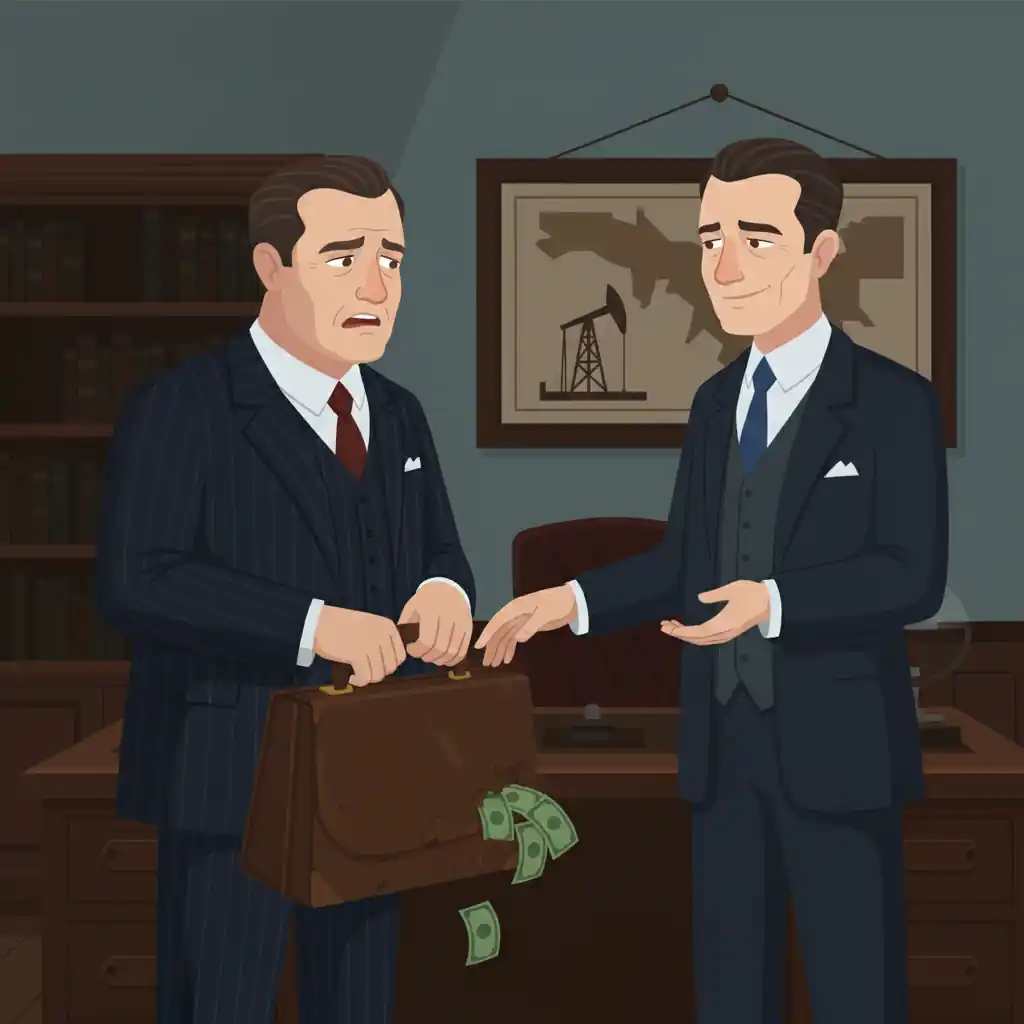
The most infamous of these transactions involved Edward L. Doheny. According to testimony given later in court, Doheny, a long-time acquaintance and former business partner of Fall's, provided a 'loan' of $100,000 to Fall. This transaction was reportedly conducted in cash, delivered in a 'little black satchel' by Doheny’s son, Albert B. Doheny, to Fall’s home. Doheny later testified that this was merely a friendly loan between old friends, without any expectation of quid pro quo for the oil leases. However, prosecutors argued it was a clear bribe, directly linked to the secret deals.
Similarly, Harry F. Sinclair, the beneficiary of the Teapot Dome lease, also allegedly made payments and gifts to Fall. Investigations later revealed that Fall received cattle, grazing rights, and a substantial sum of money from Sinclair's companies. While the exact amounts and precise nature of all these transactions were hotly debated in court, the timing and the sudden transformation of Fall's financial situation were undeniably suspicious to investigators and the public alike.
Critics and later historians have highlighted the sheer audacity of these transactions. A sitting cabinet secretary, directly overseeing the disposal of immensely valuable national assets, was simultaneously receiving large, undisclosed cash payments and gifts from the very industrialists benefiting from his decisions. This, according to prosecutors, was not just a conflict of interest, but a blatant act of bribery, hidden behind a thin veil of 'loans' and personal favors, demonstrating what some termed the 'anything goes' attitude of certain powerful figures during the Roaring Twenties.
ACT III: THE WHISTLEBLOWERS AND THE SENATE'S GRILLING
The veil of secrecy surrounding the Teapot Dome and Elk Hills leases was not destined to last. Whispers began to circulate almost immediately after the deals were struck, primarily from within the oil industry itself and from disgruntled Navy officials. The first public outcry came from independent oil producers who felt unfairly shut out of the lucrative federal contracts. Among the most vocal critics was former Attorney General Thomas W. Gregory and other progressive politicians.
Journalists, particularly the investigative reporter Carl C. Magee of the New Mexico State Tribune, began to publish articles questioning Fall’s sudden wealth and the highly unusual leasing arrangements. Magee specifically reported on Fall’s extravagant ranch improvements, noting the stark contrast to his known financial struggles just months before. His reporting, though initially met with resistance and skepticism from some quarters, helped lay the groundwork for a broader investigation.
The critical moment arrived in October 1922, when Senator Robert La Follette of Wisconsin, a progressive firebrand, introduced a resolution calling for a Senate investigation into the leases. The task fell to the Senate Committee on Public Lands and Surveys, chaired by Senator Thomas J. Walsh of Montana. Walsh, a quiet but tenacious Democrat, began a painstaking and relentless inquiry that would stretch over two years and uncover the full extent of the scandal.
The Senate’s Patient Pursuit
Senator Walsh’s investigation was, by all accounts, a masterclass in forensic persistence. Initially, Fall, Doheny, and Sinclair all denied any wrongdoing, offering plausible but ultimately flimsy explanations for the transactions. Fall famously claimed the $100,000 from Doheny was a loan to purchase livestock for his ranch, not a bribe. Sinclair initially refused to cooperate, reportedly destroying documents and tampering with witnesses, leading to later charges of contempt.
Walsh’s committee meticulously pieced together the evidence, subpoenaing bank records, personal financial statements, and witnesses from across the country. The turning point arrived when testimony revealed that Doheny’s son had indeed delivered a suitcase containing $100,000 in cash to Fall’s home in Washington D.C. This direct link, corroborated by multiple witnesses, shattered the façade of innocence Fall and Doheny had attempted to maintain. The image of the 'little black satchel' became an enduring symbol of the scandal.
The public reaction was one of shock and outrage. The hearings, widely covered by newspapers and newsreels, revealed a disturbing picture of corruption at the highest levels of government. The very assets set aside for national security were being treated as personal spoils by political appointees. Critics argued this represented a profound betrayal of public trust, shaking the nation's faith in its leaders during a time when government seemed to be retreating from progressive reforms.
Newspapers across the country lambasted the 'Ohio Gang' and the pervasive corruption. Editorials demanded justice and called for accountability from all involved. The scandal quickly overshadowed all other political news, becoming a defining controversy of the Harding administration and casting a long shadow over the 'Return to Normalcy' that Harding had promised. The revelations exposed not just the venality of a few individuals, but, according to some historians, a systemic weakness in government oversight and ethical standards.
ACT IV: HARDING'S DEMISE AND THE SHIFTING SANDS OF JUSTICE
As the Teapot Dome investigation gained momentum, President Warren G. Harding embarked on a grueling 'Voyage of Understanding' cross-country tour in the summer of 1923. Sources close to the President, including his personal physician, reported that Harding was increasingly distraught by the growing whispers of corruption within his administration, particularly concerning his close associates and the Teapot Dome leases. He reportedly confided to a friend, 'I have no trouble with my enemies... But my friends, my God-damned friends, they’re the ones that keep me walking the floor nights!'
Harding died suddenly in San Francisco on August 2, 1923, officially from a stroke or heart attack, though conspiracy theories about his death circulated for years, fueled by the scandal. His demise plunged the nation into mourning, but it also elevated Vice President Calvin Coolidge to the presidency. Coolidge, a man known for his taciturn nature and unimpeachable integrity, was determined to restore public faith in the government. He reportedly moved swiftly to clean house, retaining Attorney General Harlan Fiske Stone and appointing special prosecutors to pursue the Teapot Dome cases vigorously.
The legal battles that followed were protracted and complex, stretching for years through various courts. The government filed civil lawsuits to cancel the leases and criminal charges against Fall, Doheny, and Sinclair. A critical legal victory for the government came in 1927 when the U.S. Supreme Court, in Mammoth Oil Co. v. United States and Pan American Petroleum and Transport Co. v. United States, invalidated both the Teapot Dome and Elk Hills leases. The Court ruled that the leases had been obtained through fraud and corruption, ordering the oil fields returned to federal control. This decision was a powerful affirmation of the Senate's findings and a significant blow to the oil magnates.
Justice, Unevenly Applied
The criminal trials, however, yielded a mixed bag of results, sparking further public debate about the fairness of the justice system for the rich and powerful.
| Defendant | Charges | Outcome | Notes |
|---|---|---|---|
| Albert B. Fall | Bribery, Conspiracy | Convicted of Bribery (1929) | Sentenced to one year in prison and a $100,000 fine. First U.S. cabinet secretary jailed for crimes committed in office. |
| Edward L. Doheny | Bribery | Acquitted of Bribery (1930) | Despite paying the bribe, he was acquitted, leading to public outcry and criticism of the justice system. |
| Harry F. Sinclair | Conspiracy | Acquitted of Conspiracy (1928) | Later convicted of contempt of court (for jury tampering) and contempt of Congress (for refusing to testify), serving jail time for these offenses. |
Albert Fall's conviction in 1929 marked a historic moment: he became the first cabinet secretary to be imprisoned for actions taken while in office. He served nine months of his one-year sentence. However, the acquittal of Edward Doheny, the man who paid the bribe, for the charge of bribery, sparked considerable public cynicism. Critics argued that the justice system seemed to punish the recipient of the bribe while excusing the giver, highlighting perceived disparities in how wealthy individuals faced the law. Sinclair, though acquitted of the primary conspiracy charge, did serve jail time for his blatant attempts to obstruct justice, revealing the lengths to which some involved attempted to hide their tracks.
The differing outcomes for Fall, Doheny, and Sinclair fueled a national conversation about influence, wealth, and the law. While the government ultimately regained control of the valuable oil reserves, the legal proceedings left a lingering sense that 'justice' was not equally applied, and that the mechanisms of influence could still shield powerful figures from full accountability.
ACT V: THE LEGACY OF BETRAYAL
The Teapot Dome Scandal stands as a monumental cautionary tale in American history, leaving an indelible mark on the public consciousness and governmental practices. Its immediate impact was a profound erosion of public trust in government. The spectacle of a cabinet secretary trading national assets for personal gain, and the subsequent uneven application of justice, shattered the idealized image of public service for many Americans.
Historians have widely debated the broader implications of the scandal. Some argue it was an isolated incident of individual greed, while others contend it exposed deeper systemic vulnerabilities within the early 20th-century federal government, particularly concerning the lack of stringent ethical oversight during a period of rapid industrial expansion and wealth accumulation. The 'Ohio Gang' was not just a collection of individuals, but, as critics suggested, a symptom of a political culture that prioritized patronage and personal loyalty over competence and integrity.
Institutional Reforms and Lingering Distrust
The scandal catalyzed significant reforms in how government resources were managed and how ethical standards for public officials were enforced. It led to:
- Increased Congressional Oversight: The Senate investigation, led by Senator Walsh, demonstrated the power of congressional committees to hold the executive branch accountable, setting a precedent for future investigative efforts.
- Enhanced Transparency in Federal Contracting: While not immediately eliminating all issues, Teapot Dome put pressure on government agencies to implement more transparent bidding processes for federal contracts and resource leases.
- Strengthened Ethics Regulations: The scandal prompted calls for clearer ethical guidelines for cabinet members and high-ranking officials, though implementation was gradual.
- Public Awareness: It heightened public awareness of potential corruption and spurred civic organizations and watchdog groups to monitor government activities more closely.
The long-term consequences of Teapot Dome extended beyond legal and administrative reforms. It provided a powerful narrative for progressive critics of unchecked corporate power and government-industry collusion. It became a benchmark against which future scandals would be measured, frequently invoked as a symbol of high-level corruption and betrayal of public trust.
Ironically, the very oil reserves at the heart of the scandal, Teapot Dome and Elk Hills, continued to serve their original purpose. After the leases were voided, the fields were returned to naval control and eventually transitioned into strategic petroleum reserves, underscoring their enduring national importance, untouched by private exploitation for decades thereafter.
The Teapot Dome scandal, as documented by journalists and historians, stands as a stark reminder that even in an era perceived as 'normal,' the lure of vast wealth can corrupt public service. It underscored the fragile nature of democratic institutions when left unguarded against the machinations of powerful private interests and ambitious, unprincipled officials. The 'little black satchel' became more than just a piece of evidence; it became a symbol of a nation's lost innocence in the booming, yet ultimately flawed, Roaring Twenties.
CLOSING: THE ECHOES OF CORRUPTION
The Teapot Dome Scandal became a defining controversy of its time. Investigations revealed significant concerns regarding the clandestine leasing of naval oil reserves and the illicit payments to a cabinet secretary. While the scandal resulted in the conviction of a cabinet member for bribery and the invalidation of the fraudulent leases, historians continue to debate the full implications of the events on public trust and governmental ethics. The saga remains a critical case study in American history, illustrating the enduring tension between private gain and public good.