
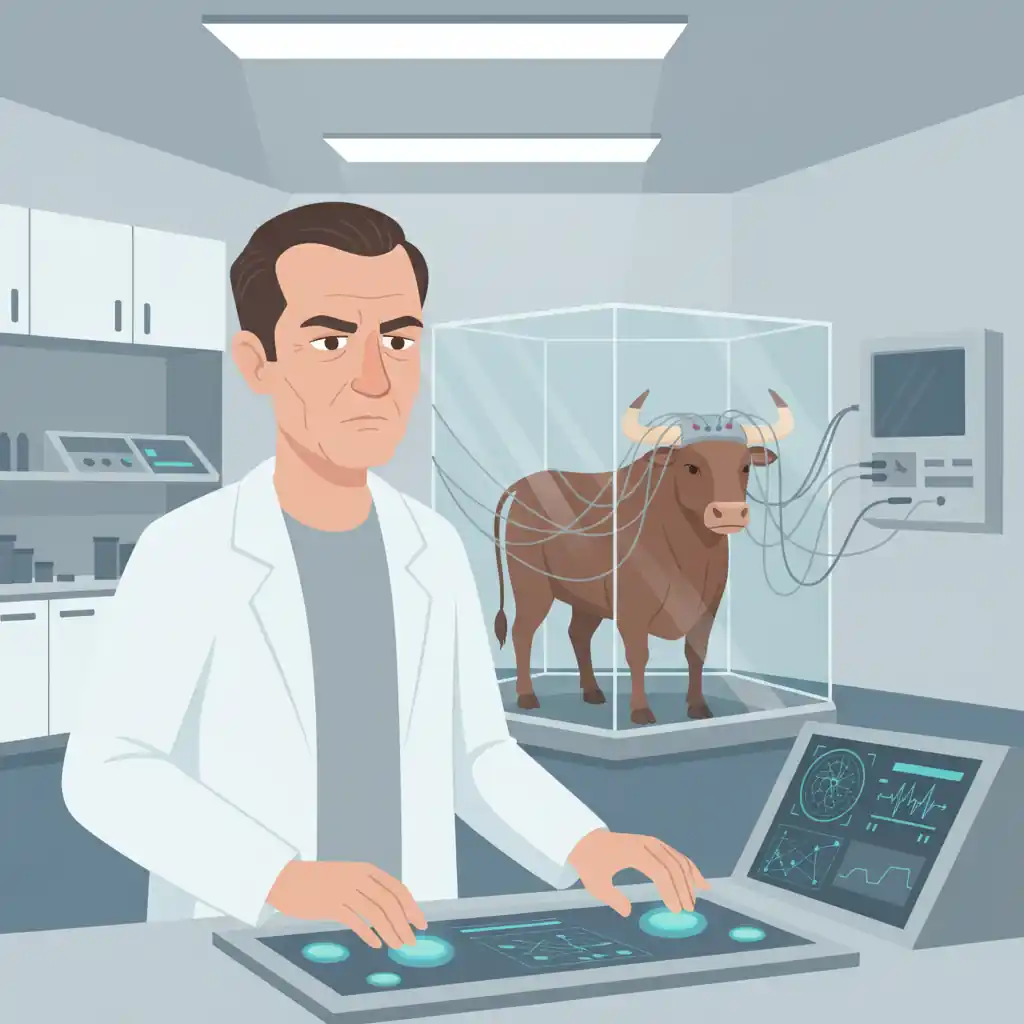
PROLOGUE: THE COMMAND FROM WITHIN
Imagine a dusty bullring in Córdoba, Spain, in 1963. Not the usual spectacle of cape and sword, but something far stranger, far more chilling. A magnificent, charging Miura bull, eyes blazing, horns lowered, barrels towards a man standing alone in the center of the arena. This is no matador; he wears a simple suit, holds no weapon, only a small, metallic box with a button. As the beast closes the distance, a flicker of panic might cross the spectator's mind. But then, a calm press of a button, an invisible signal zips through the air, and the bull, mid-charge, abruptly skids to a halt. It turns, docile as a lamb, and trots away.
This was not a parlor trick. This was a demonstration of a power once confined to science fiction: the ability to command the mind. The man with the box was José Manuel Rodríguez Delgado, a pioneering neuroscientist from Yale University, and the bull was merely a puppet on an invisible string. Buried deep within its skull, surgically implanted into its brain, was a 'stimoceiver'—a remote-controlled electrode system designed to intercept and override its most primal urges. Delgado's work, stretching from the 1950s to the 1970s, would ignite a firestorm of ethical debate, promising cures for mental illness while simultaneously raising the terrifying specter of human mind control.
At a time when psychology still grappled with Freud and pharmacology was in its infancy, Delgado dared to suggest that consciousness, emotion, and free will were not ethereal mysteries but reducible to electrical signals. And if they were signals, they could be intercepted, manipulated, and even generated. He didn't just study the brain; he sought to orchestrate it, pushing the boundaries of what it meant to be human, and asking uncomfortable questions about who, or what, truly held the reins of our minds.
ACT I: THE MAD SCIENTIST OR THE SAVIOR?
Born in Spain in 1915, José Delgado initially pursued medicine, graduating from the University of Madrid. The Spanish Civil War, a brutal crucible of ideological conflict, left an indelible mark, fueling his desire to understand and perhaps even control the destructive impulses of humanity. He often spoke of the brain as the 'last frontier,' a biological wilderness where the roots of aggression, madness, and even love resided. His early studies focused on the fundamental question: what happens when you introduce an electrical current into the intricate wiring of the brain?
Delgado’s odyssey began with animals. In the serene labs of Yale, far from the bullrings, he meticulously implanted fine wire electrodes, thinner than a human hair, into the brains of cats, monkeys, and chimpanzees. These weren't random probes; Delgado painstakingly mapped specific regions. A jolt to one area might elicit a yawn; another, a burst of rage; yet another, an involuntary movement of a limb. He meticulously documented these responses, creating a catalog of behavioral 'commands' that could be triggered by external signals.
One of his most striking early experiments involved a chimpanzee named 'Paddy.' With electrodes placed in her caudate nucleus—a part of the brain involved in motor control and learning—Delgado could make Paddy walk in circles, stop, or even initiate complex sequences of behavior, all at the flick of a switch. He demonstrated how a gentle electrical pulse could override a dominant monkey's aggressive tendencies, forcing it to back down from a confrontation. The implications were staggering: if aggression could be switched off, could peace be switched on?
The sheer audacity of his methods, though groundbreaking, immediately drew both fascination and apprehension. Critics wondered about the suffering inflicted, the ethics of 'playing God' with sentient beings. Delgado, however, remained steadfast, convinced that his work held the key to unlocking the brain's deepest secrets and potentially curing debilitating neurological and psychiatric disorders. He saw himself not as a mad scientist, but as a pioneer, charting a new path through the uncharted territory of the mind.
The Unintended Symphony of the Brain
One of Delgado's most interesting 'oddities' was discovering how interconnected brain functions truly were. He noted that stimulating one area to produce, say, a specific arm movement, might also trigger a subtle emotional shift or an altered vocalization. It was rarely just one isolated response; often, it was a cascade, a 'symphony' of changes revealing the brain's holistic nature. This made isolating specific 'commands' tricky, but also hinted at the complexity of conscious experience.
He didn't just elicit responses; he trained animals to self-stimulate their own brains using levers connected to the electrodes. Monkeys would press a lever hundreds of times an hour to receive a jolt of pleasure, ignoring food or water, sometimes to the point of exhaustion. This revealed powerful reward pathways, but also highlighted the potential for addiction and forced submission if the 'pleasure button' was externally controlled.
This early animal work laid the controversial groundwork for his most infamous innovations. Delgado was convinced that if he could precisely control a chimp's aggression, or a cat's purr, then the human brain, despite its complexity, was not entirely beyond reach. The question was not if it could be done, but when—and what would be the cost?
ACT II: THE STIMOCEVERA AND THE STAGE
Delgado’s most significant technological leap was the 'stimoceiver.' This wasn't just a simple electrode; it was a miniaturized, implantable device that could not only deliver electrical stimulation but also transmit brain activity remotely, without cumbersome wires tethering the subject to a machine. Roughly the size of a postage stamp, with multiple tiny electrodes extending like spider legs, it represented a quantum leap in neurotechnology. It meant subjects could move freely, their every neural twitch and induced behavior monitored from a distance, blurring the line between observation and manipulation.
The Justification for Human Trials
By the mid-1960s, Delgado felt confident enough to transition his experiments to human subjects. This was, naturally, the most ethically fraught phase of his work. His justification was rooted in a genuine, if controversial, desire to treat severe psychiatric conditions—epilepsy, schizophrenia, and intractable aggression—that resisted traditional therapies. He argued that if a brain region was responsible for a debilitating symptom, then directly modulating that region with electricity could offer a cure where drugs or psychotherapy failed.
Working primarily with patients at the La Paz Hospital in Madrid, often in collaboration with Dr. Francisco R. de Molina, Delgado carefully selected individuals suffering from profound mental illness, many of whom were institutionalized. These patients were typically those who experienced frequent, severe seizures, violent outbursts, or deep catatonia. The procedures involved drilling small holes in the skull and carefully implanting the stimoceiver, often with patients awake to report sensations, under local anesthesia.
The Unraveling of Free Will
The results were, to put it mildly, astonishing and deeply unsettling. With a press of a button, Delgado could induce a variety of responses in his human subjects: a sudden burst of rage, uncontrollable laughter, a feeling of deep pleasure, or even the involuntary movement of a limb. One patient, a 28-year-old woman with a history of violent outbursts, would spontaneously stop her aggressive behavior when a specific area of her brain was stimulated, stating she felt 'calm' and 'relaxed.'
A perhaps more jarring demonstration involved a young man with epilepsy. When a particular electrode was stimulated, he would clench his fist, open it, and then clench it again, repeatedly. When asked why he was doing this, he claimed, 'I am doing it myself.' He had no conscious awareness that his actions were being externally controlled. This particular experiment profoundly challenged the very notion of free will, suggesting that our internal sense of agency could be overridden, yet our minds would still rationalize the forced action as our own.
Consent in the Gray Zone
The question of informed consent hung heavy over these experiments. How could a severely mentally ill patient, often institutionalized and medicated, truly consent to having electrodes implanted in their brain and their behavior manipulated? While Delgado maintained he always sought consent from patients and their families, the power dynamics and the lack of clear understanding of the long-term implications make these ethical considerations particularly thorny by modern standards. Was it therapeutic intervention, or merely the sophisticated control of vulnerable minds for scientific curiosity? This ethical tightrope walk would define his legacy and ultimately fuel intense public and scientific backlash.
The 'stimoceiver' could communicate wirelessly over distances up to 60 feet. This meant Delgado could control and monitor subjects even when they were in another room, completely untethered. He even experimented with a self-contained unit that a subject could wear, providing stimulation on a programmed schedule, a precursor to modern deep brain stimulation devices but with a far broader, and more controversial, scope of behavioral manipulation.
ACT III: THE ELECTRIC BULL AND THE HUMAN MIND
The image of Delgado facing down the charging bull became the iconic, and often sensationalized, symbol of his work. That particular demonstration in 1963 was designed to be impactful, to show the raw power of his technology. The bull, wired with a stimoceiver, had electrodes in its caudate nucleus—the very same area he stimulated in 'Paddy' the chimp to inhibit aggression. When Delgado pressed the button, the bull's brain received an electrical signal that effectively 'turned off' its aggressive drive, causing it to halt and detour. It was a potent, dramatic illustration, but it barely scratched the surface of his human experiments, which were far more complex and ethically challenging.
Orchestrating Emotions and Memories
In his human trials, Delgado wasn't just stopping aggression; he was attempting to orchestrate a symphony of the mind. He recorded instances where patients experienced vivid hallucinations, re-lived forgotten memories with startling clarity, or burst into tears or laughter without any external trigger. One patient, when a specific brain region was stimulated, felt an intense, overwhelming urge to 'confess' something, even though there was nothing to confess. This suggested that deeply personal, internal experiences could be externally summoned.