
PROLOGUE: THE ASYLUM'S SHADOW
The mid-20th century was a crucible for psychiatric experimentation, a period where the boundaries of medical ethics were, at best, fluid, and at worst, non-existent. In the chilling shadow of institutions like New York’s Bellevue Hospital, one figure stands out with a particularly unsettling legacy: Dr. Lauretta Bender. Her vision of 'treating' disturbed children would involve methods that, in hindsight, evoke more horror than healing. This is the story of an era when childhood itself was pathologized, and young minds became unwilling battlegrounds for medical theories.
Bellevue's Dark Ward: Where Children Became Patients
Imagine a world where a child’s temper tantrum, withdrawn demeanor, or simply a lack of parental guidance could land them in a psychiatric ward, diagnosed with 'childhood schizophrenia.' These were not rare cases. Thousands of children, often from impoverished backgrounds, orphans, or those deemed 'problematic' by their families, entered the doors of institutions, vulnerable and voiceless. Bellevue Hospital, a sprawling, imposing structure, housed one of the largest psychiatric divisions for children in the world. It was here that Bender would embark on her controversial research, driven by a fervent belief in her own theories, no matter the cost to her young patients.
Bender was a towering figure in American child psychiatry, respected by many of her peers, yet her methods were extreme. She saw mental illness in children not as a complex interplay of environment and neurobiology, but often as a 'maturational lag,' a glitch in development that could be corrected—or rather, shocked—into submission. Her treatments were radical: hundreds of electroshock treatments, insulin-induced comas, and a cocktail of mind-altering drugs, all administered to children, some as young as three years old. The term 'patient' often felt more like 'prisoner' in these confines, their brains the unwitting subjects of a grand, terrifying experiment.
This narrative dives into the chilling reality of Bender's work, dissecting the scientific rationales, the sheer volume of children subjected to these procedures, and the enduring questions of consent, therapeutic intent, and the long-term human cost. It's a journey into a dark chapter of medical history where the pursuit of a cure overshadowed the fundamental principle of 'first, do no harm.'
The Unseen Scar: A Generation Under the Electrode
The silence surrounding these experiments for decades is perhaps as disturbing as the experiments themselves. Many of Bender's patients grew up with fragmented memories, unexplained anxieties, and a profound distrust of authority. Their stories were largely unheard, dismissed as the ramblings of 'mentally ill' individuals. It would take decades, and the tireless work of advocates and survivors, to finally pull back the curtain on the grim reality of 'The Prisoner Brain Surgery.'
ACT I: THE ARCHITECT OF 'INTEGRATION'
Dr. Lauretta Bender was a force of nature in mid-20th century American psychiatry. Born in 1897, she trained at Cornell and Johns Hopkins, eventually becoming the Senior Psychiatrist in Charge of the Children’s Psychiatric Ward at Bellevue Hospital in 1934, a position she held for three decades. Her intellect was undeniable, her ambition immense. Yet, it was her unwavering, almost zealous, commitment to a particular theory of mental illness in children that would define her controversial legacy.
The Bender-Gestalt Test: A Glimpse into the Mind
One of Bender's lasting contributions to psychology, ironically, was the Bender-Gestalt Test, developed in 1938. This visual-motor test, still used today in modified forms, asks patients to copy a series of geometric figures. Bender believed a child's reproductions could reveal underlying neurological or psychological issues, particularly 'schizophrenia' or 'organicity.' This test became a cornerstone of her diagnostic framework, often preceding the most drastic interventions. For Bender, the child’s drawings were not just art; they were windows into a brain she was determined to 'fix.'
Her core theory was that childhood schizophrenia, a diagnosis widely applied to a range of developmental and behavioral issues at the time, was primarily a 'maturational lag' or a 'defect in integration' of various brain functions. She believed these children struggled to 'integrate' their sensory perceptions, motor skills, and psychological experiences into a coherent whole. The solution? To provide an intense 'integrative experience' – a euphemism for physically and psychologically shocking the brain into proper functioning.
The 'Shock' Doctrine: A Therapeutic Mandate
Bender was not unique in her use of shock therapies; these were a widespread, if poorly understood, treatment for adults in the 1940s and 50s. What set her apart was the sheer scale and the age of her patients. She began administering electroshock therapy (ECT) to children as young as three, believing it could 'break through' their developmental blockages. To Bender, these were not punitive measures but necessary tools to help children 'integrate' and overcome their 'primitive' thought patterns.
The logic, as presented by Bender and her supporters, was deceptively simple: if the brain was 'stuck,' a powerful jolt could unstick it. If the child was withdrawn, a 'massive assault on the central nervous system' could force them into engagement. This was an era hungry for solutions to mental illness, and Bender offered what appeared to be a decisive, albeit brutal, approach. Her clinic became a hub of experimentation, attracting funding and students, all eager to witness and participate in the 'integration' of disturbed young minds. For thousands of children, Bellevue became less a place of healing and more a laboratory.
Lauretta Bender was notorious for her relentless work ethic, often working seven days a week. She believed firmly in the therapeutic benefits of a 'controlled environment,' which for many children, meant extended stays in the hospital, far from their families, and under constant observation. Her dedication was unquestionable, but so was the controversy it generated.
ACT II: ELECTROSHOCK AND INSULIN COMA
The centerpiece of Lauretta Bender's 'integrative' therapy was electroconvulsive therapy (ECT), often referred to simply as 'electroshock.' While ECT is still used today, its application in the mid-20th century, especially on children, was starkly different and profoundly more brutal. In Bender's wards, the procedure was a routine intervention for children exhibiting a wide range of behaviors—from extreme withdrawal to hyperactivity, from learning difficulties to what was then termed 'psychotic reactions.'
The Jolt: ECT for Tiny Brains
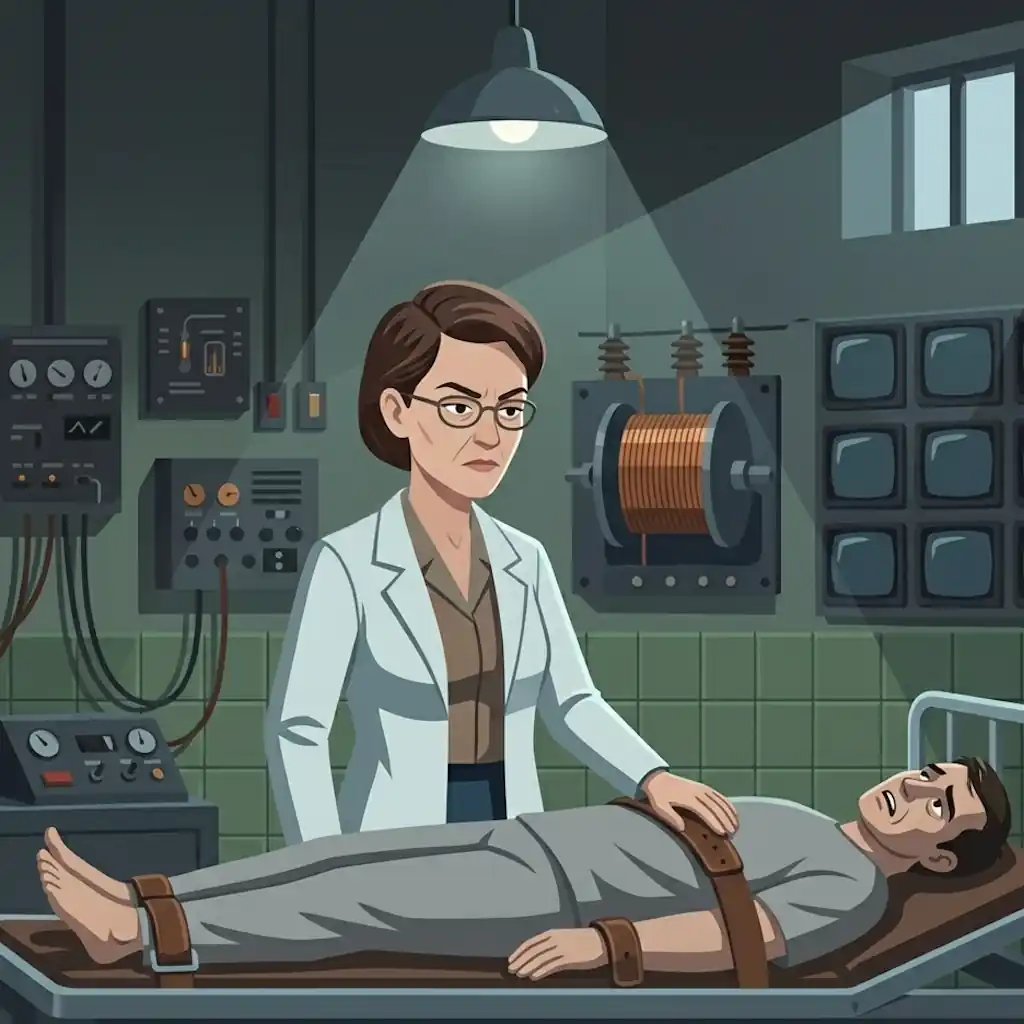
Imagine a child, some as young as three, strapped to a table, electrodes attached to their temples. An electrical current, typically 100 to 150 volts, would then be passed through their brain, inducing a grand mal seizure. Crucially, in Bender's era, ECT was often administered without muscle relaxants or proper anesthesia, leading to violent convulsions, broken bones, and profound psychological trauma. The stated goal was to 'reset' the brain, to create a tabula rasa upon which 'normal' development could resume. Children often received multiple treatments, sometimes daily, for weeks or even months. The immediate effects were terrifying: disorientation, confusion, severe memory loss, and an overwhelming sense of fear.
Bender personally oversaw thousands of these treatments, claiming a success rate of up to 70% in 'curing' childhood schizophrenia, a claim that would later be largely disproven. Her published works meticulously detailed the procedures, documenting how children would sometimes beg for the treatments to stop, or develop profound phobias related to the treatment room. Yet, Bender framed these reactions as part of the 'therapeutic process,' a necessary step towards 'integration.'
Insulin Coma Therapy: Inducing Near-Death
Beyond ECT, Bender also employed Insulin Coma Therapy (ICT), a procedure even more dangerous and now universally discredited. ICT involved injecting patients with massive doses of insulin, causing their blood sugar to plummet to dangerously low levels, inducing a profound coma. The coma would last for hours, sometimes longer, and patients would often experience seizures, sweating, and extreme disorientation upon waking. The theory, again, was to 'shock' the system, to trigger a physiological and psychological 'reset.' The risks were enormous, including irreversible brain damage, prolonged coma, and even death. It was a perilous journey to the brink, with little scientific justification.
The Pharmaceutical Cocktail: A Sedated Silence
Alongside shock therapies, children in Bender’s care were subjected to a constant regimen of various drugs. Amphetamines were used to stimulate withdrawn children, while barbiturates and other sedatives were employed to control agitated ones. This was an era before the precise understanding of psychopharmacology, where medications were often prescribed based on trial and error, or simply to manage behavior rather than address underlying issues. The result was often a sedated, compliant, but deeply confused and traumatized child, their developing brains awash in a chemical fog. The cumulative effect of these treatments was a terrifying assault on their minds and bodies, leaving deep, often invisible, scars.
ACT III: THE CHILDREN OF BELLEVUE
While Lauretta Bender’s scientific papers focused on methodologies and theoretical outcomes, the true story of her experiments resides in the experiences of the children themselves. They were not merely data points; they were vulnerable beings, often without advocates, subjected to treatments they could not understand or consent to. The atmosphere of Bellevue's children's psychiatric ward under Bender's tenure was one of institutional control, fear, and profound confusion.