
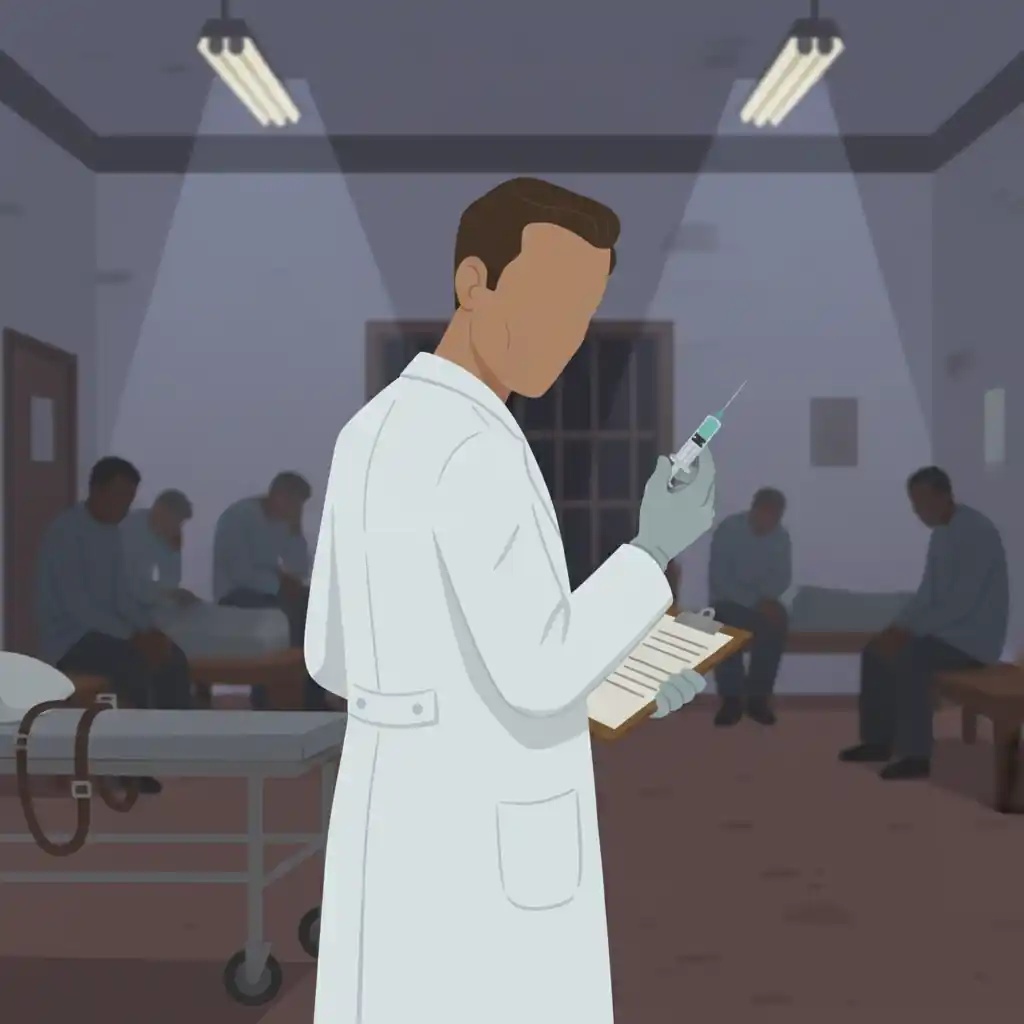
PROLOGUE: THE SHADOWS OF TUSKEGEE
The year is 1946. The world has just emerged from the brutal crucible of World War II, a conflict that redefined human cruelty and called into question the very meaning of ethics. In the wake of unspeakable atrocities committed by Nazi doctors, the Nuremberg Code was being drafted, a landmark document designed to enshrine the principle of informed consent in medical research. Yet, even as these foundational ethical standards were being painstakingly established, another dark chapter in human experimentation was quietly unfolding, far from the public eye, in the steamy tropics of Central America. This was not a rogue operation by a deranged individual, but a 'U.S.-backed medical experiment'—a phrase that chills to the bone and demands a deeper, grittier examination.
The Guatemala Syphilis Experiments represent a grotesque paradox: conducted by American public health officials, ostensibly in pursuit of scientific knowledge and disease prevention, but achieved through the deliberate infection of hundreds of vulnerable human beings with a debilitating venereal disease. It wasn't about finding a cure for syphilis; penicillin already existed. It was about testing prevention methods after infection, and observing the disease’s progression without treatment. This story isn't just a footnote in medical history; it's a stark reminder of how scientific ambition, when untethered from moral compass, can plunge into the abyss of human rights abuses, leaving a legacy of suffering and betrayal that echoes for decades.
For many, the name 'Guatemala Syphilis Experiments' might immediately evoke comparisons to the infamous Tuskegee Syphilis Study, another abhorrent U.S. government-backed research project that withheld treatment from African American men for decades. The connection is more than just thematic; a key figure, Dr. John Cutler, links both dark chapters. But Guatemala predated the most egregious abuses of Tuskegee and, in some ways, was even more audacious in its cruelty: here, the researchers didn't just withhold treatment; they actively infected individuals. This is the story of how hubris, institutional power, and a shocking disregard for human dignity conspired to create a medical nightmare.
ACT I: THE ARCHITECT OF ATROCITY - DR. JOHN CUTLER
Every dark historical event often has a central figure, a nexus where ambition and ethical decay intersect. For the Guatemala experiments, that figure was Dr. John Charles Cutler. A Public Health Service (PHS) physician, Cutler was no fringe extremist; he was a respected, if ruthless, figure in venereal disease research. His career would span decades, marked by a chilling consistency in his willingness to push, and then obliterate, ethical boundaries in the name of science.
Cutler's approach was starkly utilitarian: the ends justified the means. He believed that the control and eradication of venereal diseases, particularly syphilis and gonorrhea, were paramount public health goals, and that certain populations were expendable in the pursuit of faster, more 'efficient' research. This mindset was not entirely unique to Cutler; the post-WWII era, despite the Nuremberg Trials, still harbored segments of the scientific community who viewed marginalized groups—the poor, prisoners, mental patients, racial minorities—as convenient research subjects, their consent considered optional or easily manipulated.
In the mid-1940s, Cutler became the lead researcher for the U.S. government-funded study in Guatemala. His mandate was to explore the efficacy of penicillin in preventing and treating venereal diseases. But instead of simply observing naturally occurring infections, Cutler conceived of a 'controlled' experiment that required direct inoculation. The logic, twisted as it was, aimed to reduce the variables by creating a uniform pool of infected subjects to test prophylactic measures (like topical penicillin creams) or observe disease progression directly.
Cutler was a methodical man. His proposals and reports, later unearthed, detailed the procedures with chilling precision: the methods of infection, the observation periods, the planned treatments (or lack thereof). There was no moral ambiguity in his internal communications; only scientific objectives. His actions in Guatemala were not an aberration but a grim precursor to his later involvement with the Tuskegee Syphilis Study, where, as Assistant Chief of the Venereal Disease Division, he oversaw the long-term observation of untreated syphilis in African American men. His career trajectory illustrates a deeply embedded, systemic ethical blindness within parts of the U.S. Public Health Service at the time.
One of the most disturbing aspects is that Cutler’s actions in Guatemala were not clandestine or unauthorized. They were funded, approved, and overseen by senior officials within the PHS and the National Institutes of Health. Correspondence and budgetary allocations confirm that the highest levels of U.S. public health knew, or should have known, what was happening. This wasn't a lone wolf operation; it was an institutional failure of profound magnitude, leveraging political instability and poverty in a foreign land to conduct experiments that would have been unthinkable—even then—on American soil. The 'why' behind Guatemala wasn't just Cutler's ambition, but a complicit silence from those in power.
Dr. John Cutler not only went on to be involved with the Tuskegee Syphilis Study but also had a long and prominent career, publishing numerous papers and holding significant positions in public health until his retirement in 1980. He passed away in 2003, years before the full details of the Guatemala experiments came to light, never having to publicly account for his role.
ACT II: THE LABYRINTH OF DECEIT - GUATEMALA, 1946-1948
Why Guatemala? The choice of location was no accident. In the mid-1940s, Guatemala was a developing nation with a compliant government, a widespread lack of medical infrastructure, and a population rendered vulnerable by poverty and political instability. It was, in the cold calculus of unethical research, a 'perfect' testing ground where American researchers could operate with minimal oversight and maximum impunity. The U.S. Public Health Service, collaborating with the Pan American Sanitary Bureau, established a research clinic in Guatemala City, ostensibly for venereal disease control.
The subjects for these experiments were drawn from the most disenfranchised segments of Guatemalan society: prisoners in national penitentiaries, mental asylum patients, soldiers, and commercial sex workers. These individuals, already stripped of autonomy, were viewed as ideal candidates because their consent was deemed either unnecessary, impossible to obtain meaningfully, or easily circumvented. Imagine the chilling indifference required to look at a ward of mentally ill patients and see not human beings in need of care, but a convenient, captive population for bacterial inoculation.
The methods of infection were crude and horrifying. Researchers directly inoculated subjects with syphilis, gonorrhea, and chancroid. This wasn't incidental exposure; it was deliberate. In some instances, the bacteria were poured directly onto abrasions created on the subjects' skin or mucous membranes. In others, it was injected via needle. For some mental asylum patients, the infection was delivered by injecting the pathogens directly into their spinal fluid or even directly into their eyes. The researchers meticulously documented these methods, detailing the precise sites of infection and the progression of the diseases.
The scale of the operation was staggering. Records indicate that at least 1,300 Guatemalans were exposed to these bacteria, with over 500 confirmed infections. It wasn't merely about observing an existing condition; it was about creating the conditions for disease in healthy individuals. The explicit goal was not merely to observe disease progression but to test methods of preventing infection after exposure or to gauge the effectiveness of penicillin in treating an infection whose onset was precisely controlled. This meant that healthy people were deliberately made sick, often with insufficient or no treatment, purely for the sake of scientific observation.
Perhaps one of the most perverse aspects was the use of commercial sex workers. Researchers infected female sex workers with gonorrhea and syphilis, then encouraged them to have unprotected intercourse with male prisoners, soldiers, or mental patients. This method, intended to mimic 'natural' transmission, added another layer of calculated cruelty, turning individuals into unwitting vectors of disease for others. When this indirect method proved 'inefficient' in producing infections, the researchers simply reverted to direct inoculation, highlighting their callous determination to achieve their scientific objectives, regardless of human cost.
One particularly disturbing 'experiment' involved infecting epileptic patients by injecting syphilis bacteria directly into their brains via spinal taps. The researchers' objective was to see if the disease progression would be different when introduced directly into the central nervous system. This level of invasiveness and disregard for basic neurological health underscores the extreme nature of the atrocities.
ACT III: THE SILENT SUFFERING - LIVES UNRAVELLED
The sheer number of individuals deliberately infected paints a stark picture, but it's the personal suffering that truly defines the horror of these experiments. These were not just statistics; they were lives irrevocably altered, bodies ravaged by a disease introduced by the very people who should have been protecting them. For many, the experiments were a death sentence or a lifetime of chronic illness.
While penicillin was available and known to be effective against syphilis, treatment for the infected Guatemalans was often inadequate, delayed, or non-existent. Some subjects received only minimal doses, insufficient to cure the disease, but enough to mask symptoms, leaving them with latent infections. Others were simply observed as the disease ran its course, developing the devastating secondary and tertiary stages of syphilis, which can include blindness, paralysis, neurological damage, heart disease, and ultimately, death. For the mental asylum patients, who could not articulate their distress, their suffering was undoubtedly amplified and prolonged, their symptoms perhaps attributed to their underlying mental health conditions.
The long-term consequences for these individuals were catastrophic. Those who survived were left with chronic health problems, psychological trauma, and the stigma associated with venereal disease. Many died prematurely due to complications from untreated or undertreated syphilis. The casual cruelty extended to women who became pregnant during the study, their babies at risk of congenital syphilis, a condition that could lead to severe birth defects, stillbirth, or early death. The ripple effect of suffering extended beyond the direct subjects to their families and any offspring, creating an unseen legacy of illness.
The records reveal a cold, clinical detachment from the human cost. Researchers tracked the lesions, the rashes, the neurological symptoms, charting the decline of their subjects with an almost bureaucratic precision. There is little evidence of empathy or concern for the welfare of the individuals beyond their utility as research material. The very environment of the experiments—prisons and mental institutions—ensured that victims were isolated, their cries for help unheard, their plight invisible to the outside world.