
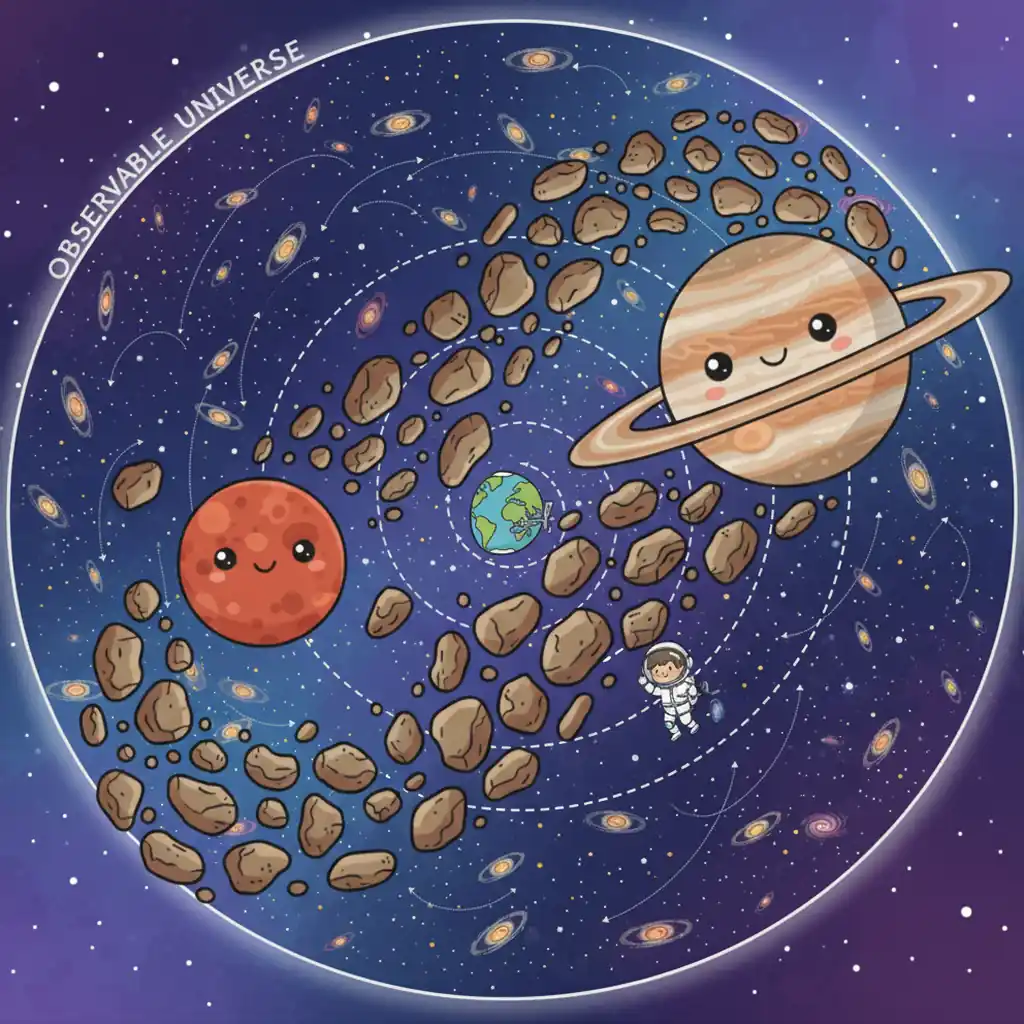
Our Home, Earth, and Its Moon
Hey space explorers! Ever looked up at the night sky and wondered just how big everything out there is? Let's start with our own home, Earth. When you're standing on it, Earth feels HUGE! You can travel for days and still not see all of it. Our planet is about 12,742 kilometers (or 7,918 miles) wide. That’s a long road trip! But as we zoom out, Earth starts to look like a tiny marble in a giant game.
Our closest neighbor is the Moon, a rocky ball about one-quarter the size of Earth. It feels super close when you see it shining bright, but it’s actually about 384,400 kilometers (238,855 miles) away! If you drove a car non-stop at highway speeds, it would take you about half a year to get there. Astronauts reached it in just a few days on their powerful rockets, but even that shows it’s not a quick hop!
Our Cosmic Neighborhood: The Solar System
Now, let’s travel to our star, the Sun! The Sun is enormous – you could fit over a million Earths inside it! We measure distances in our solar system using a special unit called the 'Astronomical Unit,' or AU. One AU is the distance from the Earth to the Sun, which is about 150 million kilometers (93 million miles). Mercury and Venus are closer to the Sun, less than 1 AU away, while Mars is about 1.5 AU.
The gas giants, Jupiter and Saturn, are much further out, around 5 and 9.5 AU from the Sun, respectively. Imagine a car taking years to reach them! Then come the ice giants, Uranus (19 AU) and Neptune (30 AU). Light from the Sun takes about 8 minutes to reach Earth, but it takes over 4 hours to reach Neptune! That means when you look at Neptune with a powerful telescope, you're seeing what it looked like 4 hours ago!
Beyond Neptune, there’s a giant, icy doughnut-shaped region called the Kuiper Belt, home to Pluto and other dwarf planets. And even further out, stretching almost halfway to the next star, is the Oort Cloud – a huge bubble of trillions of icy objects. This is truly the edge of our Sun's gravitational influence, extending up to 100,000 AU! Our solar system is like a tiny, sparkling speck in this vastness.
Beyond Our Sun: Into the Starlight (The Milky Way)
To measure distances beyond our solar system, AUs just aren't big enough! We use a super-duper unit called a 'light-year.' Don't let the 'year' part trick you – it's a measure of distance, not time! One light-year is the incredible distance light travels in one whole year, which is about 9.46 trillion kilometers (or 5.88 trillion miles). The closest star to our Sun, Proxima Centauri, is still over 4 light-years away. That means if Proxima Centauri blew up right now, we wouldn't know for over four years!
Our Sun isn't alone; it's one of billions of stars living in a giant 'city' called the Milky Way Galaxy. Imagine a flat, swirling pancake made of stars, gas, and dust! The Milky Way is a spiral galaxy, and it's HUGE – about 100,000 light-years across. If our solar system was the size of a coin, the Milky Way would be as big as the entire United States! We live on one of its spiral arms, about two-thirds of the way from the center.
Just how many stars are in our galaxy? Scientists estimate there are between 100 billion and 400 billion stars! That's more stars than all the grains of sand on all the beaches on Earth! Each one of these stars could have planets orbiting it, just like our Sun. It’s hard to even imagine that many stars, all shining brightly (even if many are too far away for us to see individually).