
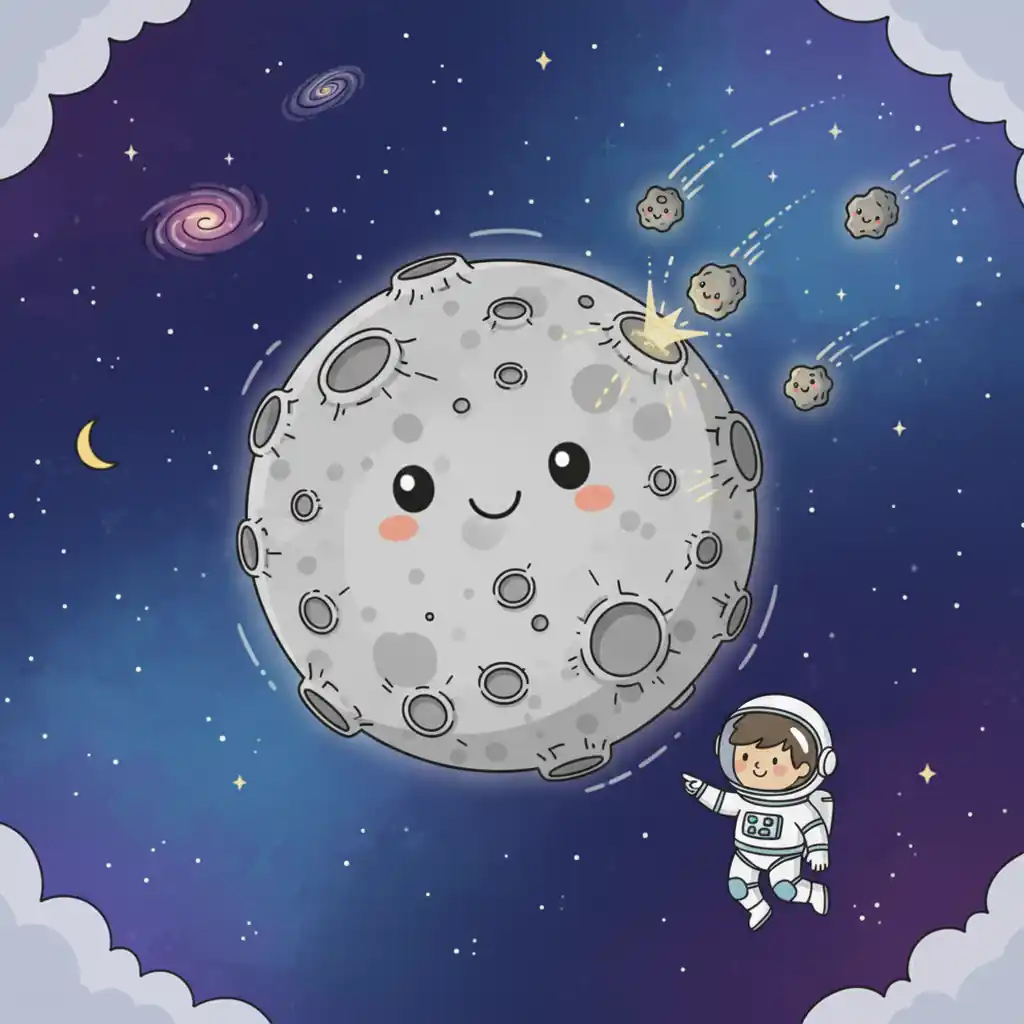
The Moon's Pockmarked Face
Look up at the night sky, and you'll often see our magnificent Moon. If you have a pair of binoculars or a small telescope, you'll notice something amazing: the Moon is covered in countless holes! Some are tiny, like pinpricks, while others are massive, like giant soup bowls that could swallow whole cities. These holes are called craters, and they tell an incredible story about the Moon's adventurous past.
From far away, the Moon might look like a smooth, glowing ball, but up close, it's more like an ancient golf ball that's been hit thousands of times! Why is our lunar neighbor so scarred? What made all those dents and divots? Get ready to become a space detective as we explore the secrets hidden in the Moon's rocky, hole-filled surface.
Cosmic Cannonballs! How Craters Are Born
Imagine throwing a rock really, really hard at a sandpit. What happens? You make a dent, right? Now, imagine that rock is as big as a mountain, and it's flying through space at speeds faster than a speeding bullet! That's how most Moon craters were made.
For billions of years, especially when our solar system was very young and messy, lots of asteroids, comets, and other space rocks were flying around. When one of these 'cosmic cannonballs' smashed into the Moon, it caused an enormous explosion! The rock itself might vaporize, but the sheer force of the impact blasts a huge amount of Moon rock outwards, digging a big hole and throwing debris far and wide. This debris often forms bright streaks called 'rays' around the new crater, like spokes on a giant wheel.
The bigger and faster the space rock, the bigger the crater! Some impacts were so powerful they could shake the entire Moon!
Earth's Cleanup Crew vs. Moon's Timeless Canvas
If space rocks were flying around everywhere, why doesn't Earth have as many visible craters as the Moon? Good question! Earth actually gets hit by space rocks too, but our planet has a fantastic 'cleanup crew' that the Moon doesn't.
First, Earth has a thick atmosphere. Smaller space rocks often burn up like shooting stars before they even reach the ground. If they're big enough to make it through, their speed is slowed down. The Moon has almost no atmosphere, so even tiny pebbles hit its surface at full speed.
Second, Earth has weather! Wind and water constantly erode and wear down our landscapes. A crater made thousands of years ago might be slowly filled with soil or washed away by rivers. Earth also has volcanoes and plate tectonics, which are like giant geological repair kits. New land is formed, old land is recycled, and craters disappear over time. The Moon, however, is a very quiet place. No wind, no rain, no active volcanoes (anymore!), and no moving plates. So, once a crater is made on the Moon, it pretty much stays there, unchanged, for billions of years – a timeless canvas of cosmic history!