
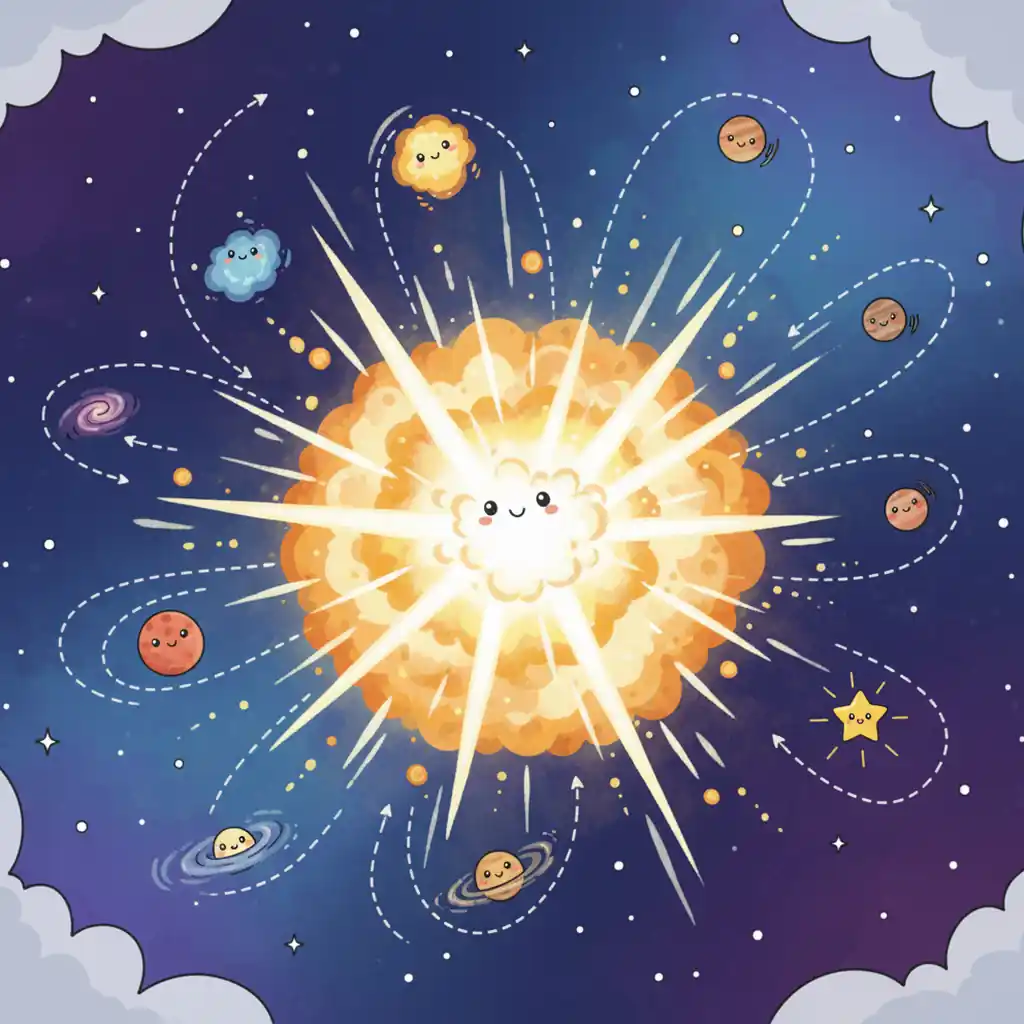
A Tiny Speck, A Giant Beginning
Imagine trying to fit everything—all the stars, planets, galaxies, and even you—into something smaller than a tiny dot. Sounds impossible, right? Yet, that's what scientists believe happened about 13.8 billion years ago. The universe didn't start with a 'pop' like a firecracker, but with something called the 'Big Bang' (even though it wasn't really a 'bang' and wasn't 'big' yet!). It was more like an incredibly rapid expansion of space itself, not an explosion in space.
Think of it like blowing up a balloon. The surface of the balloon gets bigger and bigger, but there's no single point 'in' the balloon that's exploding. Instead, the whole 'space' on the surface is stretching. In the very beginning, the universe was super-duper hot and incredibly dense, like all the energy and matter we see today were squished into an unimaginably small package. This wasn't just the start of matter and energy; it was the start of space and even time itself!
Tick-Tock Goes the Universe Clock: The First Moments
When we say 'beginning,' we mean the very first tiny fractions of a second. It's almost too fast to imagine! In the first mere moments after the Big Bang, the universe was so hot and crowded that particles couldn't even form yet. It was a pure soup of energy, much hotter than the center of any star you can imagine. There weren't any stars, planets, or even simple atoms yet!
As the universe rapidly expanded, it also cooled down, much like how a spray can gets cold when you use it. This cooling allowed the fundamental forces of nature (like gravity and electromagnetism) to separate from each other, which were once unified. It was a chaotic, energetic dance, but a very important one because it set the stage for everything that would come next.
Particle Soup and the First Building Blocks
As the universe cooled down in just a few seconds, something amazing happened: pure energy started to transform into tiny bits of matter! This is like magic, but it follows Albert Einstein's famous rule: E=mc² (Energy equals mass times the speed of light squared). This means energy and matter are two sides of the same coin.
The very first tiny particles, called 'quarks' and 'leptons' (like electrons), burst into existence. Imagine a cosmic kitchen where these super-tiny ingredients are swirling around. Then, as it cooled a little more, these quarks started to stick together. Three quarks would join up to make 'protons' and 'neutrons,' which are the building blocks for the centers of atoms! So, within minutes, the basic ingredients for all matter in the universe were already being cooked up.
Let There Be Light! (And Atoms)
For the first few hundred thousand years, even though protons and neutrons were around, the universe was still too hot for them to combine with electrons to form stable atoms. It was like a thick, glowing fog or a cosmic plasma. Electrons were zooming around too fast, unable to settle down with the protons. Light particles, called photons, kept bumping into these free electrons, making it impossible for light to travel freely across the universe. It was a very bright but also very 'fuzzy' place!