
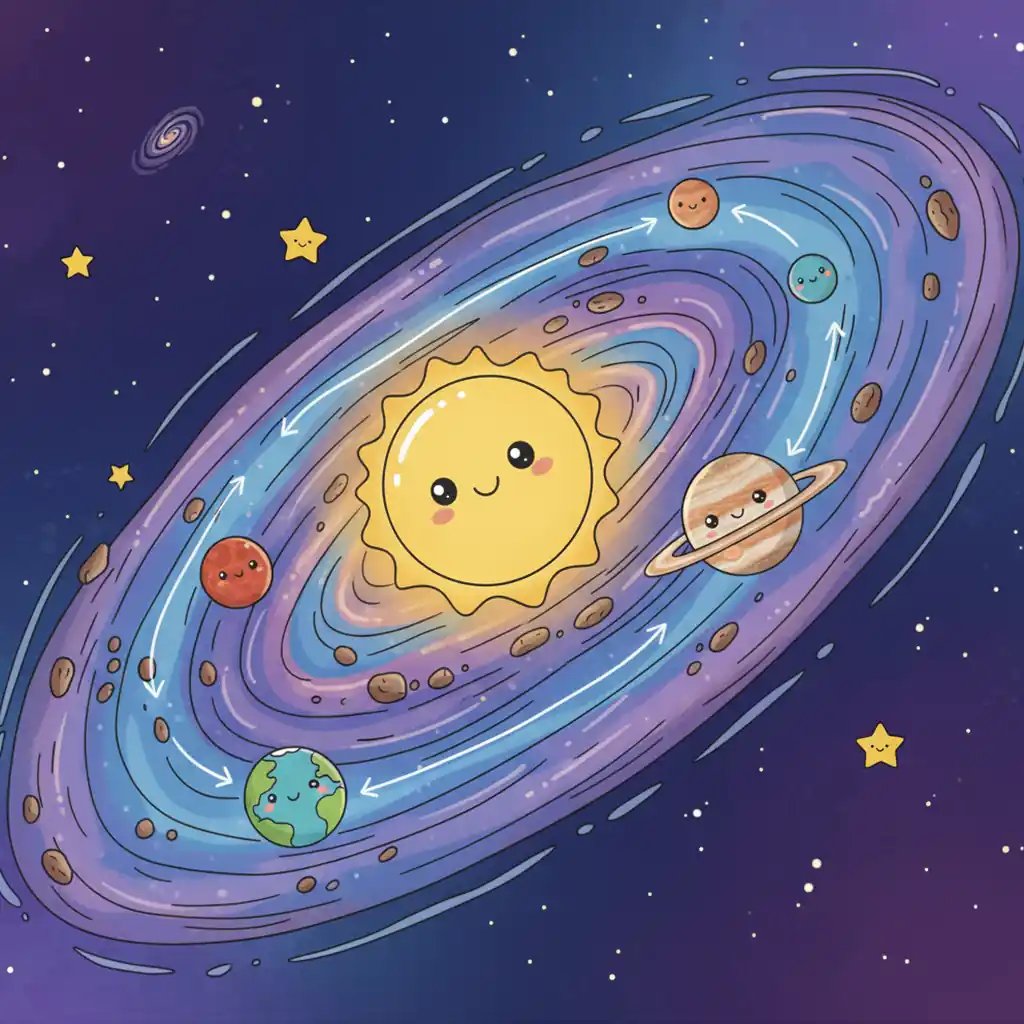
The Big Spin Question!
Have you ever looked up at the night sky and wondered why all the planets in our solar system seem to be on the same giant cosmic highway? Mercury, Venus, Earth, Mars, Jupiter, Saturn, Uranus, and Neptune—they all journey around the Sun in the same direction, like race cars speeding around a massive track. Why don't some go one way and others the opposite?
It’s a fantastic mystery, and the answer takes us back billions of years to when our solar system was just a baby, a swirling cloud of gas and dust. Understanding this cosmic dance helps us peek into the very beginning of our home in space and see how everything got its first push.
From Cloud to Cosmic Pancake
Imagine, long, long ago, there was no Sun, no Earth, just a massive, cold, and dark cloud of hydrogen gas and tiny dust particles floating in space. Scientists call this a 'solar nebula.' It was enormous, much bigger than our whole solar system is now, and it was just minding its own business, slowly drifting.
But then, something incredible happened. Maybe a faraway star exploded, sending a shockwave through space, or maybe it just got a little too heavy. Whatever the reason, gravity—that invisible force that pulls everything together—started to pull the cloud inwards. It began to shrink, slowly at first, then faster.
As the cloud got smaller, it started to spin! Think about an ice skater: when they pull their arms in close, they spin much faster, right? It's the same principle for the cosmic cloud. As it shrunk, it had to spin faster to conserve its 'angular momentum' – basically, its stored spinning energy.
And here’s where the magic truly happened. Because it was spinning, the cloud didn't just shrink into a ball. Instead, it flattened out, like someone spinning pizza dough high in the air! This flattened, spinning cloud is called a 'protoplanetary disk,' and it was the birthplace of our Sun and all its planets.
The Great Cosmic Merry-Go-Round
Now, imagine this giant, spinning disk. All the gas and dust particles within it were also moving in the same general direction, swirling around the center. It was like a colossal merry-go-round, with every tiny piece of cosmic stuff following the same circular path.
Because everything was already caught up in this grand, swirling motion, it meant that anything that formed within this disk would naturally inherit that direction. There was no going against the flow, because the flow itself was shaping everything.
Planetary Builders at Work
Inside this spinning disk, things started to get busy. Tiny dust grains, warmed by the newly forming Sun at the center, began to bump into each other. But instead of bouncing off, they stuck together, like tiny pieces of cosmic lint. This process is called 'accretion,' and it was how planets were built!
These sticky bits grew into pebbles, then rocks, then bigger chunks called 'planetesimals' – basically, baby planets. As these planetesimals orbited the Sun within the disk, they kept colliding with more dust and rock, growing larger and larger, sweeping up all the leftover material in their paths.