
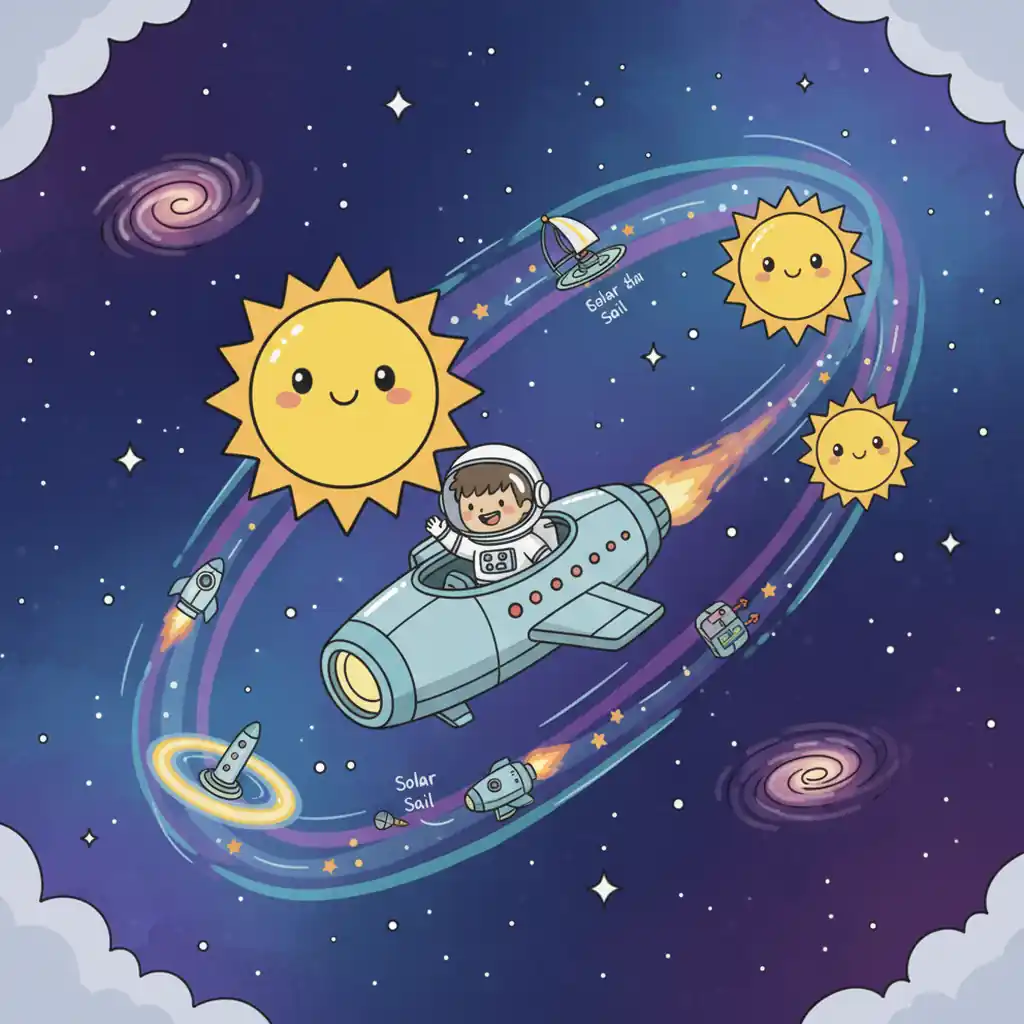
How Far is Far? Our Cosmic Neighborhood
Imagine trying to visit your best friend's house, but they live on another continent! That's kind of what visiting another star is like, but a bazillion times farther. The distances in space are so huge, that using miles or kilometers just doesn't make sense. Instead, scientists use something called a 'light-year.' It's not a measure of time, but a measure of distance – how far light travels in one whole year.
Light is the fastest thing we know of, zooming at an incredible 186,000 miles (300,000 kilometers) per second! In one year, light travels about 5.88 trillion miles (9.46 trillion kilometers). Our very closest star, Proxima Centauri, is still over 4 light-years away. That means the light you see from Proxima Centauri tonight actually left that star more than four years ago! If we sent a message there, it would take four years to arrive, and another four years for their 'hello' to reach us.
Our Speedy, But Not Speedy Enough, Spacecraft
Humans have sent amazing spacecraft out into our solar system. Probes like Voyager 1 and 2 have been traveling for over 45 years and have gone farther than any human-made object before! They're super speedy, moving at tens of thousands of miles per hour. The Parker Solar Probe is even faster, zipping past the Sun at over 400,000 miles per hour! These are incredible speeds for exploring our own solar system.
However, even with these astonishing speeds, reaching another star is a different ballgame entirely. Think of it like this: if our fastest spacecraft were a racing car, the distance to the Moon would be like driving across your town. Going to Mars would be like a cross-country trip. But going to Proxima Centauri? That would be like driving your car to the actual Moon, then turning around and driving it to another Moon thousands of times farther away! Our current rockets, though powerful, are simply not built for interstellar journeys.
The Speed of Light Wall: Einstein's Cosmic Speed Limit
Why can't we just build a bigger, faster rocket? Well, there's a cosmic speed limit. Albert Einstein, a super-smart scientist, figured out that nothing with 'mass' (which means almost everything, including you, me, and spaceships) can ever travel as fast as, or faster than, the speed of light. As an object gets closer to the speed of light, it gets heavier and needs more and more energy to go just a little bit faster, until it would need an infinite amount of energy to actually reach light speed.
This means that even if we had the most powerful rockets imaginable, we could only ever get very, very close to the speed of light, but never quite reach it. So, a trip to Proxima Centauri, even if we could travel at 99.9% the speed of light, would still take a little over 4 years. That's a very long time to be stuck in a spaceship, even with all your favorite toys!
Solar Sails: Surfing on Starlight
Since we can't just burn more fuel to go faster forever, scientists are dreaming up new ways to push spaceships. One cool idea is a 'solar sail.' Imagine a gigantic, super-thin, shiny sheet, like a huge trampoline made of aluminum foil. Instead of wind, this sail would catch tiny packets of light, called 'photons,' streaming from the Sun. Even though photons don't have much mass, they do have a tiny bit of push.
Over time, these tiny pushes can add up and make a spacecraft go incredibly fast, without needing any rocket fuel! It's like a sailboat using the wind, but in space, you're using sunlight. We've already tested small solar sails in space, and they work! A solar sail could eventually reach speeds much faster than our current rockets, cutting down those travel times to other stars, though still taking many decades or centuries.