
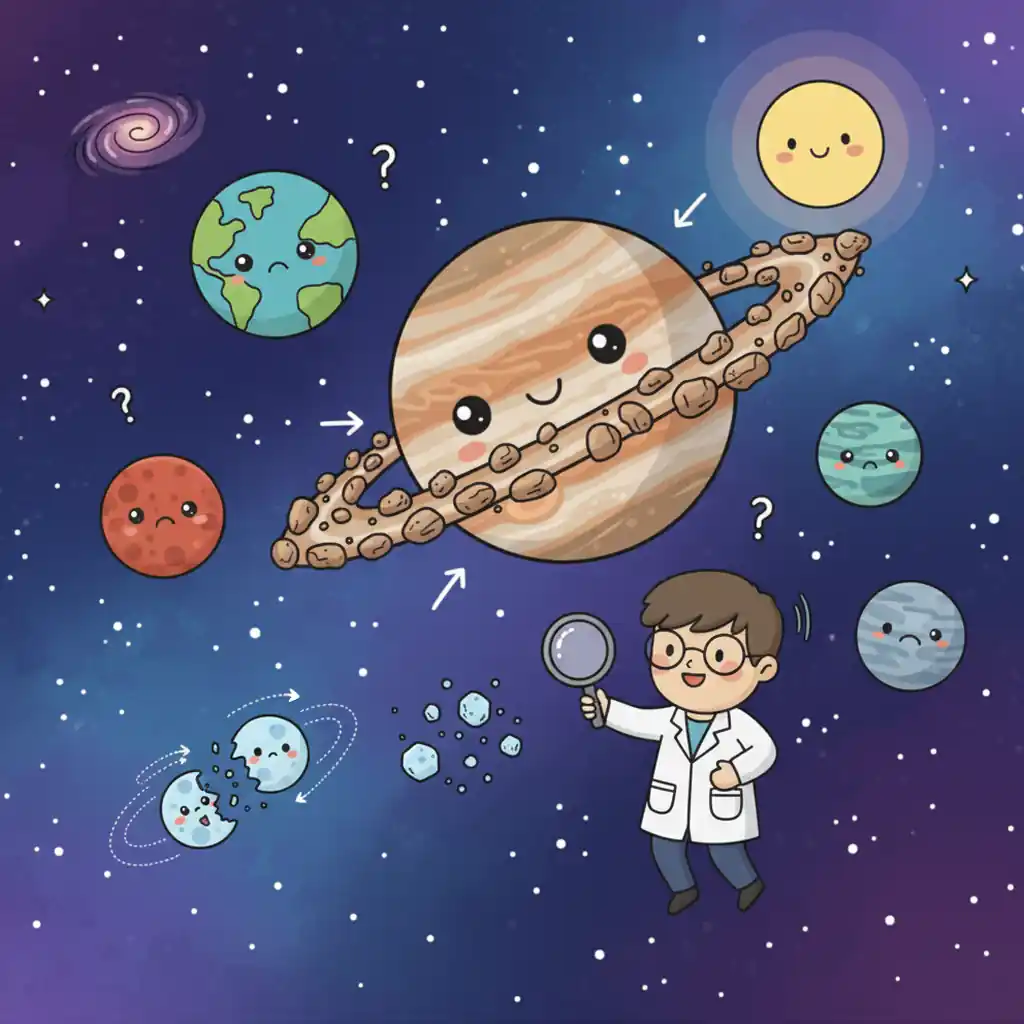
Cosmic Hula-Hoops: What Are Rings?
Imagine a giant planet wearing the most dazzling jewelry in the universe—a sparkling, glittering hula-hoop made of countless tiny diamonds! That's what planetary rings look like from far away. But if you could get closer, you'd see that these rings aren't solid at all. Instead, they're made of billions and billions of individual pieces, like a cosmic dust storm mixed with icy pebbles, rocks, and even boulders, all dancing around the planet in a majestic swirl.
These pieces range in size from tiny grains of sand to massive chunks as big as a mountain! They orbit the planet just like tiny moons, but there are so many of them, and they are so close together, that they form flat, disc-like structures. Some rings are bright and wide, like Saturn's famous ornaments, while others are dark, faint, and almost invisible, like the skinny rings around Jupiter, Uranus, and Neptune. But why do some planets get to wear these spectacular accessories while others, like our Earth, are left bare?
The Ring King: Saturn's Dazzling Display
When we think of planetary rings, Saturn is almost always the first planet that comes to mind. Its rings are truly magnificent, wide enough to stretch almost all the way from Earth to the Moon, and so reflective that you can see them even with a small telescope! They are mostly made of water ice, which is why they shine so brightly. These icy particles reflect sunlight like tiny mirrors, giving Saturn its famous shimmering appearance.
Saturn's rings aren't just one big disc; they're actually thousands of tiny ringlets, separated by gaps and divisions. Some gaps are caused by 'shepherd moons,' which are small moons orbiting within or near the rings that gravitationally 'herd' the ring particles, keeping them in narrow paths. Other gaps are caused by larger moons pulling on the ring particles in specific ways, creating empty spaces in their orbits. Saturn is the ultimate ring model, showing us just how complex and beautiful these structures can be.
The 'Ring Zone': The Roche Limit Mystery
One of the most important reasons a planet has rings is something called the 'Roche Limit.' Imagine you have a giant planet and a smaller moon orbiting very, very close to it. The planet's gravity pulls on the moon, but it pulls harder on the side of the moon that's closer to the planet than on the side that's farther away. This difference in pull creates a stretching force, like a cosmic tug-of-war on the moon itself.
If a moon gets too close to a planet, inside this 'Roche Limit,' the planet's stretching force becomes stronger than the moon's own gravity holding itself together. It's like trying to hold a sandcastle together while a giant pulls on it from both sides—eventually, it just crumbles apart! If a moon, asteroid, or comet passes inside this zone, it can be ripped to shreds, and its shattered pieces then spread out to form a ring system around the planet.
Where Do Rings Come From? Cosmic Clues
Scientists have a few ideas about how rings might form. One popular theory is that they are indeed the remains of a moon (or several moons!) that wandered too close to the planet and got torn apart by the planet's powerful gravity, as we learned with the Roche Limit. The pieces then spread out and settled into a disc.