
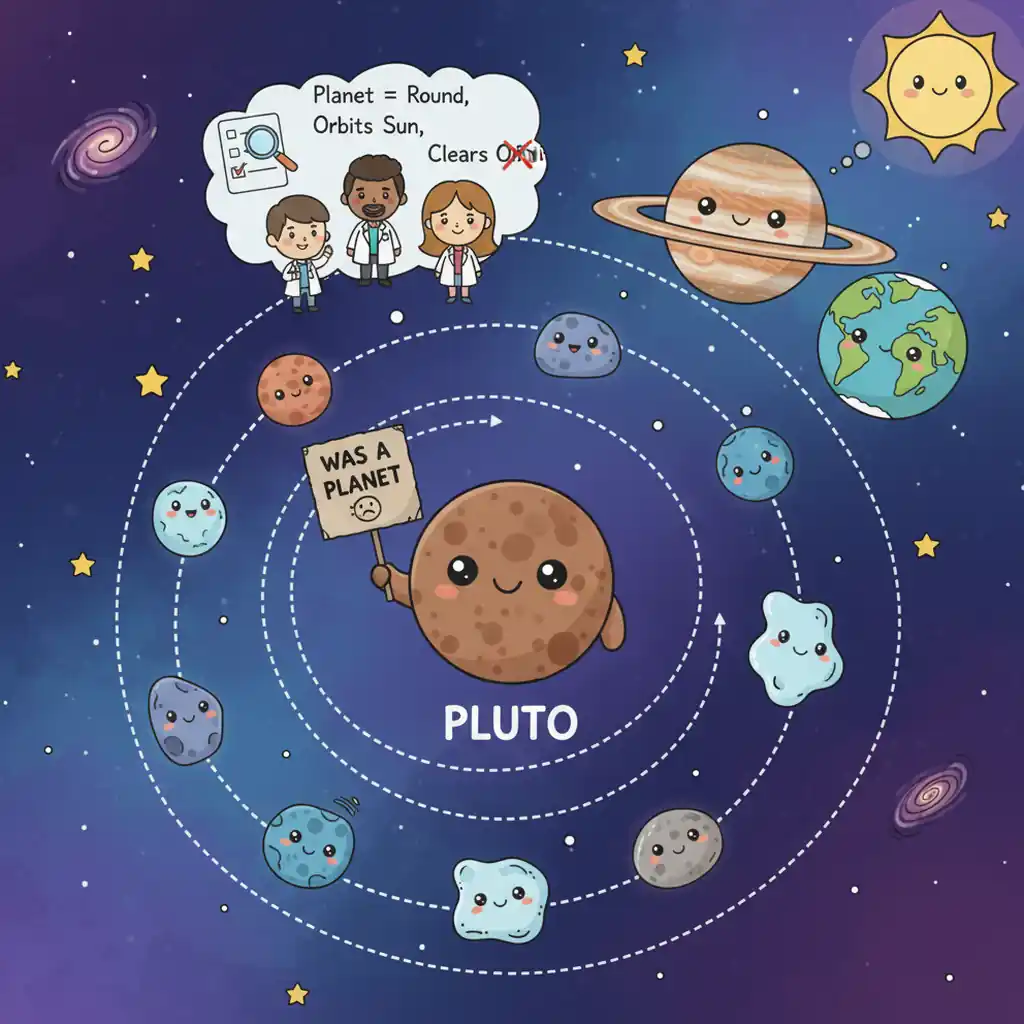
A Tiny World Far Away
Imagine a world so far away that sunlight takes over five hours to reach it. A world so cold that ice isn't just water; it's also frozen nitrogen and methane! For over 70 years, this chilly, distant place, named Pluto, was known as the ninth planet in our solar system. It was the mysterious outer guard, the last stop on our planetary tour. But then, something amazing and a little bit controversial happened: Pluto lost its planet status. How did a mighty planet become a 'dwarf'?
The Hunt for Planet X
Our story begins in 1906, when an astronomer named Percival Lowell became convinced there was a 'Planet X' pulling on Uranus and Neptune, messing with their orbits. After years of searching, a young astronomer named Clyde Tombaugh finally spotted a tiny moving point of light on his photographic plates in 1930. It was smaller than expected, but it was there! The world rejoiced, and the new discovery was named Pluto, after the Roman god of the underworld, perhaps because of its dark, distant location.
For decades, Pluto was happily considered a planet. It had a moon (Charon, discovered much later!), orbited the Sun, and was definitely a unique, icy world. Our solar system felt complete with its nine diverse planets.
Our Solar System Gets Crowded
As telescopes got bigger and better in the 1990s and early 2000s, scientists started discovering more and more icy objects out beyond Neptune, in a region called the Kuiper Belt. Think of it like a giant, icy donut shop filled with millions of frozen goodies! Some of these new discoveries, like Quaoar and Sedna, were pretty big. Then came Eris in 2005, an object that was even slightly larger than Pluto!
This created a cosmic conundrum. If Eris, which was bigger than Pluto, wasn't called a planet, then should Pluto still be one? Or should we add Eris, Quaoar, and potentially hundreds of other similar objects to our list of planets? Suddenly, our nice, neat nine-planet solar system was in danger of becoming a very, very long list!
What Makes a Planet, a Planet?
To solve this problem, astronomers from all over the world gathered in 2006 at a big meeting of the International Astronomical Union (IAU). They decided it was time to create a strict, scientific definition for what a planet actually is. Before this, the definition was a bit fuzzy, like trying to decide what counts as a 'big' toy without a ruler.
After much debate (and probably a lot of coffee!), they agreed on three main rules for a celestial body to be called a 'planet' in our solar system:
- It must orbit the Sun. (Pluto checks this box!)