
The Cosmic Recipe Book
Have you ever looked up at the twinkling stars on a clear night and wondered, 'How did all those planets get there?' It's a fantastic question, and the answer is an epic adventure that began billions of years ago, long before even the dinosaurs roamed Earth! Imagine trying to bake the biggest cake ever, but instead of flour and sugar, your ingredients are cosmic gas and stardust.
The story of planet birth begins in gigantic clouds floating in space, much, much bigger than our entire solar system! These are called 'molecular clouds' or 'stellar nurseries' because they are where stars—and later, planets—are born. These clouds are mostly made of super-light gases like hydrogen and helium, mixed with tiny, tiny specks of dust, like cosmic glitter.
Gravity's Gentle Hand
Even though these giant clouds are spread out, they have a secret superpower: gravity! Just like Earth's gravity keeps your feet on the ground, gravity in space slowly pulls things together. Sometimes, a disturbance, like a shockwave from an exploding star nearby, gives a little 'nudge' to a part of the cloud, making it slightly denser.
Once a part of the cloud gets a little denser, gravity starts pulling it inward more strongly. It's like a slow-motion cosmic squeeze! As this big lump of gas and dust collapses, it starts spinning faster and faster, just like an ice skater spins faster when they pull their arms in. The center gets squished so much that it heats up and begins to glow, becoming a 'protostar' – a baby star that's not quite ready to shine brightly yet.
The Spinning Pancake Factory
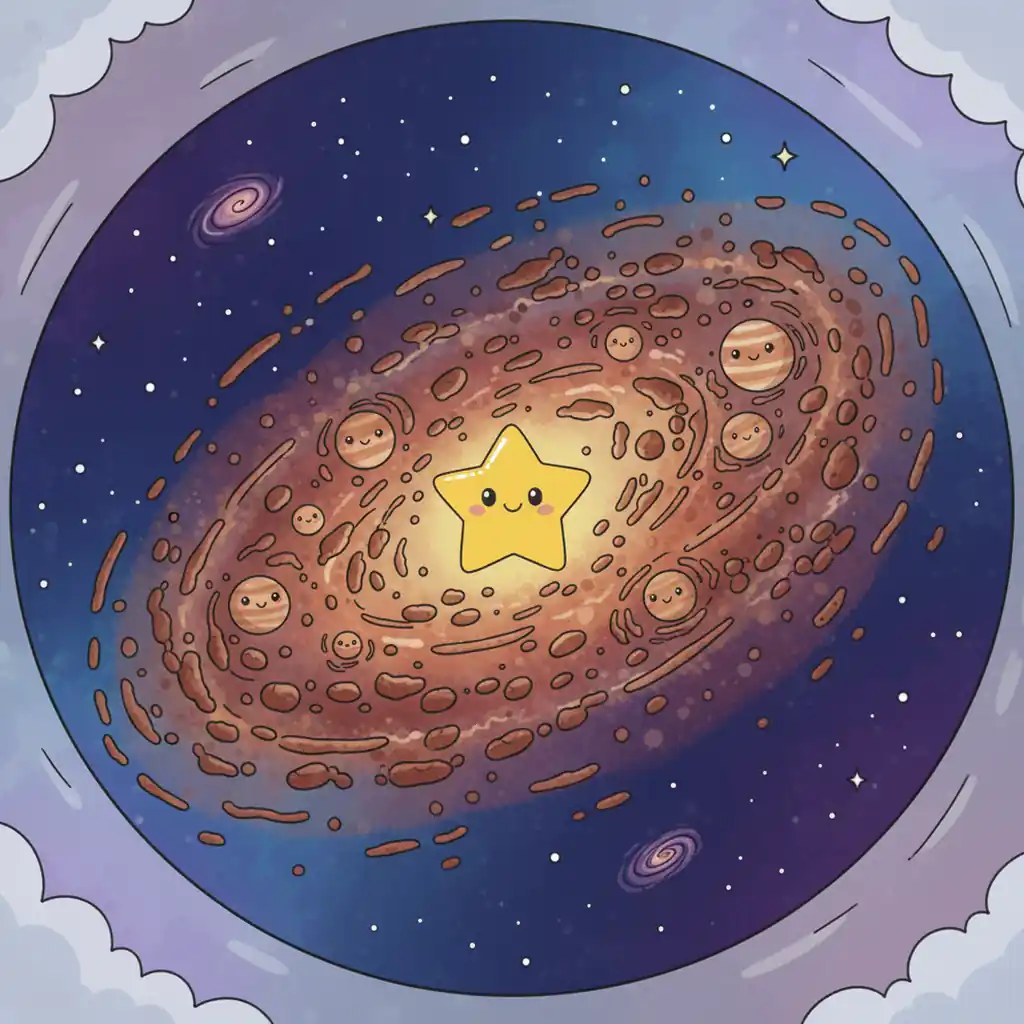
Not all the gas and dust falls into the baby star. Because it's spinning so fast, the leftover material flattens out into a giant, spinning disk around the protostar. Imagine you're making pizza dough and you spin it in the air – it gets flat! This flat, swirling disk is called a 'protoplanetary disk,' and it's where all the amazing planet-making magic really happens.
This disk is like a cosmic construction site, filled with all the ingredients needed for planets. Everything is orbiting the central protostar, bumping and grinding against each other. It's not a quiet place; there's a lot of swirling, crashing, and gathering going on. This is the stage where the tiniest pieces of dust begin their long journey to becoming magnificent worlds.
Cosmic Snowball Fight: Accretion!
Inside this spinning disk, things are constantly colliding. At first, the dust grains are tiny, smaller than a speck of glitter. But guess what? When they gently bump into each other, they often stick together! It’s like magic, or tiny bits of static electricity, making them cling. This slow process of sticking together and growing is called 'accretion.'