
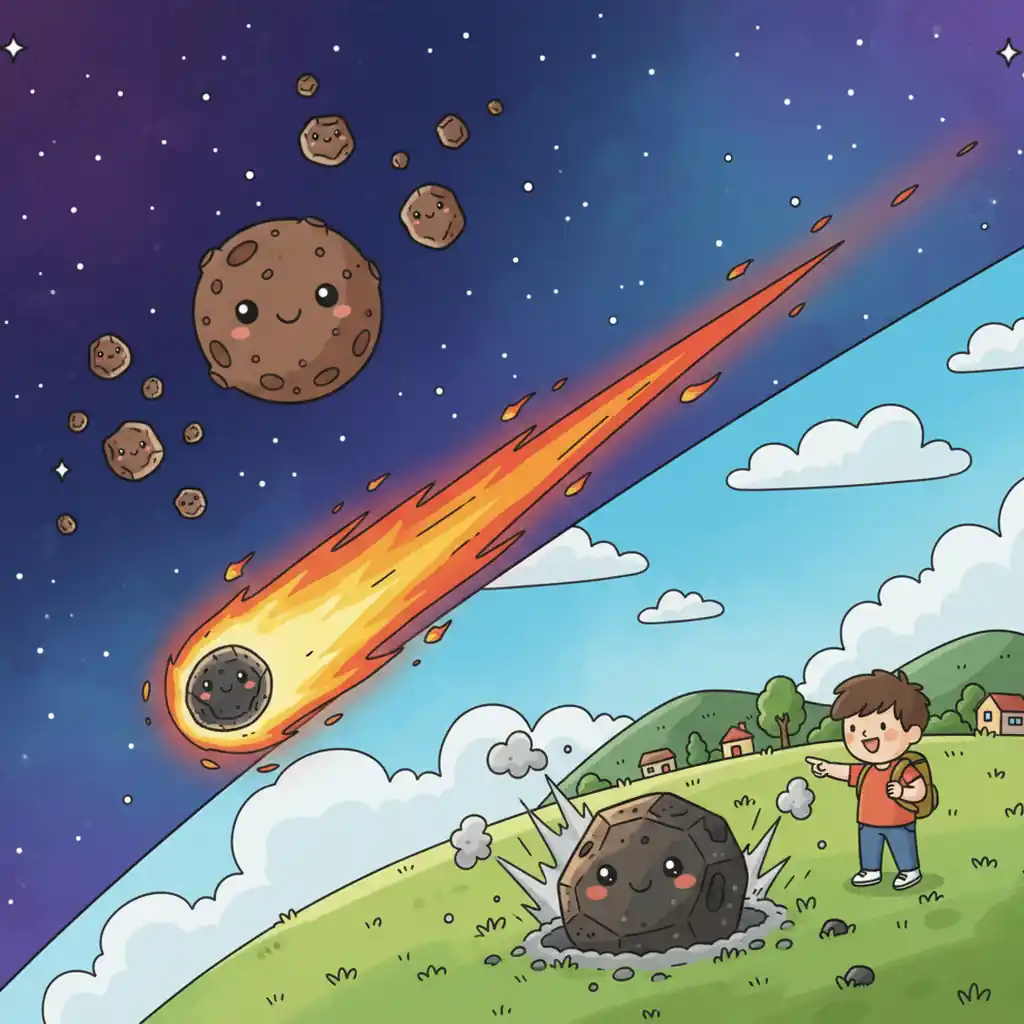
Cosmic Cannonballs: What Are Space Rocks?
Imagine tiny explorers from outer space, zipping through the cosmos. These aren't aliens, but rocks! In space, these rocks are called meteoroids. They can be as small as a pebble or as big as a house, constantly orbiting the Sun, just like Earth. They travel at incredible speeds, sometimes even faster than a rocket ship!
Most meteoroids are bits and pieces broken off from larger space objects like asteroids or comets. Asteroids are like giant space potatoes, often found in a 'belt' between Mars and Jupiter. Comets are like dirty snowballs with long, glowing tails, made of ice, dust, and rock. When these bigger objects bump into each other or get too close to the Sun, they can shatter, sending meteoroids flying in all directions.
The Invisible Shield: Entering Earth's Atmosphere
Earth is like a big, blue marble wrapped in a cozy blanket of air called the atmosphere. This blanket is super important because it acts like a shield! When a meteoroid gets too close to Earth, our planet's strong gravity starts to pull it in. The meteoroid begins to fall faster and faster, heading straight for us.
As the meteoroid plunges into the atmosphere, it slams into billions of air molecules. This is like rubbing your hands together really, really fast—it creates heat! The friction is so intense that the space rock heats up to thousands of degrees Celsius. Imagine rubbing your hands so hard they glow white-hot and start to vaporize! That's what happens to our space rock.
Shooting Stars: The Fiery Show
When a meteoroid heats up, it starts to glow brightly, leaving a fiery streak across the sky. At this point, we call it a meteor! Most people call them 'shooting stars,' but they aren't stars at all—they're just rocks burning up high above us. It's like a tiny, natural fireworks display, lighting up the night.
Most meteors are small and burn up completely before they even get close to the ground. They turn into tiny specks of dust that float down to Earth, often unseen. But sometimes, Earth passes through a trail of dust left behind by a comet. When this happens, lots of meteors enter the atmosphere at once, creating a spectacular meteor shower! It's like the universe is putting on a light show just for us.
Boom! A Meteorite Lands!
What happens if a meteoroid is big enough, or tough enough, to survive the fiery journey through our atmosphere? If a piece of the space rock actually makes it all the way to the ground, it's no longer a meteoroid or a meteor. Now, it earns a new name: a meteorite!