
The Cosmic Rainbow in the Sky
Imagine looking up at the night sky, filled with countless tiny, sparkling lights. These aren't just random twinkles; they are giant, fiery balls of gas called stars! And just like a box of crayons has many colors, so do the stars in our universe. Have you ever noticed that some stars look a little redder, while others seem bluer or brighter white?
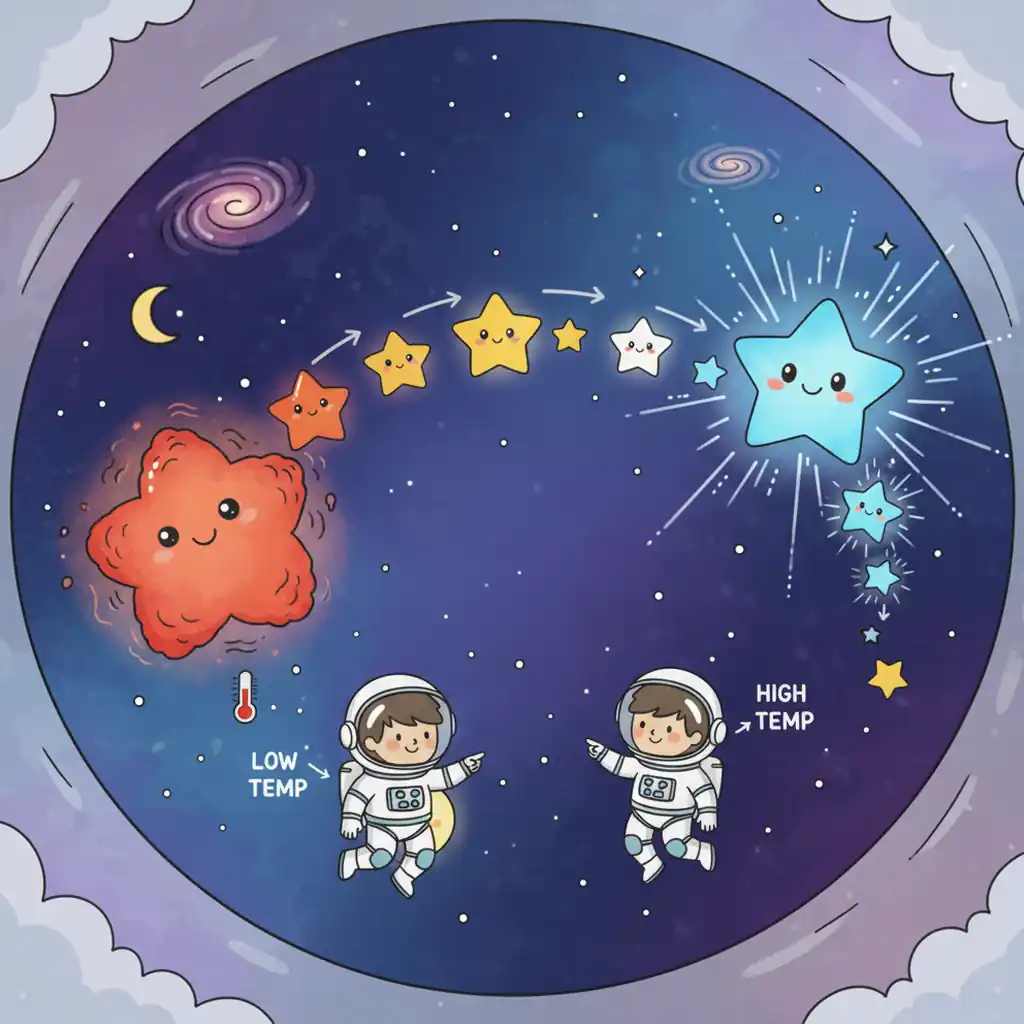
These different colors aren't just pretty; they are like secret messages from the stars themselves! Each star's color tells us something super important about it, especially how hot its surface is. It’s like a cosmic mood ring, where the color reveals its fiery personality.
Most stars are giant furnaces, constantly burning incredible amounts of hydrogen and helium in their cores, releasing tremendous energy as light and heat. The way they burn and the energy they release directly affect the color we see from Earth. So, get ready to discover the amazing secret behind the stars' dazzling rainbow!
Hotter Means Bluer, Cooler Means Redder!
This might sound a little backward, but it's one of the coolest facts about stars: the bluer a star appears, the hotter it truly is! And the redder a star looks, the cooler its surface temperature is. Think about something you might have seen get very hot, like a metal poker in a fire, or even a stove burner.
When you turn on an electric stove, the burner might first glow a dull red. As it gets hotter, it turns brighter red, then orange, and if it could get even hotter, it would glow yellow, then white, and eventually a brilliant blue-white. Stars follow this very same rule!
This happens because of how objects give off light when they're hot. Really hot objects blast out more 'short-wavelength' light, which includes blue and violet. Cooler objects, even though they're still scorching hot, mainly emit 'long-wavelength' light, which is red and orange. So, the color we see is the dominant color of light that a star is sending our way.
Red Stars: The Cozy Campfires of Space
Let's start with the coolest stars in our cosmic collection: the red ones! These stars are like the cozy campfires or glowing embers of the universe. While they're called 'cool,' their surfaces are still incredibly hot to us – usually around 3,000 to 5,000 degrees Fahrenheit (that's 1,700 to 2,800 degrees Celsius)! This is hot enough to melt and vaporize almost anything!
There are two main types of red stars we often talk about: Red Dwarfs and Red Giants. Red Dwarfs are actually the most common stars in the entire universe! They are small, dim, and burn their fuel super, super slowly. This means they can live for trillions of years, much longer than our Sun, quietly glowing in the vastness of space.
Red Giants, on the other hand, are enormous! These are stars that have aged and expanded, becoming swollen and often less dense. Our own Sun will become a Red Giant in about 5 billion years, growing so big that it will likely engulf Earth’s orbit! So, while red means 'cooler' for a star, it doesn't always mean 'small' – sometimes it means 'ancient and enormous!'
Orange and Yellow Stars: Our Sun's Neighborhood
Moving up the temperature scale, we come to the orange and yellow stars. These are the middle-of-the-road stars, not too hot and not too cool. And guess what? Our very own Sun fits perfectly into this category! It’s classified as a yellow dwarf star.
Our Sun has a comfortable surface temperature of about 10,000 degrees Fahrenheit (around 5,500 degrees Celsius). This makes it a stable star with a moderate lifespan of about 10 billion years. Yellow stars like our Sun are perfect for supporting life on planets because they provide a consistent and reliable source of light and warmth, just right for keeping water liquid and plants growing.