
Wheels on the Red Planet
Imagine trying to steer your favorite remote-control car not just across your living room, but across a vast, dusty desert that’s millions of kilometers away, where the air is thin and the temperatures are freezing! That's precisely what engineers do with Mars rovers. These incredible robots are our very own explorers on the Red Planet, acting as scientific detectives on wheels. Their main mission is to search for clues about whether Mars ever harbored life in its distant past, or if it possesses the conditions to support it in the future. Sending human astronauts to Mars is an incredibly dangerous and expensive endeavor, facing challenges like radiation exposure and the sheer cost of building a life-support system for such a long journey. So, these super-smart, resilient robots bravely do the risky work for us, enduring extreme cold, abrasive dust storms, and punishing radiation, all while sending back invaluable data.
The Big Trip: Earth to Mars
Before a rover can even begin its exciting exploration of the Martian surface, it must first undertake a colossal journey across the solar system! Tucked safely inside a protective spacecraft, it blasts off from Earth on a powerful rocket. Then, it settles into a long, silent cruise through the cold, empty vacuum of space for approximately seven to nine months. Imagine being cooped up in a tiny car for almost a year, with absolutely no snacks, bathroom breaks, or even a window to roll down! During this epic voyage, the spacecraft carrying the rover travels hundreds of millions of kilometers, trying to hit a moving target – Mars – which is also continuously zooming around the Sun at incredible speeds. It's a bit like trying to throw a dart at a dartboard that's not only constantly flying through the air but also spinning! Precision and perfect timing are absolutely critical for this interstellar aim.
Seven Minutes of Terror!
Landing a spacecraft safely on Mars is arguably the most hazardous and nail-biting part of the entire mission, famously dubbed the "Seven Minutes of Terror." Why such a dramatic name? Because that's roughly how long it takes for the spacecraft to slow down from blistering space speeds (around 20,000 kilometers per hour!) to a gentle, complete stop on the Martian surface. During these frantic seven minutes, the spacecraft has to execute a complex sequence of maneuvers all by itself. This includes deploying giant parachutes to slow down, firing powerful retro-rockets to counteract gravity, and in the case of some rovers like Curiosity and Perseverance, even using a daring "sky crane" system that lowers the rover on long cables to prevent engine exhaust from kicking up dust. If anything, even a tiny part, goes wrong during this critical window, it means the entire mission is lost. And here's the kicker: because of the immense distance, by the time engineers on Earth receive a signal confirming that the spacecraft has even entered Mars's atmosphere, the landing has already either succeeded or failed! They are literally waiting to hear the outcome of an event that has already occurred.
Driving Blind: The Time-Delay Challenge
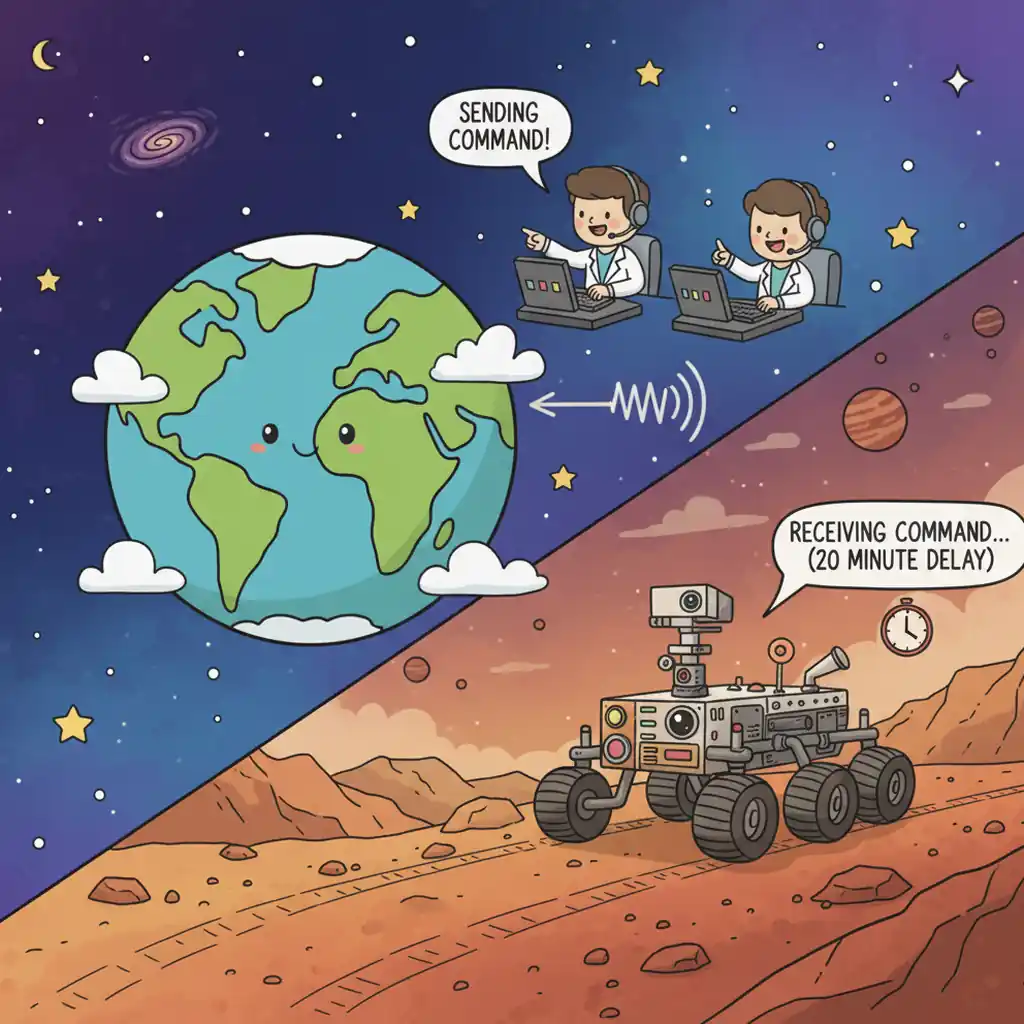
Once a rover is safely planted on the dusty Martian terrain, controlling it is far from like playing a real-time video game. You can't simply steer it with a joystick from Earth! The challenge lies in the sheer distance. Light, which carries all our radio signals, takes anywhere from 4 to 24 minutes to travel between Earth and Mars, depending on where the planets are in their respective orbits around the Sun. This means if scientists decide to send a command like "turn left" to the rover, the signal won't actually reach the rover for several minutes. Once the rover receives the command and executes the turn, it then has to take a picture and send that information back, which takes another several minutes to arrive back on Earth! It's an incredibly slow, cosmic game of "Simon Says" with a massive lag, where every action and reaction takes many minutes, making direct, moment-by-moment control utterly impossible.