
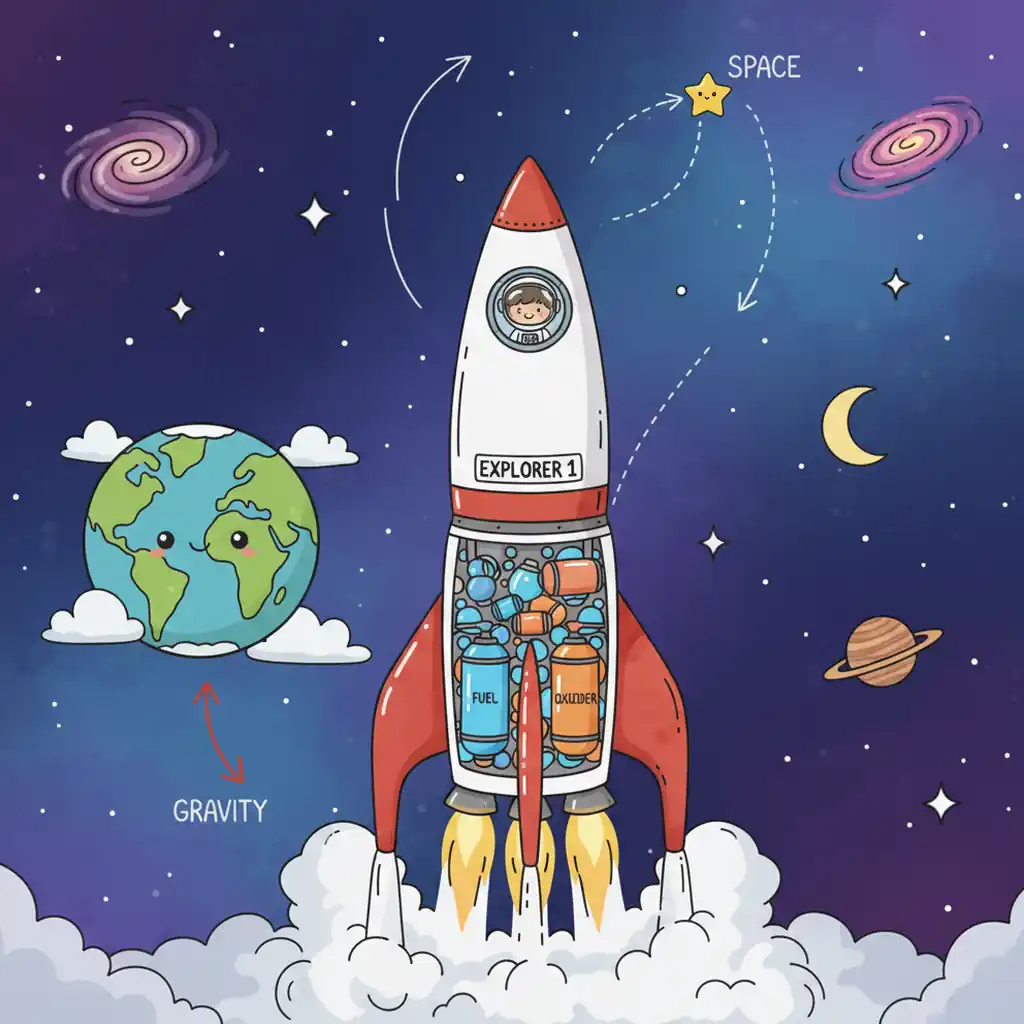
The Great Escape Artist
Imagine trying to jump really, really high. You spring up, but no matter how hard you try, you always come back down. That's Earth's gravity giving you a big, invisible hug! This invisible hug is always pulling everything towards the center of our planet. But what if you wanted to jump so high that you didn't just come back down? What if you wanted to leave Earth's hug entirely and visit the stars, or deliver a satellite to space? That's what rockets do, but it's a super tricky business, and it takes an incredible amount of power to pull off this "Great Escape" from our home planet.
Gravity's Stubborn Hug
Earth is a giant, massive sphere. A really, really giant bowling ball, if you can imagine it! Because it's so incredibly massive, its gravity is like an incredibly strong magnetic force, pulling everything towards its center with relentless strength. This is why you don't float off into space, why apples fall from trees, and why it takes a lot of effort to jump even a few feet off the ground. To break free from this powerful, constant pull and lift something heavy like a rocket off the ground, a rocket needs to generate an opposing force that's even stronger than Earth's hug. It's like trying to push a super-heavy refrigerator across the floor, or lift a stack of elephants – it needs a gargantuan amount of muscle and energy!
Newton's Secret Weapon: Action and Reaction
How do rockets fly? They use a brilliant idea from a very smart scientist named Isaac Newton, who lived a long time ago. He came up with three laws of motion, and the third one is key for rockets: for every "action," there's an equal and opposite "reaction." Think about blowing up a balloon and letting it go without tying it. The air rushes out one way (that's the action), and the balloon zooms off in the exact opposite direction (that's the reaction)!
Rockets work on this very principle, but with super-hot, high-speed gases! Inside a rocket, special liquid or solid fuel mixes with an "oxidizer" (which is like the air that helps a fire burn, but in a rocket it's usually liquid oxygen). This mixture creates a huge, controlled explosion in the engine, blasting incredibly hot gases out of the bottom of the rocket at super-fast speeds, often thousands of miles per hour. This powerful "action" of gases shooting downwards creates an equally powerful "reaction" that shoves the rocket upwards, pushing it against Earth's gravity. This upward push is called "thrust," and it's what makes the rocket lift off!
The Fuel Story: Why So Much Firepower?
Okay, so rockets need a lot of thrust to overcome gravity. But why do they need so much fuel? We're talking about millions of liters of fuel, weighing more than a whole fleet of 747 airplanes or hundreds of elephants! Here's the catch: a rocket isn't just carrying itself and its precious cargo (like astronauts or satellites); it's also carrying all that incredibly heavy fuel.
Imagine trying to carry a giant bucket of water up a steep mountain. The more water you have, the harder and heavier it becomes, and the more energy you need just to carry the bucket itself! Rockets are trying to carry a giant bucket of fuel, and the rocket structure itself, and the brave astronauts, and the valuable satellites, all while fighting gravity's constant pull. To burn all that fuel, they also need something called an "oxidizer," usually liquid oxygen, which is also very heavy. So, a huge amount—sometimes over 90%—of the rocket's total weight at launch is actually just the fuel it needs to push itself, and its own fuel, into space! It's a bit like a car that needs to carry extra gasoline just to carry the extra gasoline tank, which then needs more gasoline to carry that gasoline!
The Big Shed: Rocket Stages and Drop-Offs
If a rocket has to carry so much weight, what's a clever way to make it lighter as it climbs higher? By shedding parts! Most large rockets aren't just one big, solid piece; they're cleverly designed into several "stages" stacked on top of each other. The first stage is usually the biggest and holds the most fuel, with the most powerful engines. It burns incredibly powerfully for the first few minutes to get the rocket off the ground and through the thickest, densest part of Earth's atmosphere, where air resistance is highest.