
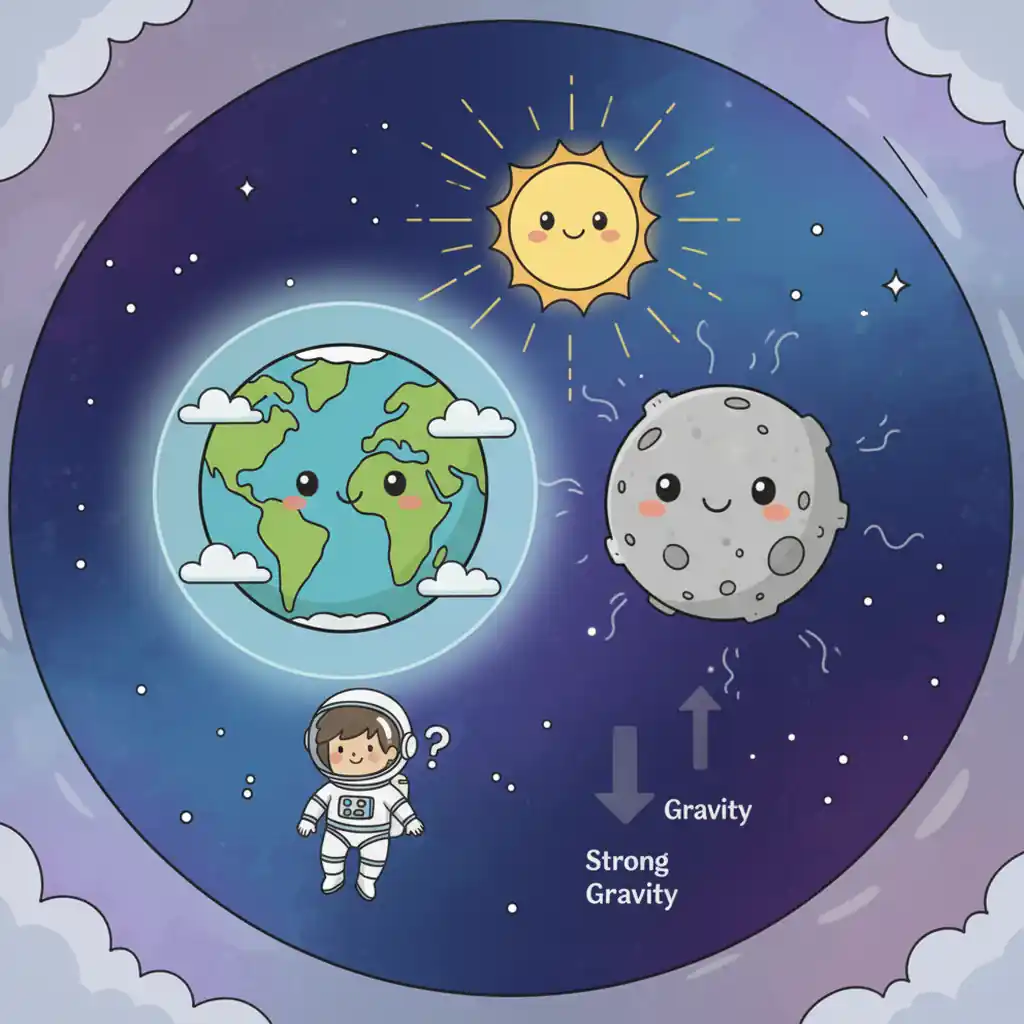
The Earth's Cozy Blanket
Imagine cuddling up under a warm, soft blanket on a chilly night. That's a bit like what Earth's atmosphere does for us! Our atmosphere is a thick, invisible layer of gases, like nitrogen, oxygen, and carbon dioxide, that wraps all around our planet. It doesn't just keep us warm; it's also like a superhero shield, protecting us from dangerous rays from the Sun and tiny space rocks.
This amazing blanket of air is essential for life! It's what we breathe, it helps control Earth's temperature, stopping it from getting too hot during the day or too cold at night, and it helps create our weather, from fluffy clouds to refreshing rain. Without it, Earth would be a barren, frozen, or scorching hot place, not very friendly for plants, animals, or us!
Gravity: The Atmosphere's Keeper
So, how does Earth hold onto this incredible blanket of air? The secret weapon is gravity! Think of gravity as a giant, invisible magnet that pulls everything with mass towards the center of our planet. Since Earth is a very big and heavy planet, it has a strong gravitational pull, strong enough to grab onto all those tiny gas molecules and keep them from floating away into space.
These gas molecules are constantly zipping around at super-fast speeds, bumping into each other. But Earth's gravity is like a powerful anchor, always tugging them back. It's a never-ending game of tug-of-war, and Earth's gravity usually wins, ensuring our precious atmosphere stays right where it belongs, hugging our planet closely.
The Moon's Light Touch
Now, let's look at our neighbor, the Moon. The Moon is much smaller and lighter than Earth – about 80 times less massive! Because it has so much less 'stuff,' its gravitational pull is also much, much weaker. Imagine trying to hold onto a handful of balloons with a very weak string; they'd quickly float away, wouldn't they?
That's exactly what happens with gas molecules on the Moon. Even if the Moon had some gases at one point, its gravity isn't strong enough to keep them tethered. The gas molecules, zipping and bumping, easily reach a speed called 'escape velocity,' which means they're moving fast enough to break free from the Moon's weak gravitational grasp and zoom off into the vacuum of space, never to return.
Solar Wind: The Cosmic Hair Dryer
Even if the Moon could hold onto a little bit of air, there's another force in space that's like a cosmic hair dryer: the solar wind. This is a constant stream of super-energetic particles blasting out from the Sun at incredible speeds. When the solar wind hits Earth, our planet has a magical shield: its magnetic field. This invisible force field deflects most of the solar wind, protecting our atmosphere.