
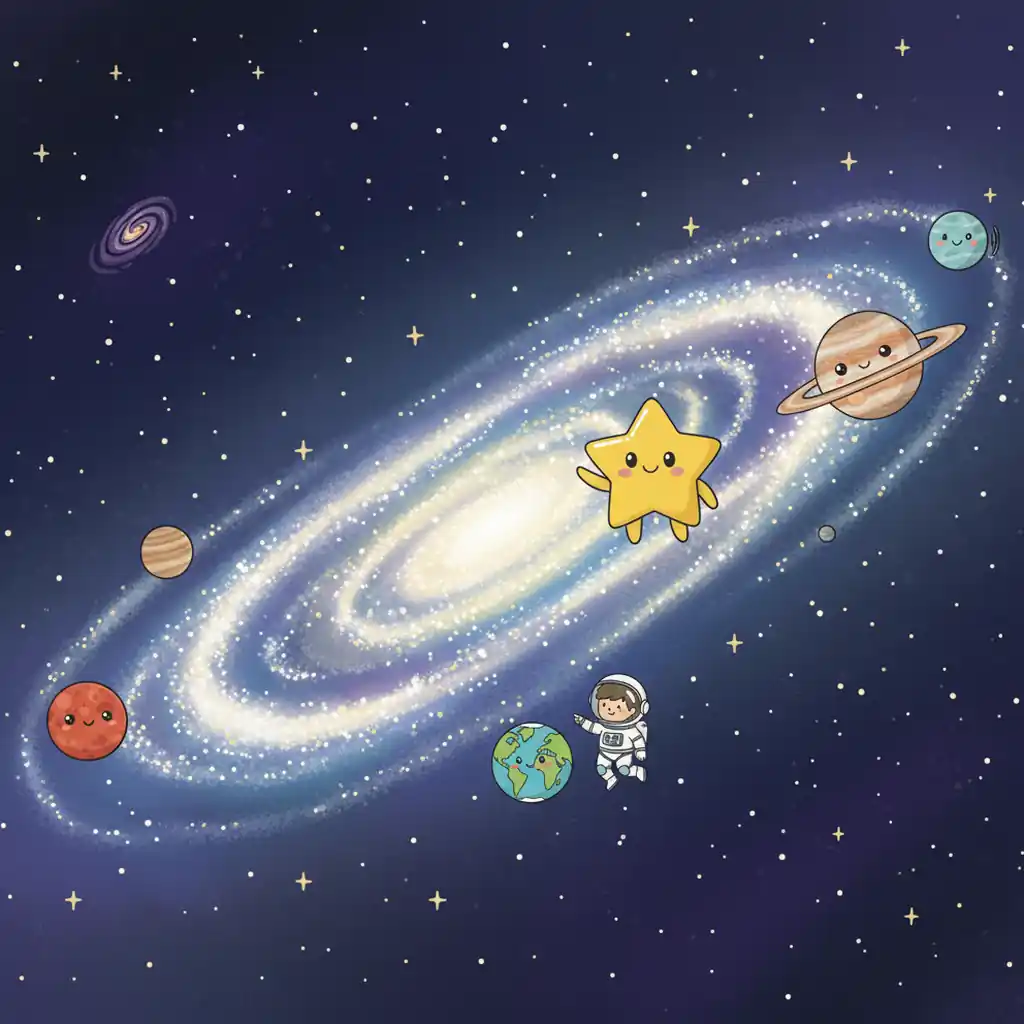
The Cosmic River of Light
Imagine you're far, far away from city lights, camping under a blanket of stars on a clear, dark night. You look up, and what do you see? Thousands of tiny, sparkling diamonds scattered across the black velvet sky! But if you're really lucky, and your eyes adjust to the darkness, you might spot something even more magnificent: a hazy, shimmering band stretching across the entire sky, like a glowing river of milk. This breathtaking sight isn't a cloud, or a magical fog – it's our very own home in the universe, the Milky Way galaxy!
So, why does our galaxy, which is a giant spiral, look like a fuzzy stripe from Earth? It's all about perspective! We live inside the Milky Way, just like a tiny ant living inside a giant, flat pancake. If that ant looks up, it sees the "pancake" stretching out in all directions around it, appearing as a dense, thick band. We're looking through billions upon billions of stars, gas, and dust that are packed tightly together in the main disk of our galaxy. When you look towards the "edge" of the pancake, it looks thinner and you see fewer stars. But when you look along the "pancake" from our position, all those distant stars blend together into that magical, glowing river.
What is a Galaxy, Anyway? A Cosmic Neighborhood!
Before we dive deeper into our amazing Milky Way, let's understand what a galaxy truly is. Think of it as the biggest, most crowded, and most fantastic cosmic neighborhood imaginable! A galaxy is a colossal collection of billions, sometimes even trillions, of stars – each one a sparkling sun in its own right. But it's not just stars; galaxies also contain vast clouds of gas (mostly hydrogen and helium), tiny specks of cosmic dust, and a mysterious, invisible "glue" called dark matter. All these incredible ingredients are held together by the super-strong, invisible hug of gravity, spinning and swirling through the universe.
Galaxies come in many spectacular shapes and sizes, like cosmic snowflakes! Some are round and puffy, like giant cotton balls (these are called elliptical galaxies). Others are shapeless and a bit messy, like abstract art (irregular galaxies). But our Milky Way is a classic beauty: a "spiral galaxy." Imagine a colossal pinwheel, slowly twirling in the cosmic ballet, with graceful arms reaching out from a bright, bustling center.
Our Swirling Spiral Home
If you could zoom out from Earth, past our solar system, and then soar millions of light-years away to get a bird's-eye view of our galaxy, you'd see the Milky Way's magnificent spiral form. It truly looks like a giant, flat disk, about 100,000 light-years across, with two main spiral arms and several smaller ones curving gracefully outwards from a thick, bright central bulge. These spiral arms aren't just pretty patterns; they're like cosmic highways, bustling with activity, especially where new, hot, bright stars are constantly being born.
And where do we, along with our Sun and all its planets, call home in this swirling wonder? We're not right in the dense, dazzling downtown of the galaxy, nor are we out in the quiet, lonely suburbs. Our solar system is nestled comfortably in one of the smaller spiral arms, often called the Orion Arm (or Orion Spur), about two-thirds of the way out from the very center. It’s a bit like having a nice house in a pleasant neighborhood, not too far from the city action, but not so close that it's too noisy or crowded. We have a great view of our galactic home from here!
The Ingredients: Stars, Dust, and Gas – Oh My!
What fills this cosmic river of light? Billions upon billions of stars, of course! Some are giant, blazing blue stars that shine brighter than a million suns, while others are tiny, cool red dwarf stars, barely visible. Every star you see in the night sky with your naked eye is part of the Milky Way, and there are countless more that are too far away or too dim to see without a telescope.
But the Milky Way isn't just a collection of stars. It's also filled with vast, ethereal clouds of gas, mostly hydrogen and helium – the building blocks of stars! And floating within these gas clouds are incredibly tiny, microscopic specks of cosmic dust, much smaller than a grain of sand. While each dust particle is tiny, there's so much of it spread throughout the galaxy that these dust clouds can be incredibly thick. They act like cosmic fog, often blocking the light from distant stars, which is why parts of the Milky Way sometimes appear as dark lanes or mysterious gaps in the glowing river. These are actually "dust lanes" – regions where the dust is so dense it creates shadowy patterns against the bright starry backdrop.