
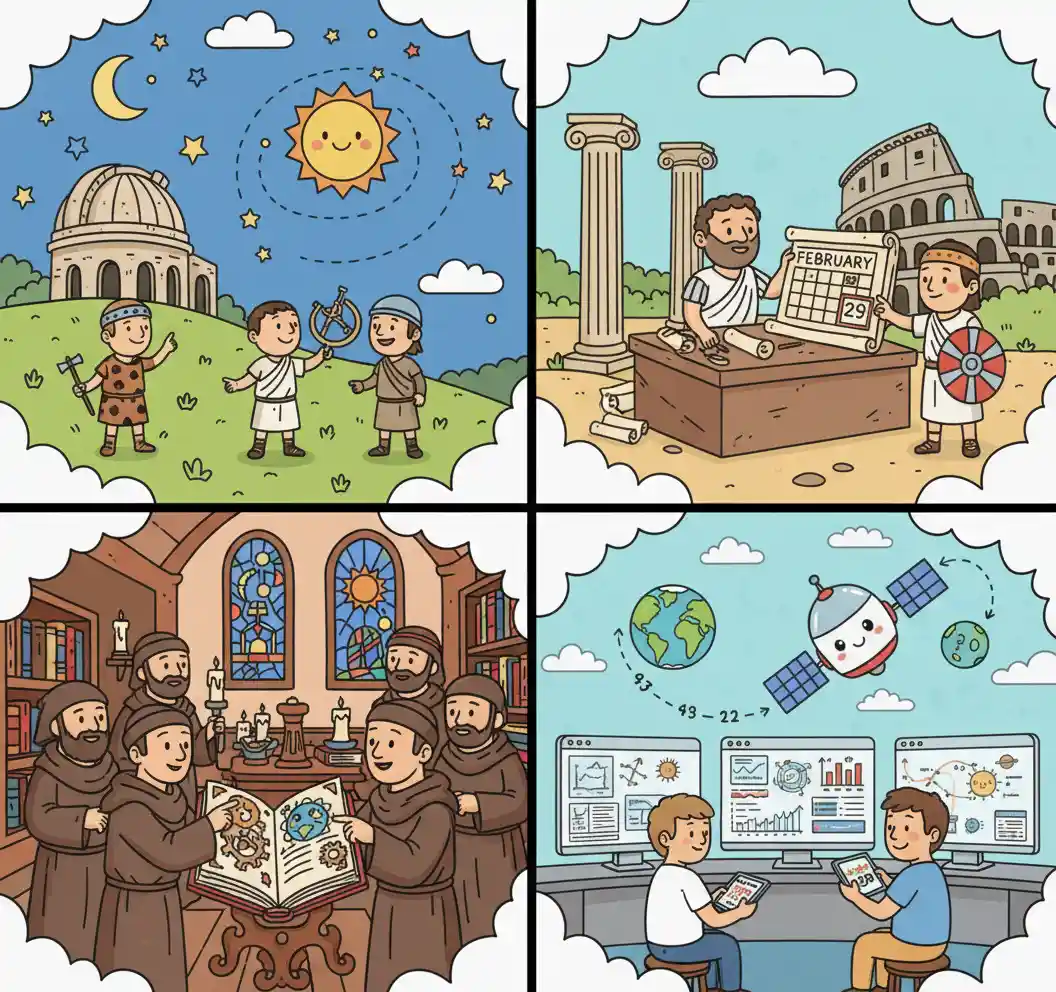
The Mathematical Glitch
We are taught that a year is 365 days long. This is the time it takes for Earth to make one full circle around the Sun. However, the universe doesn't like perfect round numbers. It actually takes Earth about 365.2422 days to complete its trip.
That extra 0.24 days is roughly six hours. It doesn't seem like much—it’s just the length of a long nap! But if we ignored those six hours every year, our calendar would slowly start to fall behind the actual position of the Earth in space.
The Slow Slide
If we didn't have Leap Years, after 100 years, our calendar would be off by about 24 days. After a few hundred years, the seasons would completely drift. You’d find yourself celebrating Christmas in the middle of a hot summer or going to the beach in January.
To fix this, we have to 'catch up' to the Sun. By adding one extra day every four years, we nudge our calendar back into alignment with the stars. This extra day is February 29th, and it acts as a 'reset' button for our clock.
The Rule of Four
The simplest rule is that a Leap Year happens every year that can be divided by four (like 2020, 2024, and 2028). Since 6 hours x 4 years = 24 hours, adding one full day every four years almost perfectly solves the problem.
But wait—there’s a catch! Remember that the extra time is 0.2422 days, not exactly 0.25. If we added a Leap Day every four years forever, we would eventually add too much time. The math is a little more complicated than it looks.