
The Heat Records
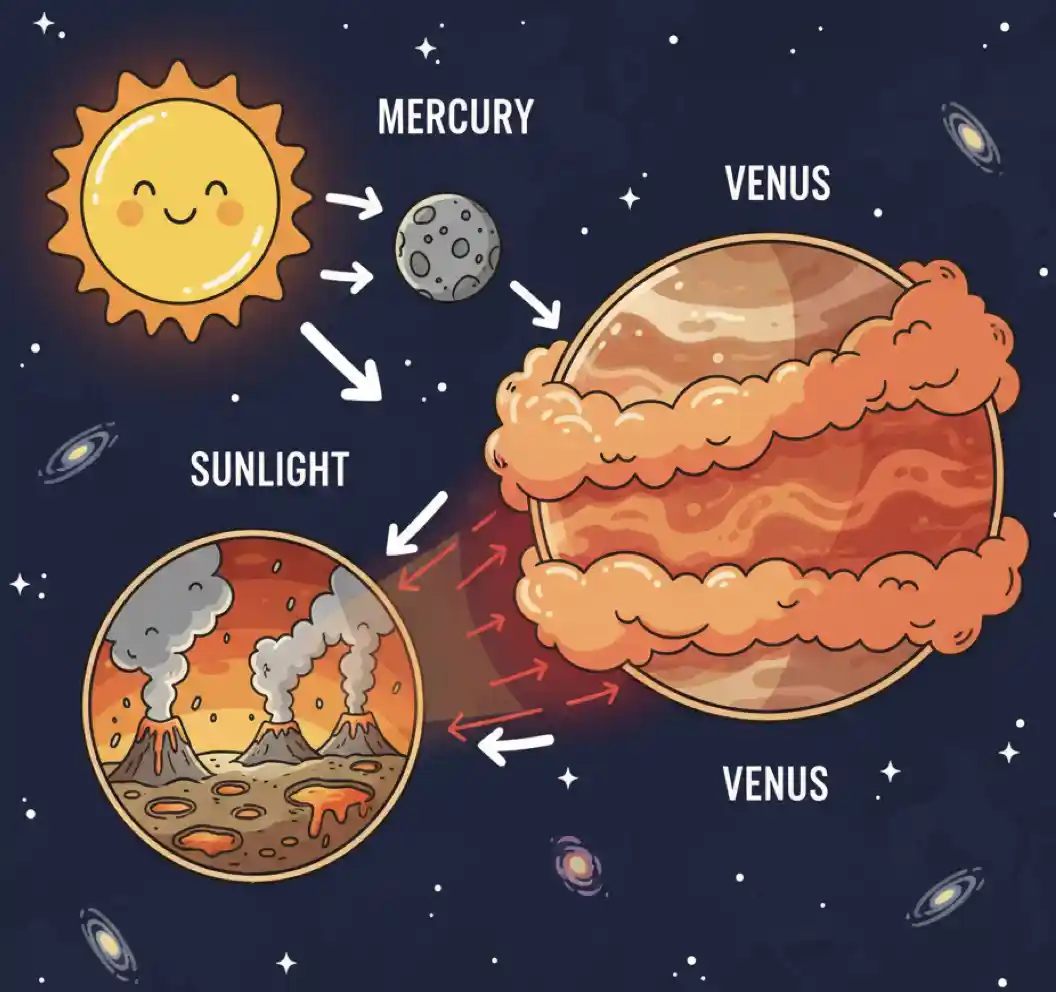
Mercury is the closest planet to the Sun, so you’d expect it to be the hottest. While Mercury is definitely hot (800°F), it has a problem: it doesn't have an atmosphere. At night, all the heat it gathered during the day leaks out into space.
Venus, the second planet, is the real champion of heat. It stays a constant 900°F (475°C) all the time—day or night, North Pole or South Pole. It is hot enough to melt a lead toy or bake a pizza in seconds just by setting it on the ground!
The CO2 Blanket
The reason for this extreme heat is Venus's atmosphere. It is 90 times thicker than Earth's and is made almost entirely of Carbon Dioxide (CO2). On Earth, CO2 helps keep us warm, but on Venus, it’s out of control.
This gas acts like a heavy, double-thick wool blanket. Sunlight can get through the clouds to hit the ground, but the heat that tries to bounce back into space gets trapped. This is the 'Greenhouse Effect' at its most extreme.
Clouds of Acid
If the heat wasn't enough, the weather on Venus is even more terrifying. The thick clouds that hide the surface aren't made of water—they are made of sulfuric acid. This acid is strong enough to burn through metal and skin.
While it 'rains' on Venus, the rain never actually hits the ground. Because the surface is so hot, the acid raindrops evaporate halfway down, turning back into gas before they can touch the volcanic rocks below.