
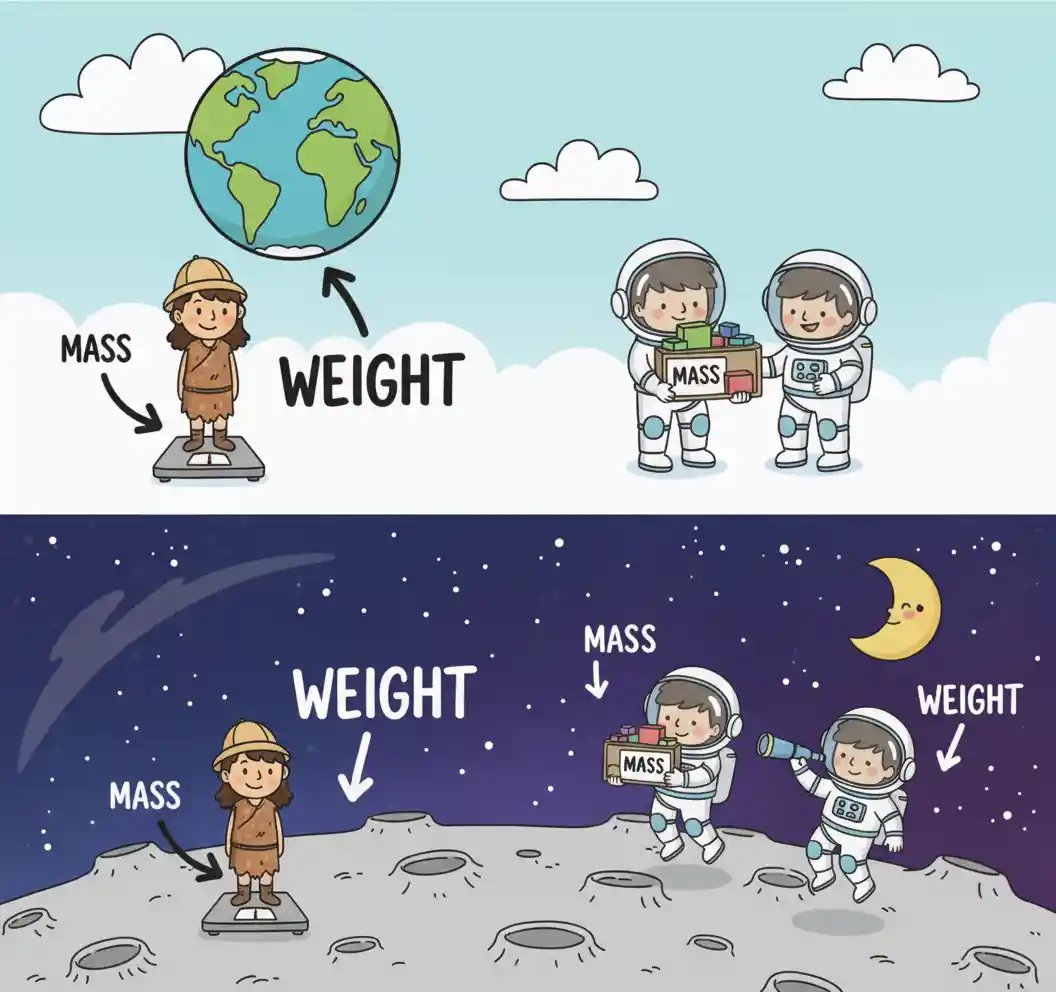
Mass vs. Weight
Most people use the words 'mass' and 'weight' to mean the same thing, but in space science, they are very different. Mass is the amount of 'stuff' you are made of—your bones, your muscles, and your skin. It never changes, no matter where you go.
Weight, on the other hand, is a measurement of the pull of gravity on that mass. Weight is like an invisible rubber band pulling you toward the center of a planet. The bigger the planet, the stronger the rubber band!
The Moon’s Weak Hug
The Moon is much smaller than the Earth—about one-fourth the size. Because it has less 'stuff' (mass) than Earth, its gravitational pull is much weaker. Specifically, the Moon's gravity is only 1/6th as strong as Earth's.
This means if you stood on a scale on the Moon, the scale would show you are much lighter. You haven't gone on a diet or lost any muscle; the Moon just isn't 'hugging' you as tightly as the Earth does.
Super-Strength
Because you weigh so little on the Moon, you would feel like a superhero. Your muscles are trained to push against Earth's strong gravity every day. When you take those same muscles to the Moon, they are suddenly overpowered!
An average kid could jump over a car or lift a heavy boulder on the Moon. Astronauts on the Apollo missions had to learn how to 'bunny hop' because walking normally would launch them too high into the air with every step.