
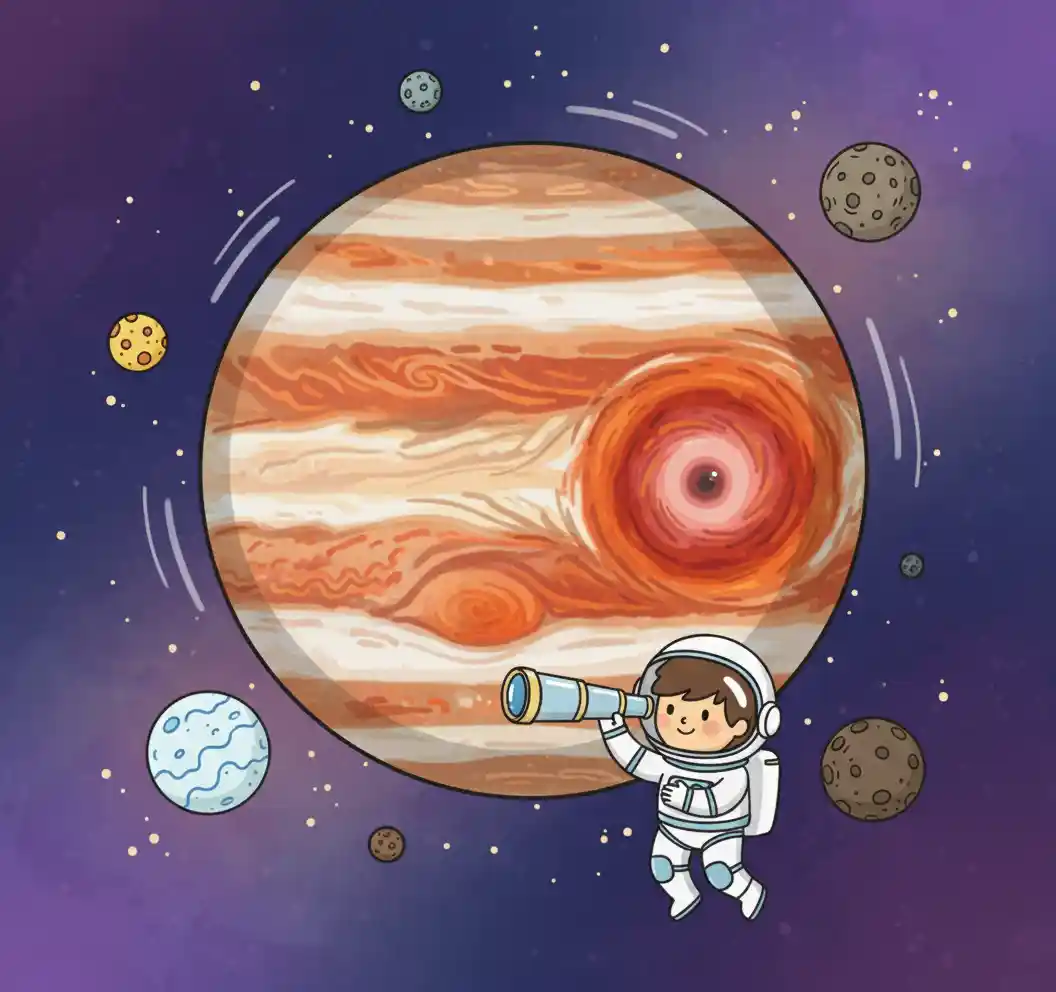
The Monster Storm
Imagine a hurricane on Earth. It might last a week or two, bringing wind and rain before it hits land and loses its power. Now, imagine a storm three times bigger than our entire planet that has been spinning for over 300 years. This is Jupiter’s Great Red Spot.
Jupiter is a 'Gas Giant,' which means it doesn't have a solid surface like Earth does. On our planet, mountains and forests act like speed bumps that slow down storms. On Jupiter, there is no land to stop them, so a storm can just keep spinning forever.
A High-Pressure Mystery
On Earth, hurricanes are 'low-pressure' systems, but the Great Red Spot is an 'anticyclone,' which is a high-pressure system. It spins counter-clockwise in Jupiter's Southern Hemisphere, completing a full rotation every six days.
Because Jupiter spins incredibly fast—a day there only lasts 10 hours—the atmosphere is whipped into powerful jet streams. The Great Red Spot is trapped between two of these jet streams, which act like conveyor belts pushing it from both sides, keeping it spinning in place.
The Red Chemical Soup
One of the biggest questions scientists have is: why is it red? If you looked deep into Jupiter, the clouds are mostly white or brown. However, the Great Red Spot is so tall that its top sticks up high above the rest of the clouds.
As the storm churns, it pulls chemicals like ammonia and acetylene from deep inside the planet. When these chemicals hit the Sun’s powerful ultraviolet (UV) rays high in the atmosphere, they undergo a chemical reaction that turns them a rusty, brick-red color.