
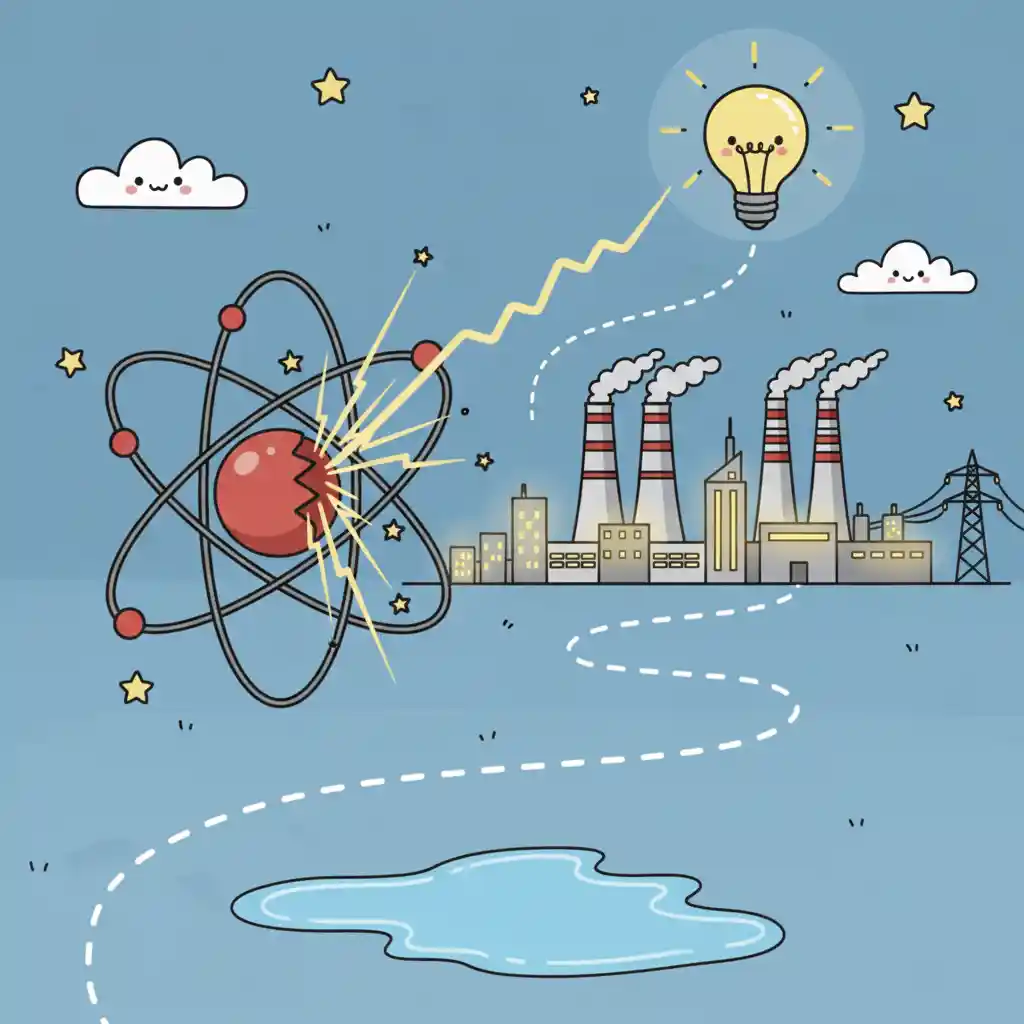
The Invisible Building Blocks
Imagine trying to build a gigantic castle, but your building blocks are so small you can't even see them! That's what atoms are like. Everything around you, from your shoes to the air you breathe, is made of these incredibly tiny particles. Inside every atom, there's a center called the nucleus, which is like the super-dense heart of the atom.
This nucleus is made up of even smaller pieces: protons (which have a positive electrical charge) and neutrons (which have no charge). Whizzing around the nucleus are tiny electrons (which have a negative charge), like super-fast bees around a beehive. It's the nucleus, however, that holds a magnificent secret, a secret to lighting up entire cities!
A Secret Superpower in the Middle
Think of the nucleus as a tightly packed bundle of energy. The protons and neutrons are squeezed together by an incredibly powerful 'glue' called the strong nuclear force. This force is so strong that if we can manage to 'unstick' these particles just a little bit, it releases a tremendous amount of energy, like opening a super-compressed spring.
For most atoms, their nucleus is very stable, meaning it's super tough to break apart. But some very special, heavy atoms have nuclei that are a bit wobbly and easier to break. These 'wobbly' atoms are like sleeping giants, waiting for just the right nudge to unleash their hidden superpower.
The Big Split! (That's Fission!)
Here's where the magic begins! One of these special 'wobbly' atoms is called Uranium-235. In a nuclear power plant, scientists take tiny pieces of this uranium. Then, they shoot a tiny, fast-moving particle called a neutron at a Uranium-235 nucleus. It’s like hitting a billiard ball with another billiard ball, but with an explosive twist!
When the neutron hits the Uranium-235 nucleus just right, the nucleus can't hold itself together anymore. It splits apart into smaller atoms, like popping a balloon into two smaller pieces! But here's the cool part: when it splits, it doesn't just make new atoms, it also releases a huge burst of energy and, guess what, more neutrons!