
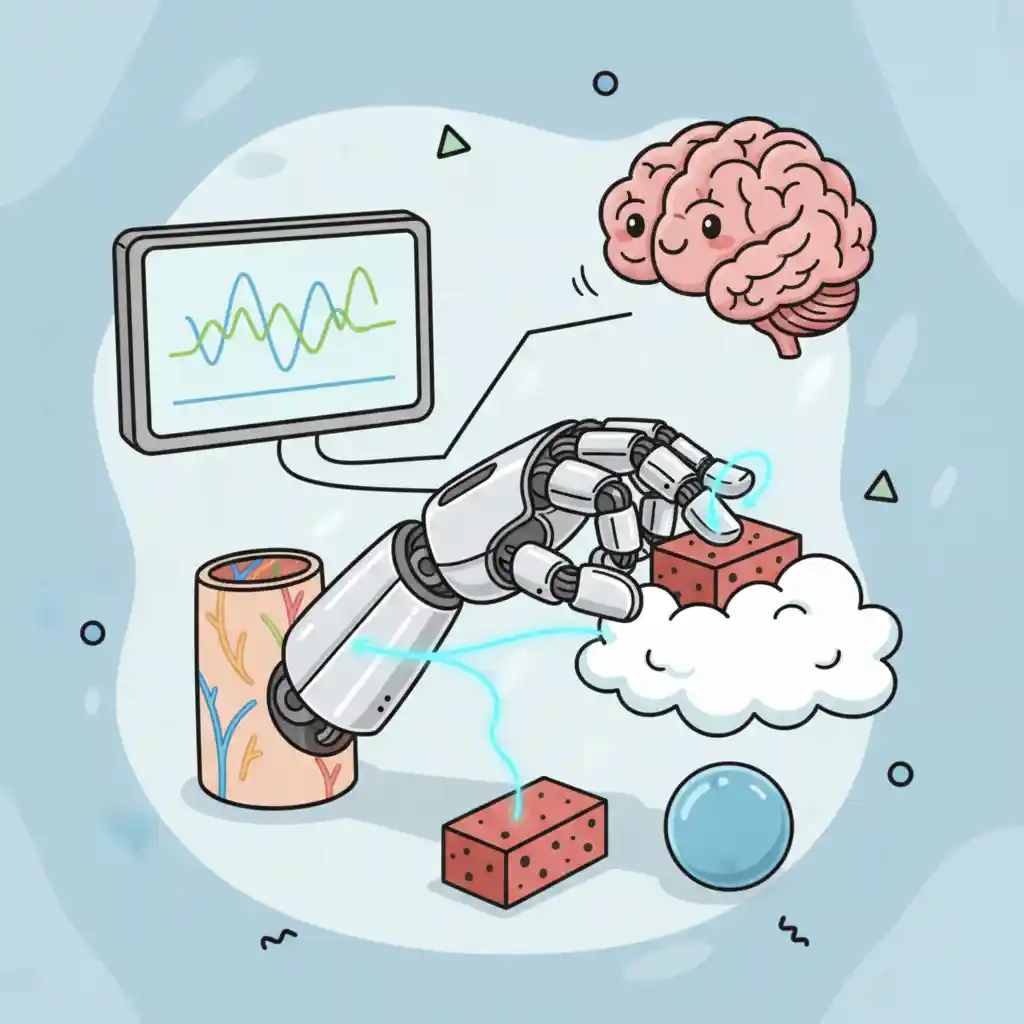
The Mystery of the Missing Touch
Imagine you have a super cool robot arm. It can grab a juice box, open a door, and even give a high-five! But what if it couldn't actually feel anything? It wouldn't know if the juice box was cold, or if the door handle was rough, or if your hand was soft. That's a big puzzle scientists are trying to solve: how can a fake hand feel things?
Feeling isn't just about knowing if something is squishy or hard. It's super important for everything we do! Think about it: without feeling, you might not know if your hot cocoa is too hot to drink, or if you're pressing too hard on a delicate toy. Our sense of touch keeps us safe and helps us interact with the world around us in amazing ways.
Your Body's Super-Fast Internet
Before we talk about robot hands, let's think about your own hand. How does it feel things? Your skin is packed with millions of tiny, special detectors called nerve endings. Some nerve endings are like 'pressure sensors' that tell you if something is pushing on your skin. Others are 'temperature sensors' that tell you if something is hot or cold, and still others are 'texture sensors' that let you know if something is smooth or bumpy.
When one of these nerve endings gets activated, it sends a tiny electrical signal. These signals travel super fast through your nerves, which are like tiny, lightning-fast wires, all the way up to your brain. Your brain is like the ultimate computer that takes all these signals and interprets them, telling you exactly what you're touching, how it feels, and even if it might hurt!
Bionic Sensors: The Robot's Touch Detectives
So, if a real hand has nerve endings, how do we give a robot hand its own 'nerve endings' so it can 'feel'? Scientists and engineers get very clever! They attach tiny electronic sensors to the fingertips and palms of a robotic or prosthetic hand. These sensors are like miniature detectives, always on the lookout for touch, pressure, and even temperature.
When the robot hand touches something, these tiny sensors spring into action. They measure how much pressure is being applied, or how warm or cool an object is, and then they convert that physical information into electrical signals. It's like the robot hand is 'translating' the feeling into a language a computer can understand.