
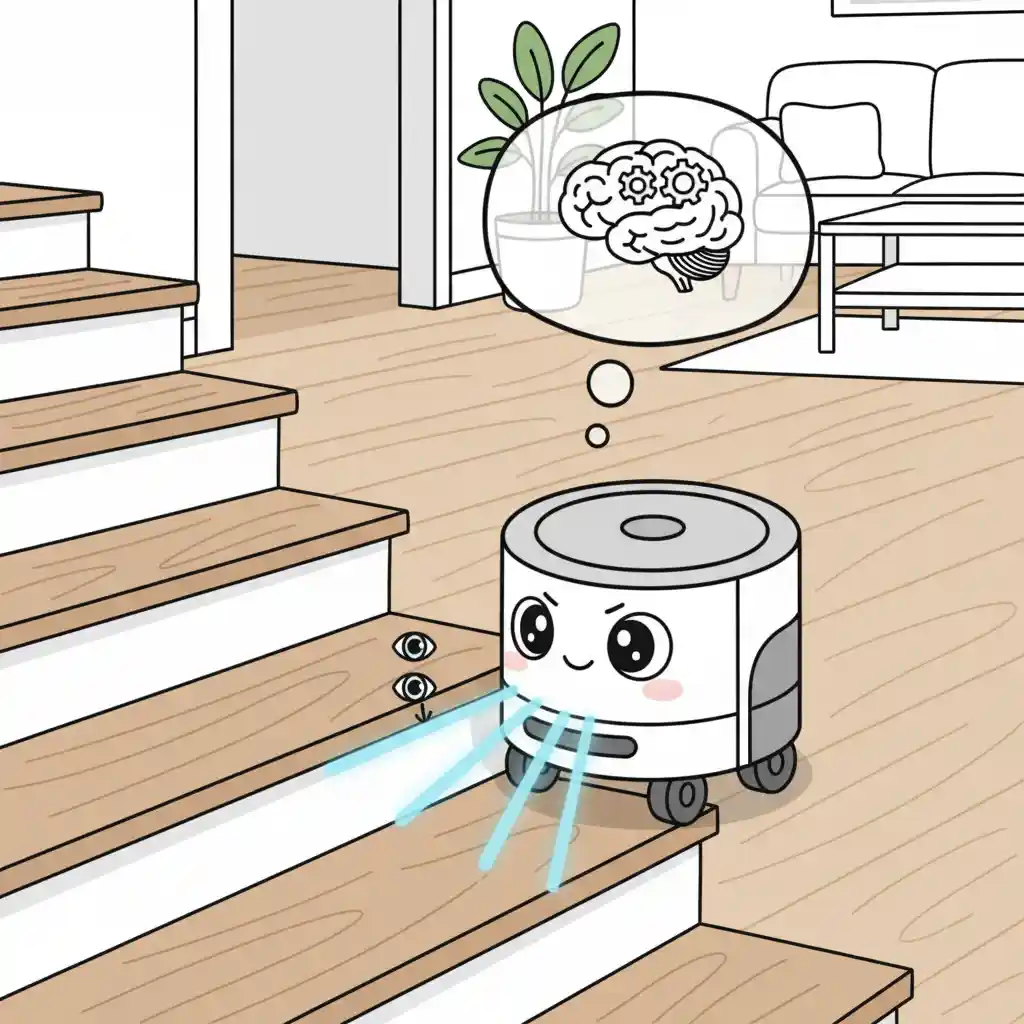
The Silent Thinker Inside
Imagine your favorite toy car, but this car can clean your room all by itself! How does it know where to go and what to do? It has a special 'robot brain' inside! This brain isn't squishy like yours; it's a super-fast computer chip packed with tiny electronic circuits. Its main job is to think, learn, and make lightning-quick decisions, all based on the information it gets from the world around it.
Just like your brain uses your eyes to see, your ears to hear, and your fingers to feel, a robot brain uses special tools called 'sensors.' These sensors are like the robot's very own eyes, ears, and sense of touch. They constantly gather and send information back to the main brain, telling it if there's a wall coming up, a toy blocking its path, or even a big drop like a staircase!
Invisible Light, Visible Safety: Cliff Sensors
One of the coolest and most important tricks a robot vacuum can do is not fall down the stairs! It achieves this thanks to tiny gadgets called 'cliff sensors,' usually found on its underside. These clever sensors work by sending out invisible beams of light, often infrared light, which is the same kind of light your TV remote uses – you can't see it, but it's there!
When the robot is on solid ground, this invisible light bounces off the floor and back into the sensor. But if the robot rolls too close to the edge of a stair, the light has nowhere to bounce back from! The sensor doesn't 'see' the light return, and instantly sends an urgent message to the robot brain: 'Danger! Big drop ahead! Turn around!' This makes the robot quickly change direction, saving it from a tumble.
Bump! The Touchy-Feely Sensors
What happens if your robot vacuum gently glides forward and bumps into a chair leg or a wall? It doesn't just keep pushing! That's thanks to its 'bump sensors,' which are like little spring-loaded buttons hidden around the edges of the robot's bumper. When the robot makes contact with something, these tiny buttons get pressed in, even just a little bit.
As soon as a bump sensor is pressed, it sends a super-fast signal to the robot brain: 'Obstacle detected!' The brain immediately tells the robot's wheels to stop spinning, back up a little bit, and then gently turn to try a slightly different path. It's a lot like how you might carefully feel your way around a dark room, but the robot does it all in a blink of an eye!