
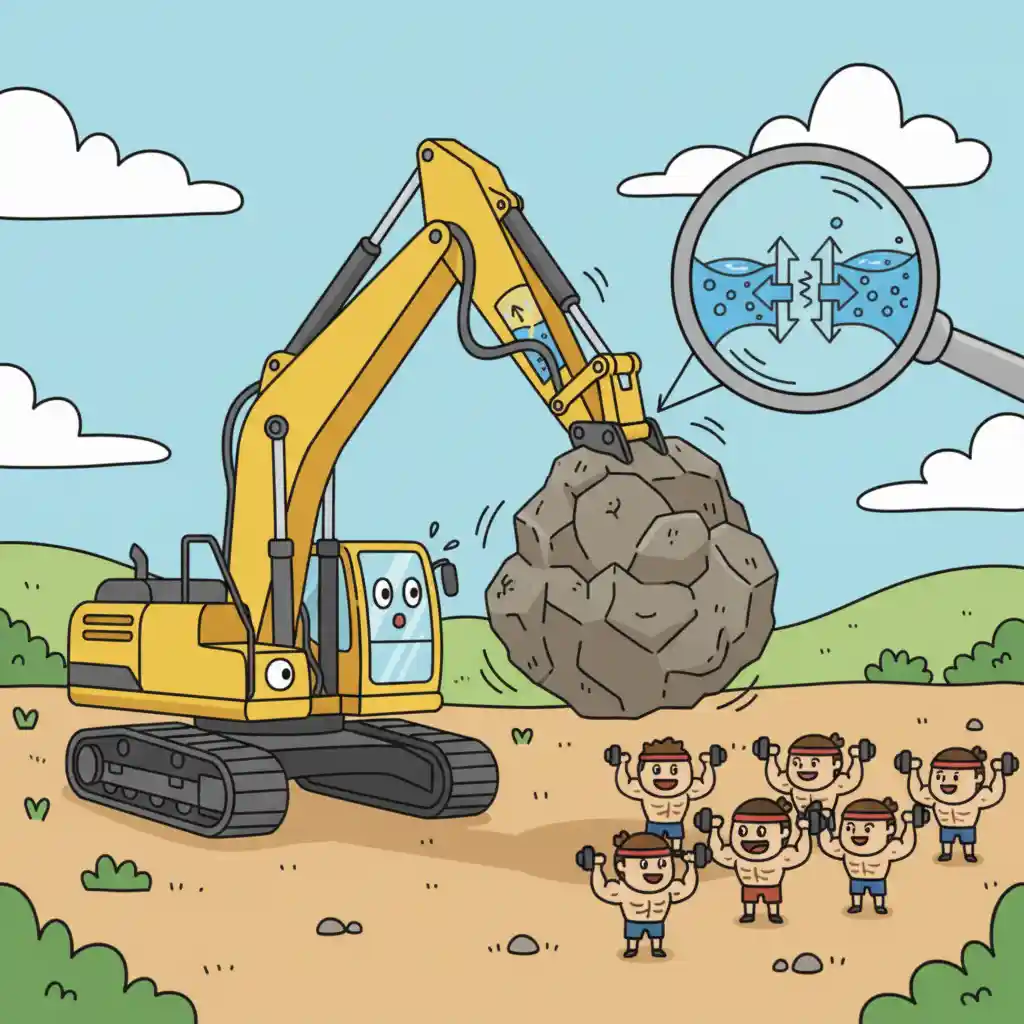
The Mighty Mover's Secret!
Imagine a giant metal dinosaur with a super-long neck and a powerful scooping mouth. That's kind of like an excavator! These incredible machines are like the superheroes of construction sites. They can dig huge holes, lift rocks heavier than a dozen cars, and move piles of dirt faster than you can say 'super strength!' But how do they do it? It’s not just big muscles and powerful engines; there's a secret, invisible force at work that lets them do amazing things.
From building roads to clearing land for new schools, excavators are busy working all around us. They can weigh many tons, and their arms can reach high into the sky or deep into the ground. If you tried to push just one of the rocks they lift, you wouldn't even budge it an inch! So, what gives these mechanical giants their incredible lifting power? It's a special kind of 'liquid muscle' called hydraulics.
The Magic of the Unsquishable Liquid
Let's do a little experiment! Take a big, empty plastic bottle and try to squish it. Easy, right? Now, fill that bottle all the way to the very top with water, screw the lid on tight, and try to squish it again. Whoa! It's much, much harder, almost impossible! That's because liquids, like water or the special oil used in excavators, don't like to be squished. Scientists call this being 'incompressible.'
Think about it: if you push on one side of a full bottle of water, that push immediately travels all the way through the water to the other side. The water molecules are packed so closely together that they can't get any closer. This un-squishable nature is super important because it means a push on one end of a liquid can create a push on another end without losing any of its power! It's like a solid connection, but with a liquid.
Tiny Push, GIANT Lift!
Here's where the real magic happens, thanks to a clever idea called Pascal's Principle (named after a smart scientist!). Imagine you have two tubes, one very skinny and one very wide, connected at the bottom by our unsquishable liquid. If you push down on the skinny tube with a small force, that force spreads through the liquid.
Because the liquid can't be squished, it has to go somewhere. So, when it pushes up on the wider tube, it lifts something heavy there. Even though you pushed with a small force on a small area, that same force, spread over the much larger area of the wide tube, turns into a huge lifting power! It's like using a little finger to push a button that makes a huge crane move a massive object. It's not magic, it's just really clever science!